Well some of them at least…
If the Earth has been proven to be a flat spinning disc, why don’t we fly off the edge due to centrifugal force?
Proof is the preserve of mathematicians and the manufacturers of hard liquor. So no scientist would ever claim that the Earth was ‘proven’ to be anything. Ergo, anyone making this claim is not a scientist.
The pinnacle of scientific achievement is actually the ‘scientific theory’, about which Wikipedia says…
A scientific theory is a well-substantiated explanation of some aspect of the natural world that is acquired through the scientific method and repeatedly tested and confirmed, preferably using a written, pre-defined, protocol of observations and experiments. Scientific theories are the most reliable, rigorous, and comprehensive form of scientific knowledge.
Regarding the shape of the Earth; since it’s been observed, measured, mapped, triangulated, orbited, flown round, and even weighed; scientific theory says it’s an oblate spheroid. Oblate because it’s circumference is slightly greater at the equator than elsewhere, which in turn is due to the centrifugal force you refer to.
But at an angular velocity of 0.0007 rpm, this isn’t exactly a fairground ride, so of course we don’t feel this force.
What can humanity do to counteract the increasing world temperatures?
With the lobbying power of the fossil fuel giants, the chemical industry, the fashion industry, the cruise lines, etc., I think it’s been adequately demonstrated that we can’t rely on politicians to fix this.
Science is doing it’s best by coming up with better photovoltaic cells, better batteries, clean hydrogen, composting bioreactors, CO2 and methane capture schemes, as well as the promise of nuclear fusion. But we as individuals should also aim to reduce our own carbon footprint.
Things we could do:
- Replace incandescent lighting with LED bulbs.
- Turn off unnecessary lights and appliances in the home.
- Install solar panels and/or ground source heat pumps
- Run major appliances overnight when there is a surplus of electricity; things like dishwashers, water heaters, washing machines, etc.
- Wear a sweater and use less home heating in the winter. Similarly restrict the use of air conditioning in the summer. Consider using fans instead of a/c.
- Don’t be a fashion victim! The fashion industry is responsible for 10% of global carbon emissions and more than 20% of wastewater. They are actually bigger polluters than all international flights and maritime shipping put together.
- Cut down on red meat. Livestock production is responsible for a lot of deforestation, and is a major producer of methane.
- And while we’re at it, we should cut down also on eating fish too. Industrial scale fishing is killing the seas.
- Use the car less, and walk and/or cycle more… your body will thanks you!
- Use public transport when possible.
- Source produce from local suppliers (for example, a lot of chicken comes from Thailand with a huge carbon footprint, similarly, lamb from New Zealand, etc.)
- Think strongly about your vacation plans. Short haul is better than long haul. And did you know that cruise ships are major polluters? The shipping line Carnival Corporation alone produces more pollution than all the cars in Europe.
If everyone on the planet makes small changes like these, then even if we can’t stop the current warming trend, there’s every chance we can make it less extreme and hopefully survivable.
How much does a bypass of Venus cool down the Earth? I would also want a calculation of how much Earth could be cooled down with satellite-based huge shaders at optimal distance between Earth and the Sun, thus blocking solar (heat) radiation?
How much does a bypass of Venus cool down the Earth?
Venus transits of the Sun are rare… the last one was 2012, the next one is in 2117. It’s orbit is elliptical so it’s angular size varies, but let’s say it covers 0.1% of the Sun and transit takes around 6 hours so I think the cooling effects would be marginal at best.
I would also want a calculation of how much Earth could be cooled down with satellite-based huge shaders at optimal distance between Earth and the Sun, thus blocking solar (heat) radiation?
This has been contemplated. The idea of a single shade is impractical because something a mile square is way beyond our current capabilities, and wouldn’t stop enough sunlight.
Another suggestion is to have clouds consisting of trillions of small shades at the Sun-Earth L1 Lagrangian points, 1.5 million km away. This could stop about 2% of sunlight. Other suggestions are huge micromesh nets, or 1,000 km dia Fresnel lenses, also at the L1 point.
But none of these proposals are feasible on a time-frame that could possibly save us from climate change. That ball is in our court!
Are the floods in Europe related to climate change?
It’s a mistake to draw conclusions from isolated events such as the North Sea floods of 1953, or the Venice floods of 1966. They were due to ‘perfect storms’ of unprepared communities, in conjunction with freak weather and tides. In the case of Venice, there were rain-swollen rivers, a spring tide, and scirocco winds which ‘backed-up’ the previous high tide.
But the climate scientists have told us all along that climate change wouldn’t be a gradual and benign warming of a degree or two. Instead, we’d start to see more and more extreme weather events. For the first half of my life, 1950 to (say) 1980. the weather was largely uneventful, and it was something that stuck in the mind when we had record-breaking hot spells, or hard winters. But for the last 40 years, we’ve had year after year of record-breaking weather events.
The recent European floods are just another example. Factor in the increasing severity of tropical storms and hurricanes; and the wildfires raging across the Canada and the US, as well as in places like South Africa, India, Turkey, and Cyprus, and I think you would have to be fairly naive to believe this is just natural ‘clustering’.
At what precise speed rate would the Earth’s movement have to be, in order for us to feel it easily?
I’m not sure what you mean by feeling movement. Elementary physics says that any constant speed in a perfect straight line will give no sensation of movement.
In a car doing thirty miles an hour, if you ignore the effects of cornering, acceleration, braking, and of bumps and undulations in the road surface, you would feel no motion. Likewise in a plane at a constant 500 mph (ignoring turbulence).
The Earth’s motion around the Sun is 67,000 mph, but apart from causing changes to our orbit, it wouldn’t ‘feel’ any different if it was travelling at 670,000 mph. As a matter of interest the Solar System is moving around the Milky Way galaxy at 483,000 mph, and the Milky Way galaxy is moving through the Universe at 1.3 million mph.
1 view · Answer requested by Amanial Soquar
Would a rocket launched horizontally still exit the Earth with all conditions being the same if it were to be launched vertically?
If you thinking in terms of a SSTO (single stage to orbit) vehicle such as Reaction Engines ‘Skylon’ with it’s air breathing SABRE engines, then yes it’s possible.
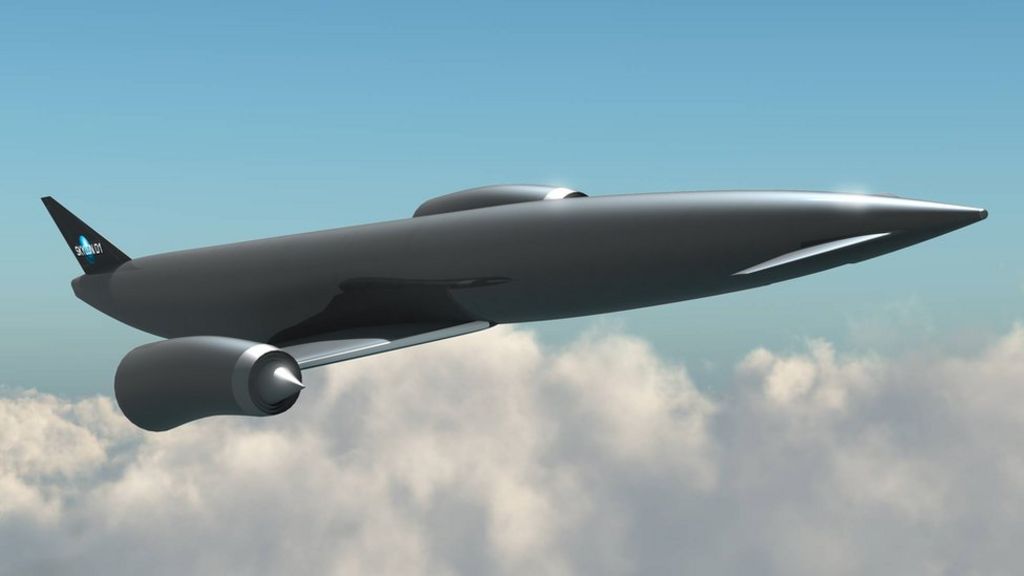
The issue is that if you take off horizontally in a conventional rocket, thrust alone won’t stop it falling back to Earth. If the craft is not aerodynamic (to generate lift), then you’d need to use additional vertical thrust to overcome the pull of gravity. And with so much extra atmoshpere to fly through, there’d be no advantage in doing this.
Why does escape velocity exist? Can’t a spacecraft slowly climb all the way to space?
Q: Why does escape velocity exist? Can’t a spacecraft slowly climb all the way to space
Escape velocity quite simply is the velocity a ballistic object would need to escape an object’s gravity – in the case of Earth, it’s around 25,000 mph. But it’s a term that only has meaning when the spacecraft is not intending to orbit the Earth, but is destined for deep space, such as Elon Musk’s Tesla Roadster.
In which case there are a number of theoretical mission profiles. You could for example fire the spacecraft from a cannon, or perhaps a rail-gun, but that would effectively pulverise the craft and it’s payload.
You could, as you suggest, design something like a slow-burn rocket that would travel at a constant speed of (say) around 500 mph and given enough fuel, continue to it’s destination. The force of gravity decreases according to the inverse square law, so at some point (don’t ask me to calculate it!), the escape velocity would only be 500 mph, but if the fuel ran out before you’d got there, you’d just fall back to Earth. And I’m bound to point out that 500 mph isn’t terribly useful for covering interplanetary distances!
Finally… you could use a two or three stage rocket to rapidly accelerate to escape velocity. When the rockets switch off, you would continue as a ballistic object, knowing that even though Earth’s gravity would be tugging at you and slowing you down, it’s not enough to stop you.
People who know about this sort of thing have concluded that the latter is the most effective solution.
BTW, a possible future mission profile is the SSTO (single stage to orbit) vehicles similar to Reaction Engines’ (REL) ‘Skylon’ with it’s Synthetic Air-Breathing Rocket Engine (SABRE), that would take-off and land like conventional aircraft, but would use advanced rocket technology to achieve orbital (or even escape) velocity.
Is the “Mad Max” kind of future for Earth has already started and inevitable given the heat waves and droughts and pandemics and hurricanes and extinctions? Is it realistic at all to think it can be slowed down let alone reverse it?
Firstly, there is almost total consensus that climate change is a) real, b) man-made, and c) requires our urgent attention.
But Climate science is a staggeringly complex field of study which seeks to predict future climate trends, based on anomalous data from just the last few of decades. It involves thousands of climate scientists aided by experts in the related disciplines of meteorology, solar physics, atmospheric physics, chemistry, oceanography, paleo-climatology, dendroclimatology, glaciology, geology, etc.
The predictions vary according to type of modelling used, but they range from a best case scenario where we manage to arrest the warming trend before it gets too bad. If you’re one of the 37 OECD countries, you’ll probably survive this mild warming. If however, you’re (say) a central American country totally dependent on one crop, and the crop can’t withstand climate change, then even mild warming could be bad.
Middle of the road warming? Possible consequences include wars and global tension over things like displaced populations, economic instability, food shortages, water rights, etc.
The ‘Terrible scenario’ is called thermal runaway. Warming causes methane currently locked in methane hydrates found in permafrost and on the ocean floors to be released. Despite the notoriety of CO2, methane is up to 84 times more potent as a greenhouse gas. So the release of new methane causes more warming, causing more methane to be released, etc.
See Runaway greenhouse effect – Wikipedia
A possible scenario is that the Earth becomes another Venus… nothing would survive.
So returning to you question “Is it realistic at all to think it can be slowed down let alone reverse it?
Any degree of global warming is extremely unlikely to be good thing, so without knowing the future with any certainty, we have to believe that it can be slowed and possibly reversed.
The alternative of asking “what’s the point?” and just giving up makes no sense whatsoever.
Is there any realistic explanation for Earth-like climate on a sun-sized planet (science based, reality check, climate, geography, worldbuilding)?
This speculative stuff because from what we know, planets can be small and rocky or large and gaseous. Assuming that planetary systems are formed from an accretion disc, then this may well be an absolute truth.
And Johns Hopkins University astrophysicist Kevin Schlaufman has calculated that with a gas giant more than 10 times the mass of Jupiter, fusion will start and it will become a star. There is also a discussion on Wikipedia about rocky ‘Super-Earths’ up to 2 time the Earth’s radius.
To answer your question, I’m aware of no theory that supports the idea of a rocky planet the size of the Sun.
But (speculating wildly)… if by some fluke one did exist, then it was either created by accretion, in which case it’s immense gravitational field means it would have quickly swept the accretion disc clear of hydrogen and helium, and it would have ignited. Or it was created by some other means (worldbuilding?) in which case it probably wouldn’t have an atmosphere, and even if it did, the gravity would mean the atmosphere would be so dense and hot that an Earth-like climate would be impossible.
As a Brit driving for 40+ years both in the UK, and on the continent, left and right, how hard would a USA driving test be?
The UK driving test is much more stringent than in the US, where if you don’t get at least 90% in the written test, you should probably give up driving!
Questions were multi-choice and along the lines of “You are approaching a pedestrian crossing, and there are people already on the crossing, so do you: a) sound your horn to indicate that they should get out of your way? b) slow down and weave between the people? or c) Bring your vehicle to a controlled stop, and wait for the road to clear?
Having said that, when I came to take my practical test in California a few years ago, I had an awkward moment I was completely unprepared for… I was approaching a busy 4-way junction in a residential part of Redwood City, when the lights changed to red. So of course I stopped at the stop line, and a queue quickly developed behind me. I was waited patiently for green, when suddenly the lights started flashing on red.
I looked at my examiner as if to say “WTF?”, but he averted his eyes. What should I do? I couldn’t afford to look indecisive, so I looked left and right and carefully crossed the junction.
I managed to pass my test, so can anyone guess what had happened? Unbeknown to me, there was a rail crossing to the right of the junction. When the gates were down, the red and green phases of nearby lights are cancelled, so that nearby streets don’t become gridlocked. Instead, they start flashing to indicate ‘proceed with caution’.
I imagine that no matter how good a driver you think you are, when taking a driving test in a different country, there are many pitfalls for the unwary!
Why is Northern Ireland the only country in the UK to allow guns to be used for self defense, when arguably, England and Wales have more crime?
Most of the questions of this nature on Quora come from Americans on some Second Amendment, pro-gun, pro-NRA crusade. To each one of them, I would pass on this little nugget. It’s from an American who truly understood the US constitution.

Edit: I do get that some people just like owning guns. I used to do both target and skeet shooting when I was younger – all completely legal in the UK. It’s guns for defence that most people outside of the USA find illogical, as it’s predicated on the assumption that everyone else, including your likely attacker has a gun. See the paradox?
Whatever your opinions of Warren Burger are is irrelevant. The US gun lobby is now just about profit. They are responsible for creating an atmosphere of paranoia to stimulate gun sales. If that doesn’t count as fraud, I don’t know what does.
One more thing… the NRA used to have a much more responsible view on gun ownership. A pre-war president of the NRA, Karl T. Frederick, said “I have never believed in the general practice of carrying weapons. I do not believe in the general promiscuous toting of guns. I think it should be sharply restricted and only under licenses.”
What is it like to experience a tsunami in the middle of the ocean? Is there a big wave or does the ocean level just rise?
In the middle of an ocean, it’s easier to think of a tsunami as just a seismic shock wave. Where the ocean is deep, these ‘shock waves’ travel at up to an astonishing 500 mph. But the wavelength would be long and the wave height small, so most people on a boat in the middle of the ocean would experience very little.
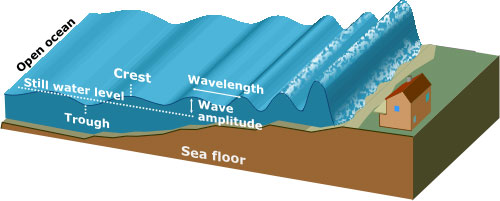
When the tsunami approaches the coast, it still has most of it’s energy, but as the ocean gets shallower, the shock wave starts slowing down. The wavelength gets shorter and the wave height increases. That’s why it’s on the coastal margins that tsunamis are so dangerous.
Does the sea level has the same distance to earth center everywhere in the earth?
Absolutely not. To measure the sea levels across the globe, scientists use satellite data along with a system of floating buoys and tidal gauges, and then sophisticated computer algorithms to smooth the instantaneous variations.
It’s a complex process because counter-intuitively, the oceans are really quite ‘lumpy’. Checkout this map of tidal ranges.
As well as tides due to the influence of the Moon, sea levels are affected by local variations of temperature, salinity, wind, air pressure, coastal and sea floor topography, Coriolis forces, centrifugal forces, thermohaline circulation, and even variations in local gravity.
Why do people freak out about flat earth believers when the Flat Earth Society has absolutely zero evidence or proofs to support the idea that the earth is flat?
I’m not sure many people freak out about flat Earth believers, because it’s difficult to take them seriously. But they are an irritation, and probably up there with QAnon, Anti-vaxxers, chem-trailers, and other conspiracists.
But you’re right, there is zero evidence, and no ‘proofs’ that stand up to scientific scrutiny. What makes me smile is that there are about as many flat-Earth theories as there are FE supporters. They bicker about whether their flat-earth model is stationary, stationary and rotating, or actually moving through the cosmos. They disagree about whether or not it’s domed. But my favourite is their contradictory explanations for gravity.
Some say “it’s the pressure of the atmosphere”, Others say “it’s an electro-magnetic effect”. Theflatearthsociety says “Gravity as a theory is false. Objects simply fall (!)”. And TFES says “the Earth is being accelerated upwards at a rate of 9.8 m / sec2”.
And I even spotted this one: “There’s no gravity but there is a repulsive force at the edge called soul magnetism and the subconscious navigation force (!)”.
How can anyone take this stuff seriously?
Why can’t a shuttle or glider be built to reenter Earth’s atmosphere at a shallow angle, at a slow speed to reduce friction, so that it returns to Earth over a long, slow period of descent, even by orbiting the Earth multiple times, if necessary?
The question has a built-in misconception. You can hypothetically go into space using just vertical thrust with no horizontal velocity. But the moment you stopped using thrust, you’d start to fall back to Earth. And then as soon as you reach the top of the atmosphere, you could conceivably glide down “at a slow speed”.
But if your mission needs to stay in space for any length of time without continuously using thrust to stay there, you must go into orbit. Effectively, this means all missions need to achieve orbital velocities, which is why you see rockets doing this:
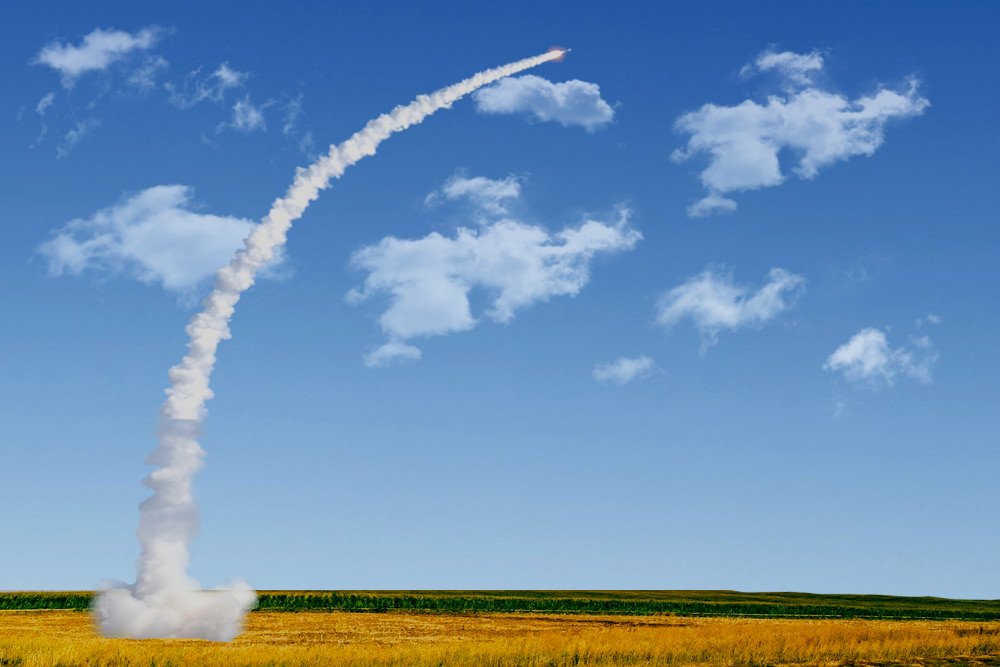
So when you want to de-orbit and return to Earth, the phrase “at a slow speed” becomes moot, because when you start encountering the atmosphere, your speed is already on the wrong side of 17,000 mph!
What city surprisingly isn’t bigger than it is?
This may sound counter-intuitive, but I’m going to suggest London, England. OK, the entire metropolitan area is more than 600 sq miles, but the part that’s likely to be of interest to visitors is surprisingly compact.
Central London has three main boroughs… the two cities of London and Westminster, and the Borough of Southwark. The City of London attractions include Sir Christopher Wren’s St Paul’s Cathedral, the Tower of London and Tower Bridge, but is mostly the commercial hub with lots of high-rise office blocks.
Southwark is south of the river to the City of London, and has a cathedral, some old pubs, some nice riverside walks, and a reconstruction of Francis Drake’s Golden Hinde. Oh and Europe’s tallest building, the Shard of Glass.
The City of Westminster has probably the most tourist attractions with more riverside walks, the Houses of Parliament (and Big Ben), Buckingham Palace, Westminster Abbey, Piccadilly Circus, Trafalgar Square, and of course the ‘West End’ with its many theatres and restaurants. It includes the best shopping areas including some high end shops on Regent Street, Bond Street and Piccadilly.
But suggestions that London is a sprawling metropolis are misleading… St Paul’s Cathedral to the Gothic Southwark Cathedral is only a mile and a half, and St Paul’s to the Neo-Byzantine Westminster Cathedral is only three miles; so (IMHO), Central London should be explored on foot. And I notice that maps of the London Underground system now include walking times between stations.. checkout
http://content.tfl.gov.uk/walking-tube-map.pdf
Having lived in London, off and on, for about 20 years, I still get a blast by (say) visiting the Tate Gallery, and afterwards just walking in the vague direction of (say) St Paul’s Cathedral, but with no real agenda. There are always pleasant surprises… shady squares, Georgian mews, historic buildings, statues, etc. And often hardly a tourist in sight… try it!
Why do people in the U.K. dislike Donald Trump even when he is not their president?
Like most people in the UK (and most of the civilised world outside of the USA), my feelings are that he is a brash, vulgar, self-agrandising, narcissistic, spoilt rich kid and ex-game show host. He bragged about his achievements, his pussy-grabbing exploits, his affairs, how he reneged on business deals, and how he stiffed his sub-contractors.
We knew about his multiple bankruptcies, his failed university scheme, and his various legal battles, and how he doesn’t really give a shit about the people who support him, the environment, or the future of the planet. He dragged his feet on the pandemic, and ended up politicising it, arguably causing 300,000 unnecessary deaths.
To us, the bigger question is why 74 million Americans still think that these are desirable qualities in a president.
What is the most dangerous volcano in Europe?
It depends on your time frame. In 2020, the most dangerous European volcano was Stromboli because it killed one person. Mount Etna on Sicily killed 56 people in 1843. Vesuvius erupted in 79 AD wiping out Pompeii and Herculaneum and killing more than 13,000 people. It erupted again in 1631 killing 3,300 people; and again in 1944 killing 27.
In 1646 BC, the Greek island of Santorini erupted, and the caldera collapse that resulted, wiped out the Minoan civilisation on nearby Crete. The exact death toll isn’t known, but the effects of the eruption and the Tsunami would have been felt all round the eastern Mediterranean.
Vesuvius will erupt again, and with huge loss of life because the area is highly populated… the city of Naples is only 12 km away. Inside the Santorini archipelago, is a relatively new volcano… the island of Nea Kameni, and this will erupt again in the distant future, and again, probably cataclysmically.
But my guess for the next ‘big one’ in Europe would be Campi Flegrei (or the Phlegraean Fields) also near Naples. This has the potential to be a super-volcano.
It probably won’t happen for a few thousand years, but when it does it could be catastrophic for the western Mediterranean, and potentially for the whole world. The most recent super-volcano eruption was Tambora in 1815, and this caused crop failures on the other side of the world, and 1816 was dubbed ‘the year without a summer’.
What is the effect of methane in the atmosphere?
Methane is a greenhouse gas, which means like CO2, it allows sunlight to pass through, but when the sunlight is re-radiated as heat, the methane absorbs the heat and prevents it from being lost to space. So the Earth’s atmosphere is warming up.
Atmospheric methane tends to disappear after around a decade, whereas CO2 take 200 years to break down. But this doesn’t tell the whole story because while it is present, methane is 84 times more potent as a greenhouse gas.
Furthermore, about 60% of methane is produced by human activities, so this is something we can fix… if we have the will.
Since science is always changing, will future scientists one day conclude that the Earth is flat?
No. People were inferring it was a sphere several millennia ago. Then they measured it’s diameter. Then they calculated it’s mass. And all of this happened before we could go into space and look at it. And photograph it. And orbit it. And establish it’s rotundity with great precision.
And “science is always changing”? Only in the sense that scientific theories are constantly being refined.
98% of experts agree the Earth is flat according to an online survey. Why do round Earthers refuse to believe in science?
Rodney Jones, Likes cosmology but wishes he could remember more.
98% of experts agree the Earth is flat according to an online survey. Why do round Earthers refuse to believe in science?
Flat-Earth ‘science’ consists of statements like “The Full Moon is Impossible in Round Earth Theory” totally failing to understand that the moon’s orbit around the Earth is inclined by some 5.14° to Earth’s own orbit around the Sun.
They are also confused by gravity… depending on which flat-Earther you talk to, they believe it’s “the pressure of the atmosphere” or “it’s an electro-magnetic effect” or “universal acceleration”. Others say “Gravity as a theory is false. Objects simply fall”.
This stuff is entertaining and often hilarious, but it’s not science. So your question is actually a tautology…. “98% of experts agree the Earth is flat” makes them flat-Earthers, so I’m not sure what field they are experts in, but it’s not science.
Why does the rain that falls from the topmost part of the troposphere doesn’t burn and evaporate again just as the meteorites do because of the gravitational force and drag?
Rodney Jones, Been following science for 60 years
Raindrops start of as water vapour with very little velocity, and as they condense and form water droplets, they start falling to Earth, but they don’t keep accelerating. Air resistance, coupled with the raindrop’s mass and size mean that no matter how high they fall from, they never exceed a velocity of 20 – 30 mph.
By comparison, meteors enter our atmosphere at velocities of 20,000 mph to 160,000 mph!
What if earth never had a magnetic field
Rodney Jones, Been following science for 60 years
Answered February 25th 2021
There’s a very good chance that we wouldn’t be here. The earth’s magnetosphere diverts hard solar radiation over the poles, and without it, it’s arguable that life as we know it would not have developed.
BUT… even more important, the magnetosphere diverts the solar wind as well. After 4.5 billion years of exposure to full force of the solar wind, and the Earth’s atmosphere would probably have been stripped away, which is the best guess as to what happened to the atmosphere on Mars, since Mars only has a weak magnetosphere.
A recent study determined that a large scale solar farm would heat the air in the area and change the weather pattern. Has anyone ever studied whether all the miles of blacktop on the earth’s roadways add to global warming?
Rodney Jones, Knows enough about climate to trust the experts
Answered February 25th 2021
The actual reflectivity of any planet is called it’s albedo, and the Earth’s albedo is 0.39, meaning that it reflects 39% of visible light that falls onto it, and therefore is absorbs 61%. I doubt that all the roads on the planet have changed the albedo in any significant way.
The study I read about large scale solar farms expressed concern only in terms of what it would do to local weather patterns.
Why are we spending so much on space exploration when we could use that funding to make Earth a better place?
Rodney Jones Been following science for 60 years
Answered January 31st 2021
Why single out space exploration? Why not question all scientific research? And why science anyway? Did you know that the US military budget is $934 billion, which is more than the next 26 countries combined – 5 of whom are allies? By comparison, the 2020 NASA budget was a mere $22.6 billion.
The issue is that with any ‘blue-sky’ science, the goal is the pursuit of knowledge, which is part of being human. But there are always spin-off benefits that we can’t always predict.
Here are some unexpected benefits that came from space exploration.
Artificial limbs
Innovations originally designed for space vehicles, including artificial muscle systems, robotic sensors, diamond-joint coatings, and temper foam, make artificial human limbs more functional, durable, comfortable and life-like.
Scratch-resistant lenses
After NASA developed scratch-resistant astronaut helmets, the agency gave a license to Foster-Grant Corporation to continue experimenting with scratch-resistant plastics, which now comprise most sunglasses and prescription lenses.
Insulin pump
Needing to monitor astronauts’ vital signs in space, the Goddard Space Flight Center created monitoring systems that have been adapted to regulate blood sugar levels and release insulin as needed.
Firefighting equipment
The polymers created for use in space suits have been valuable in creating flame-retardant, heat-resistant suits for firefighters. Newer suits also feature circulating coolant to keep firefighters from succumbing to heat and advanced breathing systems modeled after astronaut life support systems.
DustBusters
During the Apollo moon landings, NASA partnered with Black & Decker to invent various battery-powered tools for drilling and taking rock samples in space. This led to the creation of the ultra-light, compact, cordless DustBuster.
LASIK
Technology used to track astronauts’ eyes during periods in space in order to assess how humans’ frames of reference are affected by weightlessness has become essential for use during LASIK surgery. The device tracks a patient’s eye positions for the surgeon.
Shock absorbers for buildings
Shock absorbers designed to protect equipment during space shuttle launches are now used to protect bridges and buildings in areas prone to earthquakes.
Solar cells
Out of a need to power space missions, NASA has invented, and consistently improved, photovoltaic cells, sharing the advancements with other companies to accelerate the technology.
Water filtration
In the 1970s, NASA developed filtration systems that utilized iodine and cartridge filters to ensure that astronauts had access to safe, tasteless water. This filtering technology is now standard.
Better tires
After the Goodyear Tire and Rubber Company invented the material used in NASA’s Viking Lander parachute shrouds, the company began using it in its everyday radial tires. The material is stronger than steel and adds thousands of miles of life to the tires.
Wireless headsets
Along with two airline pilots who’d invented a prototype of a wireless headset, NASA built a light, hands-free communication system that would allow astronauts to communicate with teams on Earth. The technology was utilized in the Mercury and Apollo missions.
Adjustable smoke detector
In partnership with the Honeywell Corporation, NASA improved smoke detector technology in the 1970s, creating a unit with adjustable sensitivity to avoid constant false alarms.
Invisible braces
After NASA and Ceradyne invented a clear material that could protect radar equipment without blocking the radar’s signal, Unitek Corporation/3M teamed up with Ceradyne, using the material to invent invisible braces.
Freeze-dried foods
During long space missions where every ounce of weight and inch of space aboard a shuttle must be maximized, freeze-dried foods have become a staple. Freeze-dried foods are incredibly light, and they retain their nutritional value. Once reconstituted, they are also easier and more pleasant to eat than former meal sources that were packed into squeeze tubes.
Camera phones
In the 1990s, NASA’s Jet Propulsion Laboratory invented a light, miniature imaging system that required little energy in order to take high quality photographs from space. This technology has become standard in cell phone and computer cameras.
CAT scans
NASA’s digital signal technology, originally used to recreate images of the moon during the Apollo missions, is the underlying technology that makes CAT scans and MRIs possible.
Baby formula
A nutritious, algae-based vegetable oil invented by NASA scientists who were searching for a recycling agent to use during long space missions is now an additive in many infant formulas. It contains two essential fatty acids that cannot be synthesized by the human body.
Lifeshears
The pyrotechnic mechanism used to detach a space shuttle from its rocket boosters after launch is the same used in Lifeshears, but in a smaller scale. Lifeshears are a tool that can be used in emergency situations to cut into cars or collapsed buildings to rescue people trapped inside.
Grooved pavement
The requirements for landing space shuttles led NASA scientists to do extensive research on minimizing hydroplaning – when vehicles slide uncontrollably on a wet surface – on runways. They discovered that cutting grooves into runways helps channel water away from the runway and significantly reduces accidents. Many highways and airports now have grooved pavement.
Air purifier
In the sealed, artificial environment of a spacecraft, attempts to grow plants have led to ethylene buildup. NASA invented an air purifier for the International Space Station that is now used widely on Earth – everywhere from restaurants, to hospitals, to refrigerators – to remove ethylene, which hastens decay, as well as other particulates and pathogens.
Memory foam
Memory foam was originally invented as a pad for astronaut seats that would mold to their bodies during the high forces of takeoff and landing, then return to a neutral state. This eliminated the need to customize seats to individual astronauts’ body sizes.
Workout machines
Because prolonged exposure to zero-gravity leads to bone loss and muscle atrophy, NASA created workout machines to enable astronauts to maintain physical fitness while in space.
Home insulation
NASA began experimenting with insulation technology for the Apollo space crafts and suits, leading to the invention of common construction insulation.
Infrared ear thermometers
Infrared ear thermometers, which allow for instant temperature capture without the risk of picking up pathogens and causing cross-infection, utilize the same technology developed for assessing the temperature of distant planets.
Ice-resistant airplanes
Ice is a real threat for shuttles in space, and NASA has devised multiple electronic solutions to prevent ice formation on spacecrafts, some of which are now used on commercial aircraft.
Portable computer
The first portable computer, the Grid Compass, was used on multiple shuttle missions in the 1980s. Nicknamed SPOC (Shuttle Portable On-Board Computer), the computer could communicate with onboard devices and was used to launch satellites off space shuttles.
LEDs
Intended for use to help in growing plants aboard space shuttles, NASA’s LED technology has been utilized in the development of LED medical devices that relax muscles and relieve pain in soldiers, cancer patients, and those with Parkinson’s disease.
3D food printing
The ability to cook food on long space missions is no longer impossible with the invention of 3D food printers. This technology is now being refined for commercial use for the production of chocolates and other confections as well as to create nutritious foods for diabetics and others with specific dietary needs.
Computer mouse
While searching for a way to increase interaction with onboard computers and allow users to perform tasks like manipulate data, NASA and Stanford researchers developed the first mouse.
Athletic shoes
A shock-absorbent rubber moulding designed for astronauts’ helmets inspired what is now a common feature in the soles of modern athletic shoes.
Thanks to https://eu.usatoday.com/story/money/2019/07/08/space-race-inventions-we-use-every-day-were-created-for-space-exploration/39580591/ for this list.
What are some of the greatest marketing disasters in history?
Rodney Jones British by birth, but also lived in America, France, Holland and Spain
Answered January 10th 2021
There’s the story of the American fast food chain A & W who classically overestimated the intelligence of it’s marketplace.
In competition with McDonalds and their Quarter Pounder, A & W introduced a new burger that was a third of a pound. In taste tests, customers preferred the A & W burger. And it was cheaper. They spent a fortune trying to promote their new burger, but the public snubbed it.
Only later when they had customer focus groups did the truth emerge… the great American public couldn’t get the hang of fractions. Because 3 as in 1/3 is smaller than 4 as in 1/4, most people thought they were getting LESS meat!
Is Jacinda Ardern correct in that climate change is a serious emergency and that the world should act with urgency or is she being a bit of an alarmist and exaggerating the severity of the issue?
https://www.theguardian.com/world/2020/dec/02/new-zealand-declares-a-climate-change-emergency
Rodney Jones Knows enough about climate to trust the experts
Answered January 4th 2021
The real answer is… nobody knows for sure. What we do know is that people who understand the science of climate change are in almost complete agreement that it’s: a) real, b) man-made, and c) requires our urgent attention.
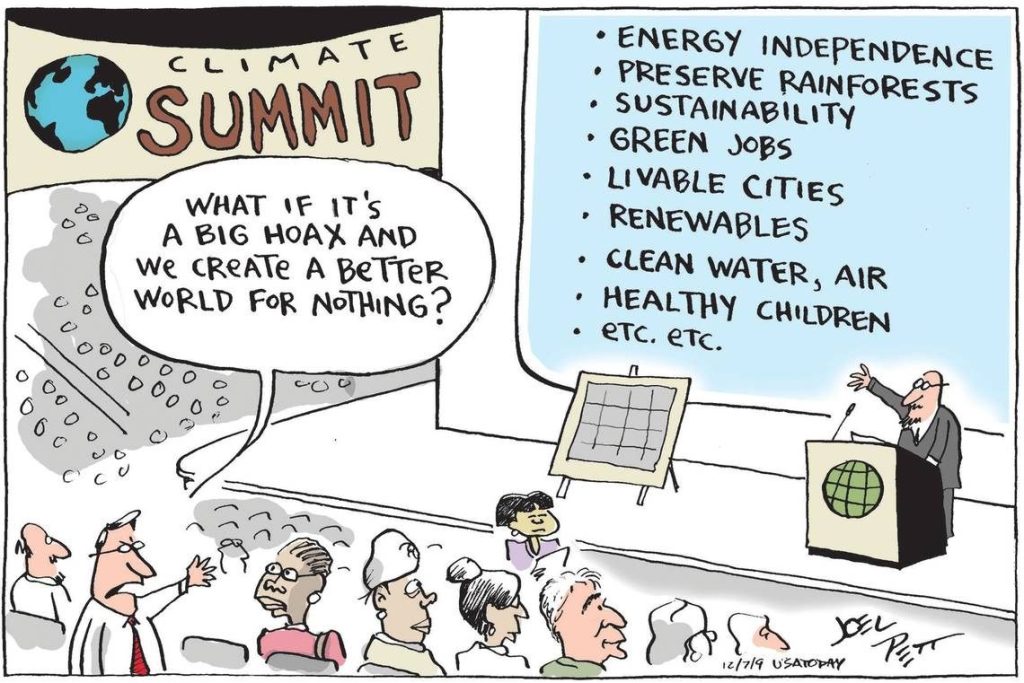
If we fail to take action, there are a range of possible scenarios, one of which is that nothing happens. But another scenario is that the current warming trend causes the methane hydrates found in permafrost and on the ocean floors to be released. The release of new methane causes more warming, causing more methane to be released, etc. It’s called thermal runaway, and the Earth could end up like Venus and therefore uninhabitable.
Other possible consequences include wars and global tension over things like displaced populations, economic instability, food shortages, water rights, etc.
Given that the stakes are so high, and we’ve been dragging our feet for so long, I think acting with urgency is the only intelligent thing to do.
How do air breathing rocket engines work? How do these engines take the contents of space (or Earth’s) atmosphere and use it?
Rodney Jones· Been following science for 60 years
Answered December 29th 2020
Most answers seem to point out that if the engine breaths air, it’s not a rocket engine. While this is arguably true, it’s not terribly helpful when the question is presumably asking about SSTO (Single Stage To Orbit) engines like LACE and SABRE.
The physics of rockets are conceptually simple… you have a payload of (say) 100 kg, so you think you just need a rocket with a thrust of more than 100 kg. Then you realise that this rocket needs fuel. So now the payload is now more than the thrust of the rocket, so you need a bigger rocket… which mean more fuel, etc. The mathematics is relentless, which is why we ended up with something the height of a 36 storey building, just to take 3 men to the moon.
As Scotty in Star Trek is supposed to have said “You canna break the laws of physics”.
But… if you can cut down on take-off weight, the calculations show that orbital velocities can be achieved by a single stage vehicle.
Cue LACE and SABRE concept engines. The idea is that a spaceplane equipped with these engines would take-off horizontally (since gaining height using lift is more efficient than using thrust), and gradually accelerate towards orbital speeds. But here’s the big difference… LACE and SABRE are hybrid engines and would use atmospheric oxygen to achieve hypersonic speeds up to Mach 5, so the take-of weight (so critical in calculating performance envelopes of their missions) wouldn’t need to include high quantities of the liquid oxygen. Once the spaceplane becomes hypersonic, the engine intakes would be closed, they would switch to on-board oxygen, and the engine would become closer to a conventional rocket engine, and accelerate the vehicle into orbit.
LACE was an ambitious concept as it would not only use atmospheric oxygen to become hypersonic, but it would also liquefy and capture the oxygen needed for the ‘space’ part of the mission. In the 1980s when LACE was proposed, there were too many technological obstacles, so it was shelved. Possibly it will be resurrected when more advanced technology and better materials become available.
SABRE on the other hand must carry some oxygen at take-off, but it’s passed the proof-of-concept phase with the European Space Agency as well as the US Air Force, and the thinking is that with some further development, it could be made using existing materials and current technology.
Why isn’t studying UFOs considered to be a real science?
Rodney Jones Been following science for 60 years
Answered December 13th 2020
Hi, and thanks for the A2A…
As others have suggested, UFOs are not a repeatable phenomenon, so research cannot follow the scientific method.
And most UFO enthusiasts are too much like Mulder’s X-Files poster… “I want to believe”, when a little scepticism would serve UFO research far better.
Case in point: I used to camp out on a hilltop called Cley Hill near Warminster in the UK which during the 60’s and 70’s was the subject of some weird stuff… cigar shaped objects in the sky; bright lights; loud unearthly noises that rattled roof tiles; flocks of pigeons dying in mid-flight; etc.
I would go with a friend to watch the Perseids meteor display on August 12th every year for about twenty years. We didn’t expect to see any UFO activity, but hey, we loved the meteor displays, and we were in the perfect place in case the UFOs chose that night to make an appearance.
Well occasionally, in the middle of the night we’d hear approaching footsteps of other (mostly UFO hunting) night owls. You have to bear in mind that Cley Hill has 360 degree panoramas of the surrounding countryside; an awful lot of which is Salisbury Plain, and an awful lot of Salisbury Plain is used by the military. As such, it wasn’t unusual to see landing lights of aircraft and helicopters.
On one occasion, about midnight, we saw what looked like a stationary bright light low in the sky, which suddenly winked out. An hour or so later we heard voices, and saw a group of 3 men. “Did you see that bright light over there?” they asked. “Yes” we answered… “we thought it was probably a military helicopter on approach with it’s landing lights on, and then it turned away just as it landed”. “Oh no, we’re members of BUFORA, and we’re putting it down as a sighting”. BUFORA is the British Unidentified Flying Object Research Association, and people like this should learn about Occam’s Razor. Sadly, they prefer irrational explanations when a much more rational, if slightly less exciting alternative is available, and they are doing UFO research no favours whatsoever.
If we pour water from a water bottle to the ground, is it possible for the germ on the ground to climb up to the water stream and make it to the rest of the water in the bottle?
Rodney Jones Been following science for 60 years
Answered December 10th 2020
OK, two points… There was an episode of Mythbusters that explored the possibility that you could electrocute your self by urinating on the live rail on a railtrack. They found that unless you got down on your hands and knees and urinated from a few inches, the stream would separate into droplets and you wouldn’t be electrocuted.
So for a start, it depends how high you hold the water bottle above the ground.
Second point… even the most athletic of germs can only swim at around a millimetre a minute, so even if the water was a continuous stream, the germs cannot swim fast enough to overcome acceleration of the water due to gravity, so the answer in no.
Why do earthquakes shift the Earth’s axis and why the displacement is greater with earthquakes at higher latitudes?
Rodney Jones Likes cosmology but wishes he could remember more.
Answered October 25th 2020
Think of the Earth as a large gyroscope; one of the principles of a gyroscope is that it resists attempts to change it’s axis. If you force a change to it’s axis, this will result in the spin speeding up or slowing down. That’s the principle of theses things…
Conversely, if you increase or decrease the spin, the axis will change.
The Chilean earthquake of 2010 was a sufficient shift of mass that it shortened the day by just over a millionth of a second; the increased spin shifted the axis by 8 cm (or 3 inches).
I would have expected the displacement to be greater nearer the equator… can you give a source for your second question?
What is the greatest blunder in aviation history that took the longest to correct?
Rodney Jones No stranger to airports and I have the grey hair to prove it
Answered October 25th 2020
What about the de Havilland Comet – the world’s first commercial jet airliner? This is surely the greatest blunder in aviation history.
It was innovative and well ahead of it’s time, and came as a result of the British having an edge in jet engine technology. It should have been a major triumph, and possibly the world might never have heard of the 707 or the DC-8. At the time the magazine Popular Mechanics said “that Britain had a lead of three to five years on the rest of the world in jetliners”.
Sadly, that was until politics raised it’s ugly head. The UK government at the time found itself pressured into using de Havilland Ghost engines instead of the more powerful Rolls-Royce Avon engines. The result was that serious compromises were made in the design. The airframe needed to be much lighter, and the skin made thinner. I’ve heard people who flew on the early Comets say that you could look out of the window and see the skin rippling in the slip-stream.
There were several ‘failed to become airborne’ incidents, and then a Comet 1, registered G-ALYV ‘fell apart’ in a thunderstorm over India. And Comet G-ALYP, broke up in mid-air over Italy.
Then there was the issue of the stresses around the squarish windows that led to other crashes.
Problems were fixed as they were found, but the result was a major loss of confidence in the plane, and airlines were cancelling orders. Meanwhile of course, on the other side of the Atlantic, Douglas and Boeing watched and learned.
Development of the Comet continued, and arguably the Comet 3 and final Comet 4a’s and 4b’s were fine planes, but by this time Douglas and Boeing had caught up, and the Comets were now competing with the larger, faster and more long-ranged 707′s and DC-8′s.
This is all a gross over-simplification of course, but in terms of British aviation throwing away a significant technological and commercial advantage, the Comet is surely the greatest blunder in aviation history.
What fact about the universe’s size blows your mind?
Rodney Jones Likes cosmology but wishes he could remember more.
Answered October 18th 2020
Ah, you’ve got me thinking about the Total Perspective Vortex from Douglas Adams’ “Hitchhiker’s Guide to the Galaxy”.
“The Total Perspective Vortex is the most savage psychic torture a sentient being can undergo.
“When you are put into the Vortex you are given just one momentary glimpse of the entire unimaginable infinity of creation, and somewhere in it a tiny little marker, a microscopic dot on a microscopic dot, which says “You are here”.”
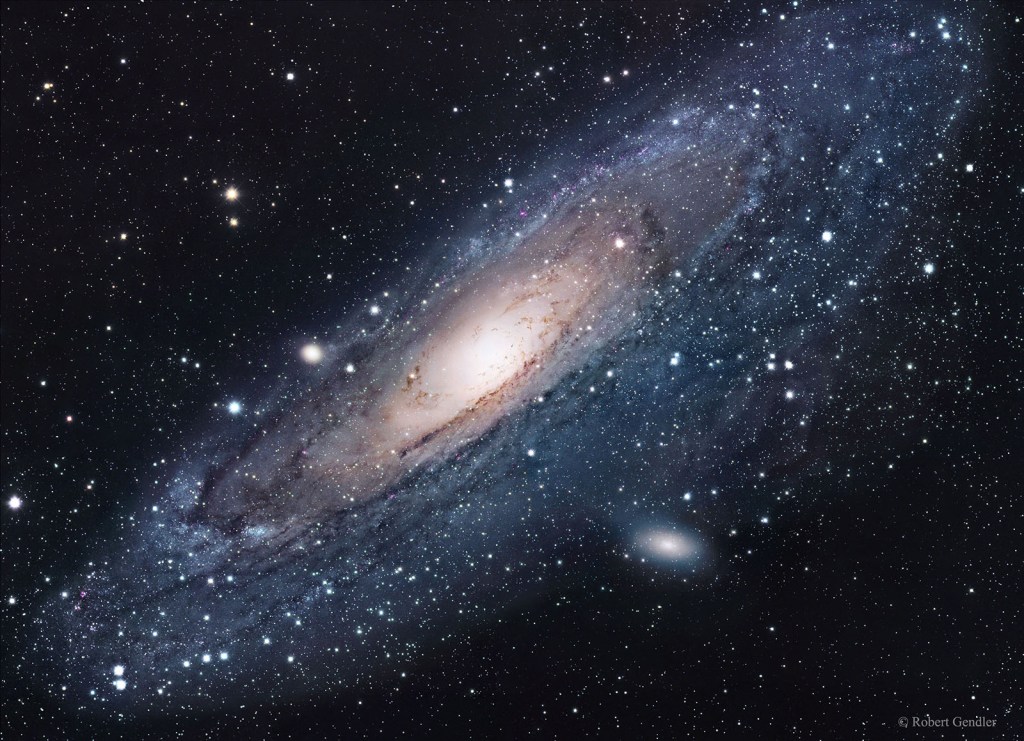
OK some points of reference. Outside our own Milky Way galaxy (if you ignore the Magellanic Clouds which are gravitationally bound to the Milky Way), our nearest neighbour is the Andromeda Galaxy, some 2.5 million light years away.
And this is the Hubble Ultra-Deep Field (or HUDF)… an image that took the Hubble Space Telescope four months to build-up.
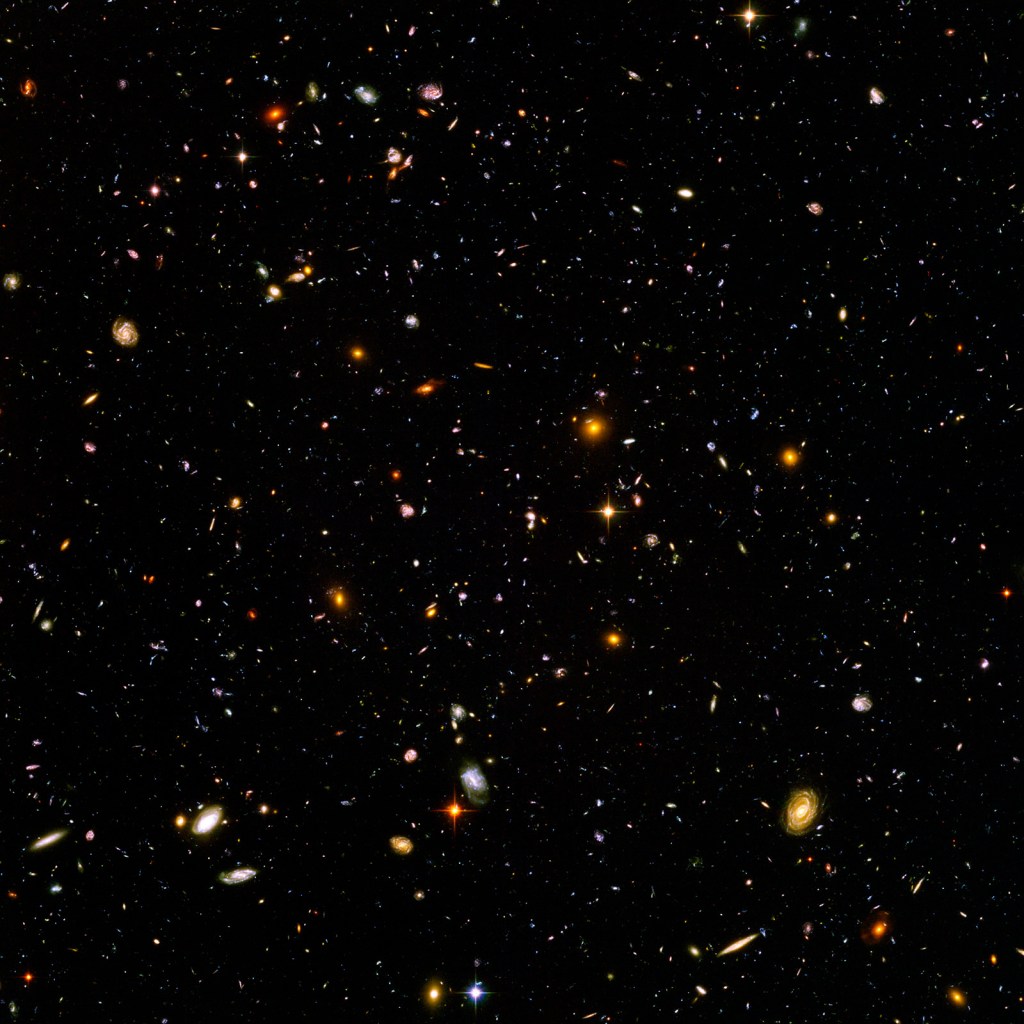
The image contains around 10,000 galaxies, but it represents a very tiny area of sky, equivalent to a 1mm square held at arm’s length.
The observable universe contains an estimated 200 billion galaxies. The observable universe by the way, is that part of the universe where light and other electromagnetic radiation has reached us. It is 93 billion light years in diameter.
The entire universe on the other hand, may be infinite in size, but if finite, is calculated to be at least 250 times larger than the observable universe.
But these are just numbers… big numbers admittedly, but still numbers. To put it all into a human context, I like to ask people, suppose the Solar System (which is 5.5 billion miles across) was reduced to the size of a DVD, on this scale, how far do you think our nearest neighbour, the Andromeda Galaxy is from us?
The answers I get are “Oh, ermm 100 meters?”, “Five miles?”.
The answer is just under a billion miles, or ten times further than the Sun. That’s what blows my mind.
Another recurring thought is “isn’t the universe a little over-engineered if we’re the only occupants?”
If evolution is a theory, why are we required to learn about it in school?
Rodney Jones Been following science for 60 years
Answered October 15th 2020
Evolution is a scientific theory and on Quora alone, this and similar questions must have been asked and answered more than a hundred times, so I’m genuinely surprised that anyone still needs this explaining to them.
Wikipedia says…
“A scientific theory is a well-substantiated explanation of some aspect of the natural world that is acquired through the scientific method and repeatedly tested and confirmed, preferably using a written, pre-defined, protocol of observations and experiments. Scientific theories are the most reliable, rigorous, and comprehensive form of scientific knowledge”.
It has nothing to do with the common usage of ‘theory’ which usually means speculation or conjecture.
Science recognises that some subjects like Evolution, Big Bang, Gravity, etc., are ultimately unknowable, but this shouldn’t stop scientists contemplating these mighty issues. The value of the Scientific Theory is that it explains our observations and experiences, even though the underlying mechanisms may not be not fully understood.
A good example is quantum mechanics which is puzzling, often counter-intuitive, and certainly not fully understood, and therefore it is a Scientific Theory. But it’s a good theory because without it, there would be no computers, smart phones, etc., so you wouldn’t be reading this.
Another thing to understand about scientific theories is that they are not static… they are constantly being challenged by new research and new discoveries, and they get refined as we understand more of the underlying mechanisms. But… if like Evolution, the theory is still around after decades or even centuries of such challenges, then you can take it to the bank.
For all intents and purposes, we laymen should think… ‘scientific theory’ = ‘fact’.
Is the internet the true reason the ball Earth theory is being dismantled?
Rodney Jones Been following science for 60 years
Answered October 12th 2020
The ‘ball Earth (well actually it’s slightly wider at the equator due to it’s spin, so technically it’s an oblate spheroid) theory’ is no more dismantled now than it was when a showman called Samuel Birley Rowbotham (who later awarded himself a doctorate to increase his credibility) first suggested the idea. His ideas were discredited more than a hundred years ago.
For example, when challenged to explain why the northern hemisphere sees different constellations to the southern hemisphere, Rowbotham claimed this was nonsense and that (for instance) Polaris was visible from all parts of the Earth… something he could get away with in the 19th century, but not any longer.
So until some flat-Earther can give a plausible explanation as to why the night sky in the southern hemisphere rotates the opposite way to the night sky in the northern hemisphere, the Earth as a rotating oblate spheroid will remain an observable and easily verifiable fact.
Would current technology allow near real time audio or video communication over interplanetary distances, say Mars to Earth?
Rodney Jones Likes cosmology but wishes he could remember more.
Answered October 11th 2020
If by real time, you mean instantaneous, the simple answer is no, and probably not with any future technology either. Mars is several light minutes away (from 3 to 20 light minutes actually, depending on our relative positions). So any communication using the electromagnetic spectrum (radio, micro-wave, light, etc.) would be subject to that much delay.
I don’t know much about quantum-entanglement, but from what little I know, I don’t see how it could be used for instantaneous communications. Perhaps someone can enlighten us all?
If the earth and planets orbit the sun, does the sun also orbit something at the center of the Galaxy? What objects are in the center of the Galaxy? And what about galaxies, are they also orbiting something?
Rodney Jones Likes cosmology but wishes he could remember more.
Answered October 9th 2020
If you’ve read the other answers, you’ll begin to appreciate that orbital mechanics is a complex topic, but I’ll attempt to simplify it by saying that objects do not orbit each other.
They orbit around a common centre of gravity called the barycentre. In the case of the Earth-Moon system, the barycentre is close enough to the Earth’s centre of gravity that it’s convenient to think of the Moon orbiting the Earth, but strictly speaking, they both orbit around this common centre of gravity.
For three or more bodies, the absolute positions and orbits are literally impossible to resolve (see Three-body problem – Wikipedia).
In the case of the Solar System, everything in it orbits around it’s barycentre, but since the Sun contains 99.8% of the mass of the entire system, we go along with the idea that the planets orbit the Sun just for convenience.
And it’s nice to think of galaxies as being held together by the super-massive black holes at the centre, but the same principles apply.
Everything in the Universe is gravitationally affected by everything else, and is part of a vast celestial dance!
When is the next meteor storm (different than the typical meteor shower)?
Rodney Jones Been following science for 60 years
Answered October 9th 2020
The simple answer is, no one knows with any certainty.
So far, the science of predicting ZHRs (Zenith Hourly Rate) for the major meteor showers has had mixed success. I’ve been watching meteor showers for more than 40 years, and the predictions, both amateur and professional, have been little more than best guesses.
For example, the Perseid shower in August is the debris left behind by the comet Swift-Tuttle. The last time the Earth passed through the orbit of Swift-Tuttle, there were high expectations from meteor watchers, but in the event the resulting shower was unspectacular.
The best candidate for meteor ‘storms’ is the Leonids in November, and there is even a statistical basis for this as there were significant ‘meteor storms’ in 1767, 1799, 1833, 1866, 1867, and 1966, suggesting a 33 year period between maximums. Sadly, when the Leonids are not ‘storming’, the showers can be disappointing. However, the 1833 storm recorded meteors at a rate of 100,000 per hour… that would have been something to behold!
So fingers crossed for 2032.
If the equator is warm because it is closer to the sun, then why aren’t mountaintops? Technically they’re closer to the sun too, but they’re cold and covered in snow.
Rodney Jones Been following science for 60 years
Answered October 8th 2020
The equator is warm because when the Sun is overhead, the radiation per square metre is greater than anywhere else.
But are you seriously asking why mountaintops aren’t as warm as the equator despite being a few miles closer to the Sun?
Well let’s consider Chimborazo in Equador… it’s near the equator and is roughly 4 miles high, so at midday it’s around 0.0000043% closer to the Sun than the ground around sea level, and arguably the top does receive 0.0000043% more radiated heat than the ground below. But because air gets cooler as it becomes thinner at a rate of around half a degree Celsius per 100 meters of altitude, the extra radiation is trivial.
Which is just as well, because if 4 miles was significant, then the 3.5 million mile difference between the closest and most distant part of our orbit round the Sun would be catastrophic.
Why does the US have lower food standards than the UK and Europe?
Rodney Jones British by birth, but also lived in America, France, Holland and Spain
Answered September 27th 2020
Most people who’ve travelled on the I5 interstate between Los Angeles and San Francisco will not have failed to notice a large steer farm, with the nice folksy sounding name of the Harris Ranch.
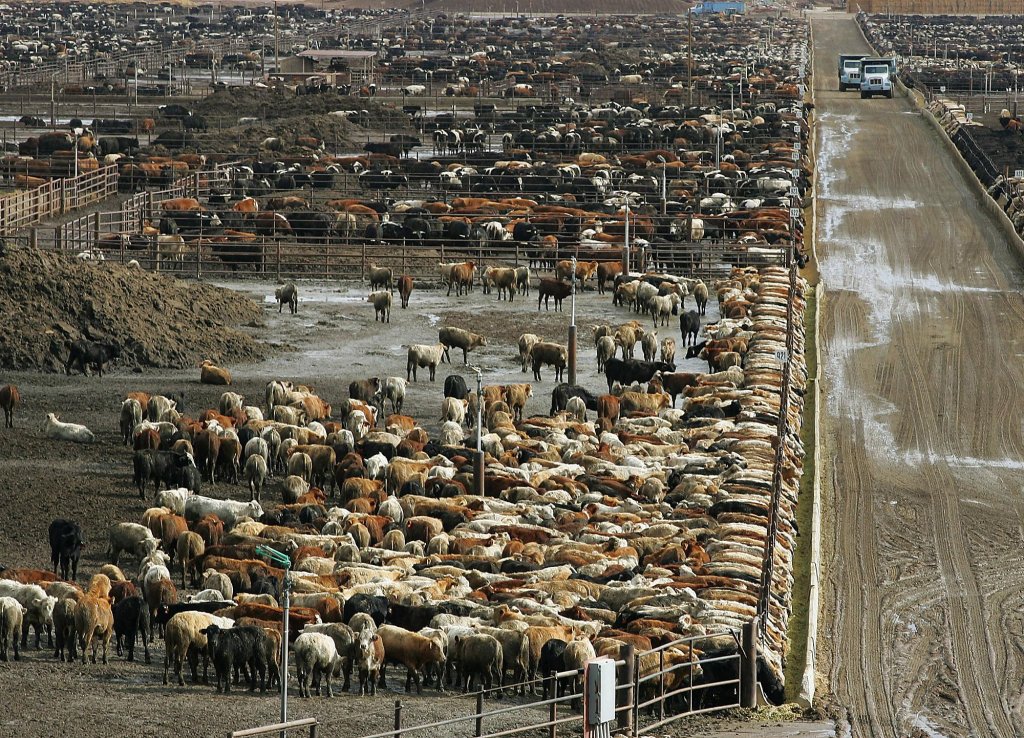
It’s difficult not to notice it because you can smell it miles before you can see it.
It’s where cattle, mostly bulls, are reared in industrial numbers in unpleasant, unsanitary, and overcrowded conditions before being made into burgers. A few years ago, a Harris Ranch worker turned whistle-blower and reported that the FDA was turning a blind-eye to the use of illegal levels of growth hormones and steroids.
So the answer to your question Why does the US have lower food standards than the UK and Europe? is that the FDA seems to be in the pockets of the food giants, in the same way that the FAA is (or at least was) in the pocket of Boeing.
Are people who believe climate change is fake the same people who believe that the Earth is flat?
Rodney Jones Knows enough about climate to trust the experts
Answered September 25th 2020
I suspect that they are from the same mould… they would have to be to believe that mainstream science is fundamentally flawed, and just they and their fellow conspiracists are privy to secrets that have eluded the rest of us.
I suspect that some of the more passive ones do believe more than one conspiracy theory, and it’s not uncommon to find that flat-Earther are also anti-vaxxers, chem-trailers, climate change deniers, etc. But the more active and opinionated ones have learned to ‘specialise’ and hone their arguments using the many books, websites and YouTube videos that support their views.
How do we know that the axial tilt of Venus is 177° instead of its inverted north and south poles as well as unique clockwise rotation just being the way they are?
Rodney Jones Likes cosmology but wishes he could remember more.
Answered September 13th 2020
As others have indicated, it’s mostly convention.
The accretion disk of dust and gas that all objects in the Solar System coalesced from, was slowly rotating. The law of conservation of angular momentum dictates that as the objects we now know as the Sun and the planets formed, they inherited this spin, and of course it was all the same direction. Conventionally, we look down on the Solar System, so we call the original spin ‘anti-clockwise’.
Venus then had a close encounter with another planet sized object, which turned it virtually upside-down, so that it is now seen to rotate clockwise. But it would be misleading to say it’s axial tilt was 2.4 degrees, when it’s actually 177.6 degrees from it’s original orientation.
Can somebody explain this: A chemist froze himself at -273.15°C, everyone said he was crazy but he was OK?
Rodney Jones Been following science for 60 years
Answered September 6th 2020
It’s a joke! He was 0K ie, zero degrees Kelvin!
What is piprake in geography?
Rodney Jones Been following climate & weather for 50 years.
Answered August 29th 2020
Not exactly geography, but in the colder climates, Piprake (aka silk frost) refers to water that’s forced out of something (the ground, rotting wood, etc), and then freezes. Here’s a pic I took of Piprake in a rotting twig.

Why isn’t there a public debate between experts on anthropogenic global warming (e.g., Dr. Michael Mann of Penn State versus Dr. Richard Lindzen of MIT)?
Rodney Jones Knows enough about climate to trust the experts
Answered August 25th 2020
Because quite simply, within the realms of climate science, there is no debate. There is almost total consensus (Climate Scientists Virtually Unanimous) that climate change is a) real, b) man-made, and c) requires our urgent attention.
The only people disagreeing have been influenced by the fossil fuel industry’s attempts to protect their profits. This includes Richard Lindzen, who has made quite a career out of being a scientific contrarian, including questioning the links between smoking and lung diseases.
Could we use sound waves to cause fusion, like a ripple?
Rodney Jones Been following science for 60 years
Answered August 24th 2020
Someone called Rusi Taleyarkhan claimed to have done this using a technique called sonoluminescence or Bubble Fusion, but sadly, his research was generally discredited and attempts to replicate his findings have so far failed.
Are most lakes and/or ponds created from crater impacts?
Rodney Jones Been following science for 60 years
Answered August 11th 2020
No… hardly any are impact craters because Earth’s crust is relatively young and dynamic. Subduction and mountain building means the surface is constantly reformed. Throw in an ice age or two with glaciation up to two miles thick, and it’s easy to see why only the bigger (> 10km dia) craters are more than a few thousand years old.
Most ponds and lakes have formed where there is a natural depression in the terrain, and where there is a reliable source of water. Most are not very deep. Sometimes one will form where the ground has subsided, or where an underground cave collapsed, probably millions of years ago.
What’s the best “tourist trap” you’ve ever fallen into?
Rodney Jones
Answered August 10th 2020
My wife and I have such an aversion to Tourist Traps that on a trip to Tunisia, rather than take the organised trips to places like Carthage, we chose to rent a car and ended up well off the tourist trail, looking at Roman ruins in cow fields!
But to answer the question What’s the best “tourist trap” you’ve ever fallen into? I guess that would have to be Pompeii. We were holidaying on Capri when we decided to bite the bullet. We took the ferry to Sorrento and the Circumvesuviana train to Pompeii. There were dozens of tour buses when we got there, so we feared the worst.
We genuinely expected something like when they open the gates at a football stadium. Walking shoulder to shoulder, maybe six abreast with everyone else. But the reality was quite different. We’d failed to reckon with the shear size of the place; the city walls are 2 miles round, and the site itself is 163 acres.

It was fantastic… completely unhassled by the crowds we’d expected, we were able to feel and appreciate the atmosphere of the place. The only caveat … this was in October 2002. Maybe we wouldn’t have enjoyed it so much in August (or since the invention of the selfie!).
Is there a website that debunks the theory of evolution in a simple way for kids to understand?
Rodney Jones Been following science for 60 years
Answered August 5th 2020
I can see why you’d wish for your children to live in a nice cocoon where everything was either black or white, sheltered from the complexities of the real world, and where Christianity is good, and science is bad…
But only for about a millisecond.
Because scientific opinion and religious belief are not mutually exclusive. That is unless you are one of those people who choose a literal interpretation of the religious works… the Bible, the Qu’ran, the Torah, etc.
The Bible was compiled from many different sources. Then at various times by various councils and synods, the content was discussed, edited and redacted, so that the narrative was consistent with contemporary ‘Christian Doctrine’. Sadly, there are now contradictions and ambiguities, as well as various sections that may have had relevance 2,000 years ago but now seem questionable advice, such as selling your daughter into slavery (Exodus 21:7) and not eating shellfish (Leviticus 11:10). It’s obvious to most impartial observers that readers should take things with a grain of salt.
As Mark Twain noted, “The Bible… is full of interest. It has noble poetry in it; and some clever fables; and some blood-drenched history; and some good morals; and a wealth of obscenity; and upwards of a thousand lies.”
People seem to forget that many of our greatest scientists were religious including Galileo, Newton, Faraday, Maxwell, J J Thompson, Heisenberg and of course, Charles Darwin himself. Furthermore, there are many people in high office within organised religion who believe in science and the scientific method. They would all advocate not taking the Bible too literally, but they would see the hand of God in what are generally seen as scientific explanations.
Sadly, the 20th century brought religious intolerance, things like the Scopes monkey trial of 1925, and the refusal by school authorities in America’s bible belt to allow the teaching of evolution. This was the rise of people who must live in a black and white world. This is religious fundamentalism, and it’s a divisive, toxic, and ultimately short-sighted influence wherever it’s encountered.
I hope you don’t inflict this on your kids.
What is the effect of atmospheric refraction?
Rodney Jones Been following science for 60 years
Answered August 2nd 2020
The effect is to bend light. Air is pretty transparent, but when there’s a lot of it (ie. between an observer and a distant horizon, it bends light downwards and allows us to see over the horizon. The exact amount of ‘bending’ depends on things like air density, temperature, humidity, and the angle of the observation, but would typically be around 1/2 a degree of arc at the horizon.
For example, when you see the Sun just touch the horizon prior to sunset, it has actually just set. That’s because 1/2 a degree of arc is coincidentally about the same apparent size of the Sun.
Why do environmentalists say that we need to save water? Didn’t they learn the Circle of Water at sixth grade?
Rodney Jones Been following science for 60 years
Answered July 22nd 2020
The problem with the water cycle is that 71% of rainfall goes into the sea. Sea water obviously can’t be used for human consumption, or for most animals, or for irrigation. Yes, we can turn sea water back into usable water, but the process is energy intensive, and not all countries can afford to do this on the scales necessary. So the obvious solution is to conserve water.
We’re a blue planet, and we clearly have all the water we could possibly need. The problem is that not all of it is useful.
How much time does it take 1m³ of water at 10⁰C to reach, and what will be, its maximum temperature in a sunny day with 30⁰C and no clouds?
Rodney Jones Been following science for 60 years
Answered July 14th 2020
The question is ambiguous… you seem to be asking how long will it take, but you also ask what will be the maximum temperature. You can’t have two unknowns!
Also… there’s not nearly enough information.
The water will heat through a combination of radiation (direct sunlight), convection (air temperature), and even some conduction (what’s the temperature of the surface the water is sitting on? It could even be conducting heat out of the water).
30⁰C may be the maximum, but you would need to specify the average temperature, or at least a temperature variance curve.
How is the water distributed? A 1m³ is 1,000,000 cc. It could be a 1 meter cube, or it could be a square 1 cm thick and 10 m on each side. The latter would heat faster as long as you can prevent heat being conducted away from the water.
What colour is the container, or is it transparent? For example, a black container would heat faster than white.
Sorry to be difficult… theoretical physics is nice and neat, but the real world is much more complicated!
Would it be faster for people trying to travel long distances to go up into space and wait for the earth to spin then drop back down, since the earth spins faster than planes can travel? Do you think this is the future of reusable rockets?
Rodney Jones Likes cosmology but wishes he could remember more.
Answered June 30th 2020
Well firstly, the Earth does not “…spin faster than planes can travel”. Spin is a measure of ‘angular momentum’. The Earth’s spin equates to a speed of 1,000 mph at the equator and 0 mph at the poles. Concorde could travel much faster than 1,000 mph and many military aircraft can do this.
I think what you’re really asking is what if we go up into space, become stationary, and wait for the Earth to rotate beneath us, before dropping down to our destination.
Sadly, the act of becoming stationary means that you must accelerate to 1,000 mph in the opposite direction to Earth’s rotation to do this.
So yes, you could argue that you are stationary, and the Earth is rotating beneath you. But this being stationary requires a lot of fuel, technology and effort, and after-all, it’s only being stationary in a very limited sense, so let’s call it ‘travelling’ instead.
It’s also comparatively slow; if you wanted to go to the opposite side of the Earth, you’d have to wait 12 hours for the Earth to do half a rotation before descending. Furthermore, this technique would only work if you were flying to a similar latitude. No good if you’re flying from (say) London to Sydney.
No, I suspect that the future of long-distance air travel is with hypersonic aircraft such as Reaction Engines’ (REL) ‘Skylon’.
Why do some people call capitalism imperfect when it is a mutually agreed upon exchange between two or more parties?
Rodney Jones Been following science for 60 years
Answered June 24th 2020
Well lets see…
The tobacco industry hired the PR firm Hill and Knowlton who came up with the idea of the Tobacco Industry Research Council to aggressively deny that there was any connection between smoking and lung disease.
Then there was the petrochemical industry who needed an ‘anti-knock’ additive for gasoline, so despite the known health risks, they opted to use Lead Tetraethyl, when there were healthier (but less profitable) alternatives.
Climate change is another in a long line of pro-business denials. There are many right-wing ‘think tanks’ and ‘research foundations’, all dedicated to funding climate change denial. The Scientific American says “140 foundations funneled $558 million to almost 100 climate denial organizations…”
And let’s not forget that the likes of Chevron, Exxon, Dow Chemicals, etc. funded Trump’s election campaign so that he could pull America out of the Paris Accord, so it’s clear that there’s big money backing CC denial.
Big business has a history of putting profit before lives, so yes it seems self-evident that capitalism is imperfect.
What do you think will be the continent that will suffer the most from climate change in the next 20 years?
Rodney Jones Knows enough about climate to trust the experts
Answered June 23rd 2020
Thanks for the A2A…
There are too many variables for definitive answers, but right now I can think of three candidates.
In terms of actual warming, temperatures inside the Arctic Circle have increased at a rate of twice the global average.
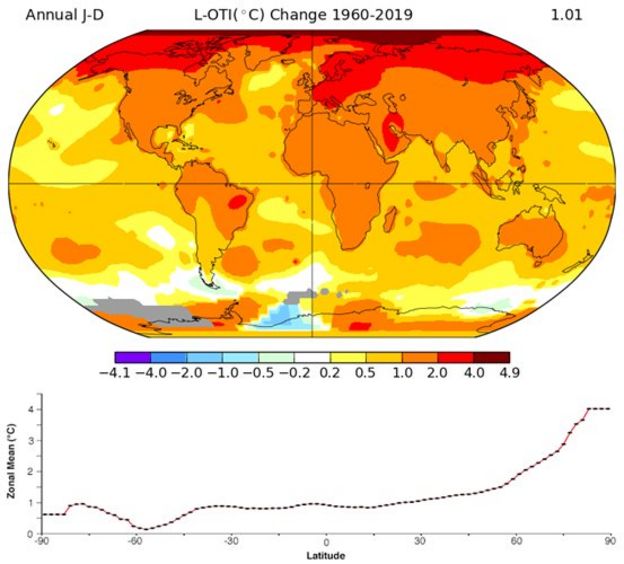
which is affecting Canada and Siberia (continents N. America and Asia).
Secondly, the NOAA tells us that along the USA’s eastern coast “…high-tide flooding is now 300% to 900% more frequent than it was 50 years ago”. Sea level rise is accelerating, so this will continue to get worse.
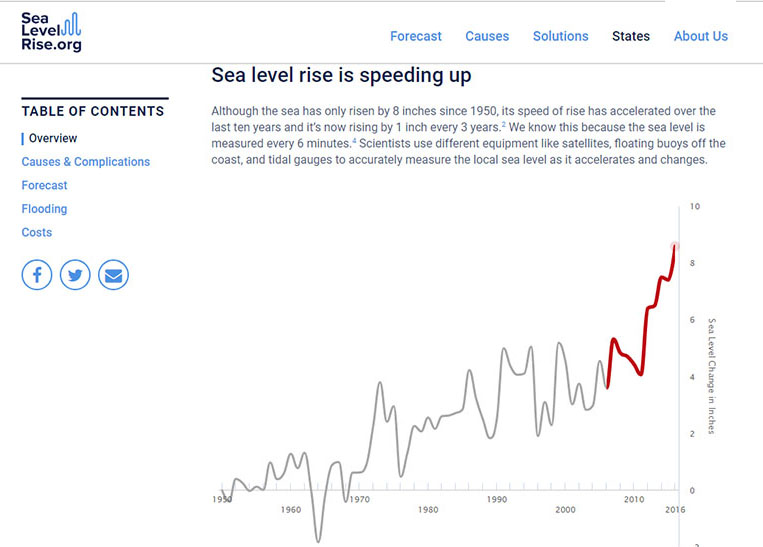
Finally, the process called thermohaline circulation gives us things like the Gulf Stream. Global warming has caused the Gulf Stream to lose 15% of it’s flow since 1950 because glaciers and ice caps are melting, releasing freshwater into the sea. This is more buoyant than salt-water, and is disrupting the flow.
If the Gulf Stream ‘switches off’, temperate western and northern Europe will lose the warming effects of this current, and will start experiencing Siberian winters. Fishing and farming in Europe will be badly hit.
The Gulf of Mexico will lose the cooling effects of the current’s return, and fishing and agriculture in southern USA and central America will be severely impacted.
Make no mistake… if we can’t stop climate change, these things will just be the start. Possible consequences include global tension over things like displaced populations, economic instability, food shortages, water rights, etc., so no continent will remain unaffected for very long.
Why does the sound of thunder get “stretched out” the further away you are from the strike?
Rodney Jones Been following science for 60 years
Answered June 22nd 2020
Funny you should ask… I grew up under the misapprehension that it was echoing around the area, reflected off hills, cliffs, buildings, trees, etc.
Then one day, I was in a very flat part of the world and noticed that thunder sounded the same there as anywhere else. Then there was a ‘Duhh…’ moment when the penny dropped.
Thunder is the sound of the rapid expansion of the heated air of a lightning strike… and a typical lightning strike, either cloud to cloud or cloud to ground, will have some horizontal dimension.
So the ‘stretched out’ is due to the speed of sound. You are hearing the nearest part of the lightning strike first and the furthest part last. Lighting strikes can be huge, and ones 50 miles long are not unheard of, but the average lightning strike is 6 miles long, so depending on where you’re standing, the sound from start to finish would be around 30 seconds.
Would a desert with only black sand be colder or hotter?
Rodney Jones Been following science for 60 years
Answered June 6th 2020
A little physics… when an item has colour, it will reflect electromagnetic radiation of that wavelength, and absorb the other wavelengths. A yellow wall in bright sunlight appears yellow because it’s reflecting light of that wavelength.
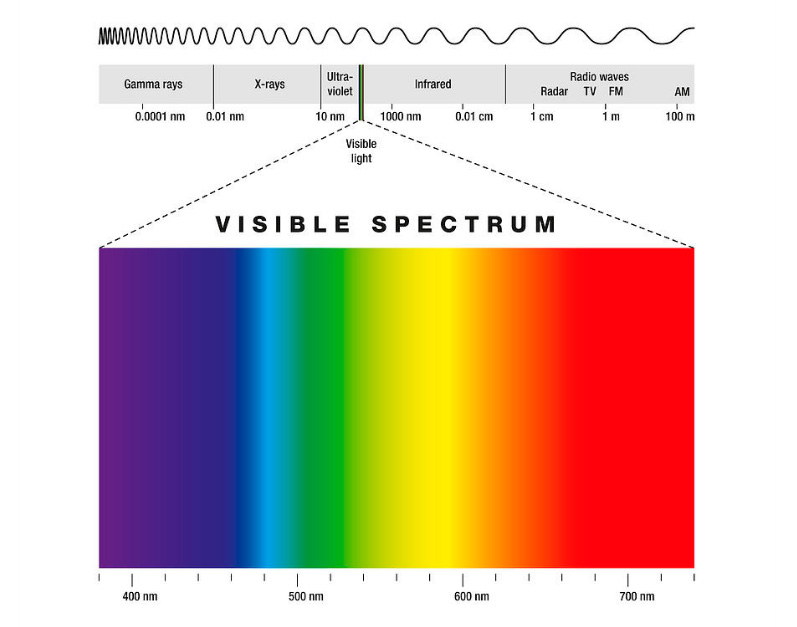
And in absorbing the other wavelengths, it turns this energy into thermal energy, and therefore the item gets a little warmer.
When something is black, it will theoretically convert ALL of the electromagnetic spectrum into heat. Of course nothing is perfectly black so some light will be reflected. Another property of black items is that they are very good radiators of heat.
In the case of a desert, this means that under sunlight, black sand will absorb more electromagnetic energy and therefore get warmer than regular sand, but in the absence of sunlight, it will radiate heat better, and cool down faster.
So returning to your question “Would a desert with only black sand be colder or hotter?”; it would at times get both hotter AND colder. Whether the average temperature would be warmer or colder would depend on the ratio of sunlight to darkness, and also things like air movement and air density.
Abandoning physics for a moment, my gut feel is that the average temperature would be hotter.
Why does the ocean absorb color in the red part of the spectrum of light, but the sea isn’t red?
https://oceanservice.noaa.gov/facts/oceanblue.html
Rodney Jones Been following science for 70 years
Answered June 3rd 2020
Hi and thanks for the A2A…
When you see something, and ascribe a colour to it, that’s because it’s reflecting that colour and absorbing all others. You shine a white light (eg. sunlight) on a yellow wall, it reflects yellow and absorbs the greens, blues, reds, violets, etc.
The sea is no different… small amounts of water are essentially transparent but significant amounts of it are blue/green, so it reflects blue/green light and absorbs everything else in the light spectrum.
So why doesn’t the sea show the colours it has absorbed? The answer is that light doesn’t accumulate like a stain. Instead the energy of the absorbed wavelengths are turned into heat, so yes broad spectrum light makes the sea slightly warmer.
1 view · Answer requested by Jerry Joo
If the Earth is a globe, then it is impossible to create a 2-D map with no distance distortions. So on the flat Earth model, the areas and the distances between cities are measurably distorted. Is this reasoning right?
Rodney Jones Likes cosmology but wishes he could remember more.
Answered May 31st 2020
Yes, you are right.
I almost feel sorry for the flat-Earthers, because clearly they’ve painted themselves into a corner. When rational people have a theory about something that starts looking a little shaky, they would normally accept that they were wrong and move on. The FE-ers however, having made more of an emotional investment in their theories, are forced into increasingly desperate attempts to support them.
Linear distance is just one of many problems they have. When you flatten the surface of a sphere centered on the North Pole (as in the FE maps), as you move away from the North Pole, the distortions increase. What is the northern hemisphere on an FE map (Europe, Asia, North America) the distortions aren’t too bad, but everything below the equator is distorted out of all recognition.
Australia for example, is around 2,000 miles from north to south, and 2,500 miles from west to east. On the FE map, it’s flattened to a ratio of around 5:1, so if the width of 2,500 miles is taken as accurate, the height can only be around 500 miles. So it’s very easy to disprove the FE rendition of Australia. Of course South America and most of Africa is similarly distorted.
It’s such a problem that there are some FE-ers who believe that Australia is a hoax. Check this out:
UNSW Flat Earth Society
October 13, 2017 ·
Australia is not real. It’s a hoax, made for us to believe that Britain moved over their criminals to someplace. In reality, all these criminals were loaded off the ships into the waters, drowning before they could see land ever again. It’s a cover-up for one of the greatest mass murders in history, made by one of the most prominent empires.
Australia does not exist. All things you call “proof” are actually well fabricated lies and documents made by the leading governments of the world. Your Australian friends? They’re all actors and computer generated personas, part of the plot to trick the world.
If you think you’ve ever been to Australia, you’re terribly wrong. The plane pilots are all in on this, and have in all actuality only flown you to islands close nearby – or in some cases, parts of South America, where they have cleared space and hired actors to act out as real Australians.
Australia is one of the biggest hoaxes ever created, and you have all been tricked. Join the movement today, and make it known that they have been deceived. Make it known, that this has all just been a cover-up. The things these “Australian” says to be doing, all these swear words and actions based on alcoholism, MDMA and bad decisions, are all ways to distract you from the ugly truth that is one of the greatest genocides in history. 162,000 people was said to have been transported to this imaginary land during a mere 80 years, and they are all long dead by now. They never reached that promised land.
Tell the truth. Stand up for what is right. Make sure to spread the world – Australia is not real. It’s a codeword for the cold blooded murder of more than a hundred thousand people, and it is not okay. We will not, accept this.
Stand up for the ones who died. Let it be known, that Australia does not exist.
#AustraliaisNOTreal
What coastal cities would still exist in a scenario where all the ice completely melts?
Rodney Jones Knows enough about climate to trust the experts
Answered May 30th 2020
The NOAA tell us that if we don’t do what we can to mitigate the effects of climate change, the loss of glaciers and ice sheets could allow the sea level to rise by up to 2.5 meters by the end of the century. If/when all the 35 million cubic kilometers (!) of ice melts, sea level will rise by 70 meters (230 feet).
Any city that we currently think of as a coastal city will be inundated. BUT… this will happen over several centuries, and I imagine that some cities with high ground nearby could begin developing this area, so as low-lying parts are lost to rising sea levels, the city could gradually move into the hills.
Off the top of my head, some coastal cities that have this potential are Bergen, Rio de Janeiro, Athens, Lisbon, Barcelona, San Francisco, Los Angeles and Marseilles.
Sadly, London, New York, Miami, Houston, etc. will just be distant memories.
How can you explain the Bermuda Triangle in words?
Rodney Jones
Answered May 29th2020
Pretty simple really… it’s a hoax that’s made a lot of money for many authors and conspiracists.
What they call the Bermuda Triangle is an area of nearly half a million square miles between Florida, Bermuda and Puerto Rico. The idea of it having some strange properties that cause ships, planes and boats to get disorientated and disappear has been comprehensively debunked. The accidents and disappearances in this area are quite consistent with the large amount of air and sea traffic, changeable weather and sea conditions, and the high proportion of unqualified people making what can be deceptively difficult crossings.
The Florida coastguards have many stories about Mayday calls from people heading for Bermuda or the Bahamas without adequate preparation, supplies, or even the basic navigational skills. It’s not unknown for yachts to attempt long distance sea crossings using just a world atlas!
How much time will it take to die all population of earth if earth’s magnetic field disappeared at once?
Rodney Jones Been following climate & weather for 50 years.
Answered May 26th 2020
Tricky one… there have been many reversals, just as the magnetic field seems to be doing right now, but the Earth has always had a magnetic field.
But hypothetically, how much time would we have if Earth’s magnetic field suddenly disappeared? Minutes? Hours, perhaps days? The problem isn’t so much the hard radiation that we’d experience, though that would surely get us eventually.
The bigger problem is that we rely on the magnetic field to divert the Solar Wind over the poles. Without it, the Solar Wind could just strip away our atmosphere. Without an atmosphere we’d experience a moment of utter silence. Then in the absence of air, all birds and planes would fall to earth. All surface dwelling creatures would start asphyxiating through lack of oxygen. And it’s debatable whether that would kill us first, or the blood boiling in our veins through a process called ebullism. Either way, without an atmosphere, complex surface dwelling life would be dead within minutes.
Plants and fungi need to breath as well, so they’d start to wither pretty quickly.
Marine creatures might live a little longer; the waters would begin to boil; not with heat of course, but due to the loss of air pressure. The ponds, lakes and rivers wouldn’t last long, but the oceans boiling might release enough water vapour into the atmosphere, that a point of equilibrium would be reached and the boiling would stop. But then what water is left in the oceans would freeze.
So marine animals might last weeks or months.
It’s not all doom and gloom though… some bacterias and extremophiles could survive the loss of an atmosphere, hard radiation and the vacuum of outer space, and who knows, could provide a basis for the next Genesis!
Can we all agree that the Earth is not spinning at 1,000 mph, not at the equator ?
Rodney Jones, Likes cosmology but wishes he could remember more.
Answered May 20th 2020
Yes of course we can. We can also agree that vaccines are dangerous, climate change is a hoax, Intelligent Design is a science, and that the 5G network is designed to spread Coronavirus. But agreeing doesn’t make it so.
And by the way, spin is also known as angular displacement (or angular momentum) whereas mph is a measure of linear displacement. The circumference of the Earth is roughly 24,000 miles and one rotation per day does equate to a linear displacement of around 1,000 mph at the equator; but if you’re standing on one of the poles, this comes down to 0 mph.
A better way to measure spin is in rpm, and our daily rotation equates to 0.0007 rpm, so is it any surprise that we don’t feel any rotational forces?
But we don’t just have rotational speed… our orbital speed around the Sun is 67,000 mph, and our position in the slightly unfashionable Orion-Cygnus arm of the Milky Way means that we’re careering around the galaxy at 483,000 mph.
But as mind-boggling as these numbers are, they stem from a fairly deep understanding of the universe. So people are faced with choices:
1) They can decide that reality is all too complicated, and sink into a world of ignorance, magic, superstition and belief systems.
2) Or they can make the harder choice of accepting scientific orthodoxy and rational thought, and occasionally grappling with some of the many counter-intuitive elements involved in trying to understand the natural world.
Did anyone go to the Bermuda Triangle to explore?
Rodney Jones, British by birth, but also lived in America, France, Holland and Spain
Answered April 30th 2020
The ‘Bermuda Triangle’ is half a million square miles of some of the busiest ocean in the world. It’s very popular with private owners of boats and light aircraft hopping between the main cities of Florida and the Caribbean islands, so the answer to your question is yes, people do go there.
The coastguards who patrol these waters report that the accidents and disappearances in this area are quite consistent with the large amount of air and sea traffic, together with changeable weather and sea conditions.
They have many stories about Mayday calls from people heading for the islands without adequate preparation, supplies, or even the basic navigational skills.
Why did Gove keep telling us there would be no barriers to EU trade if we voted Brexit?
Rodney Jones, British by birth, but also lived in America, France, Holland and Spain
Answered April 29th 2020
Why did Gove keep telling us there would be no barriers to EU trade if we voted Brexit?
Michael Gove is pro-Brexit and he was lying. He also said: “The day after we vote to leave, we hold all the cards and we can choose the path we want.”
And it wasn’t just Gove…
John Redwood said something similar “Getting out of the EU can be quick and easy – the UK holds most of the cards.”
And the lies didn’t end there, Boris Johnson said: “Once we have settled our accounts, we will take back control of roughly £350m per week” and… “There will continue to be free trade, and access to the single market.”
Liam Fox said “The free trade agreement that we will have to do with the European Union should be one of the easiest in human history.”
Douglas Carswell said “I think we could very easily get a better trade deal than we have at the moment”.
David Davis said “There will be no downside to Brexit, only a considerable upside.” and… “I believe that we can get a free trade and customs agreement concluded before March 2019.”
At this point, the British public should have been thinking “If the far-right has to lie to promote the idea of Brexit, then maybe leaving is not such a good idea.”
Sadly they didn’t. So how gullible does that make the British electorate?
How do you win an argument with someone who thinks universal health care is theft?
Rodney Jones, British by birth, but also lived in America, France, Holland and Spain
Answered April 25th 2020
It seems to most Europeans that politics in Trump’s America is becoming very polarised.
For a large number of Republican supporters, rational thought has gone out the window. They have made an emotional investment in everything that their party stands for, and no amount of rational argument will change their minds.
In Europe we read about the Republicans in Congress refusing to wear masks. We see people protesting in the streets, that social distancing equates to communism. We know Americans are told that Europe has Sharia Courts, and most European cities have ‘no go’ zones. We constantly see on Quora, questions along the lines of “How do Europeans defend themselves if they can’t own guns?”.
If these same people have made their minds up about universal health care, I suspect hell will freeze over before they become open to reasoned discussion.
What screams “I have a low IQ”?
Rodney Jones
Answered April 24th 2020
When I happen mention in a comment on Quora that half the population is of below average intelligence, and someone replies angrily “Half the population is below average intelligence? Of course they’re not… that’s a stupid thing to say”.
Case rested I think.
When will the Netherlands disappear because of climate change?
Rodney Jones, lived in The Netherlands
Answered April 23rd 2020
The simple answer is probably never. It’s a popular misconception that all of the Netherlands was reclaimed from the sea. In reality it’s around half, and this is the area most at risk.
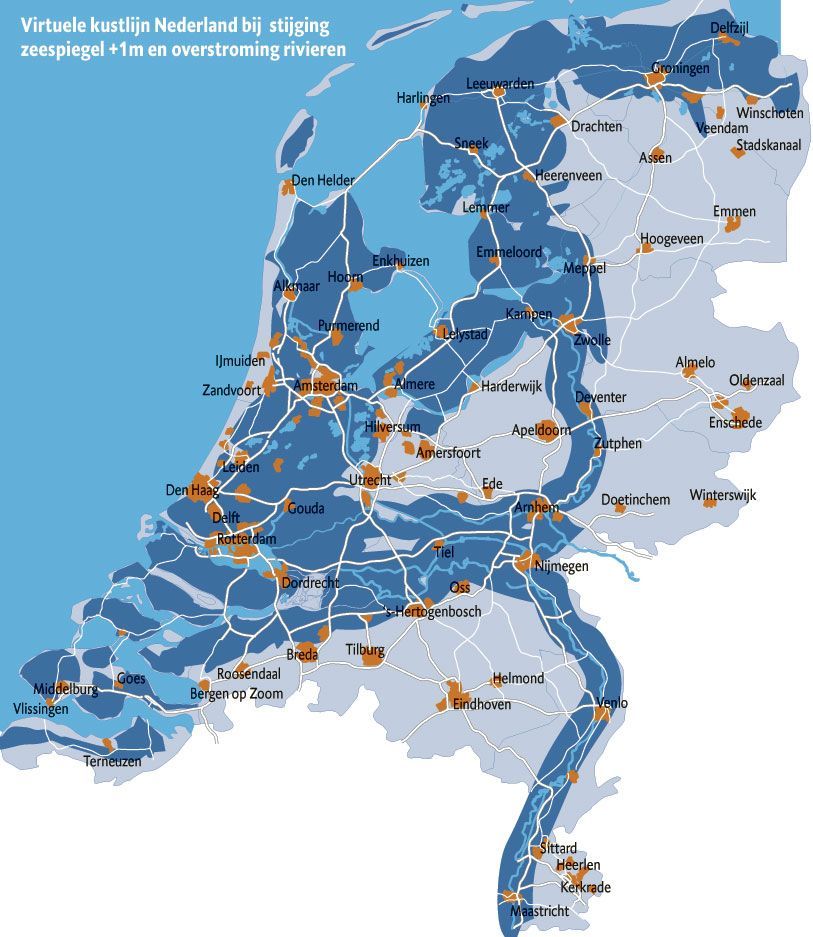
However, there is 35 million cubic kilometers of freshwater currently locked up as ice. If climate change cannot be arrested and all of this ice melts, sea levels will rise by up to 70 meters. That will be a challenge for not just the Netherlands. Other European countries such as the UK, Belgium, Denmark, France, Germany and Italy will all lose large ares of land. In the USA, states on the eastern seaboard will be badly hit and some like Florida, Louisiana, Delaware, New Jersey and Connecticut could virtually disappear.
Why is Greenwich the centre of time?
Rodney Jones, Been following science for 70 years
Answered April 19th 2020
Thanks for the A2A…
The simple answer is convention, dictated by the fact that the prime meridian passes through Greenwich, near London.
But why Greenwich? In 1884, the International Meridian Conference – Wikipedia was held to standardise marine charts, and also to unify times for railway timetables. Before this conference, there were several contenders for the position of prime meridian, including Washington, Paris and Greenwich. Paris was the standard for all French charts.
But by the time of the conference, Greenwich was the main contender as most nautical charts around at the time were produced by the British, and of course, referenced the Greenwich meridian. The reason Greenwich was proposed and not London, is that it was the home of the Royal Observatory and the Royal Naval College.
The vote for Greenwich was almost unanimous, with only San Domingo voting against. France of course abstained, and to this day, France avoids referring to the prime meridian as the Greenwich meridian, and some French map-makers still use the Paris meridian.
Why would ocean level rise because of global warming? Doesn’t ice have less density than water? And the majority of an iceberg is under water so if they melt shouldn’t ocean level lower?
Rodney Jones, Been following science for 70 years!
Answered April 17th 2020
In the case of icebergs, you are essentially correct that icebergs melting doesn’t cause ocean levels to rise. Their density is lower than that of liquid water which is why they float, but when they melt, the volume is equal to the amount of water they displace, so the sea levels don’t fall either. Remember Archimedes?
The problem is that for the most part icebergs result from ‘calving’ of glaciers. And these were on land. Right now there is a staggering 8 million cubic miles (or 35 million cubic kilometers) of freshwater still locked up in glaciers and ice sheets. If climate change cannot be arrested, they will eventually become liquid water, and the sea levels will rise by 230 feet (70 meters). Probably not this century, possibly not even the next century, but eventually the US East Coast would look like this.
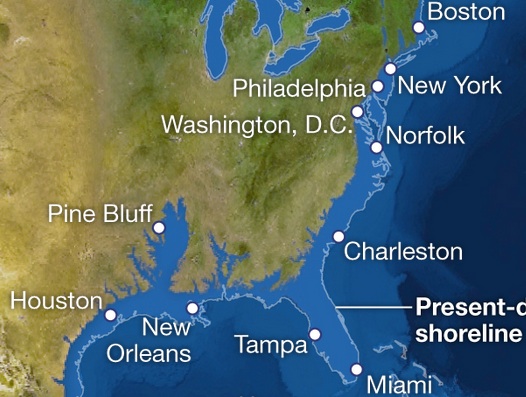
How is sea level accurately measured, what with waves and tides?
Rodney Jones, Been following science for 70 years!
Answered April 9th 2020
They use satellite data along with a system of floating buoys and tidal gauges, and sophisticated computer algorithms to smooth the instantaneous variations.
It’s a complex process because counter-intuitively, the oceans are really quite ‘lumpy’. Checkout this map of average sea levels.
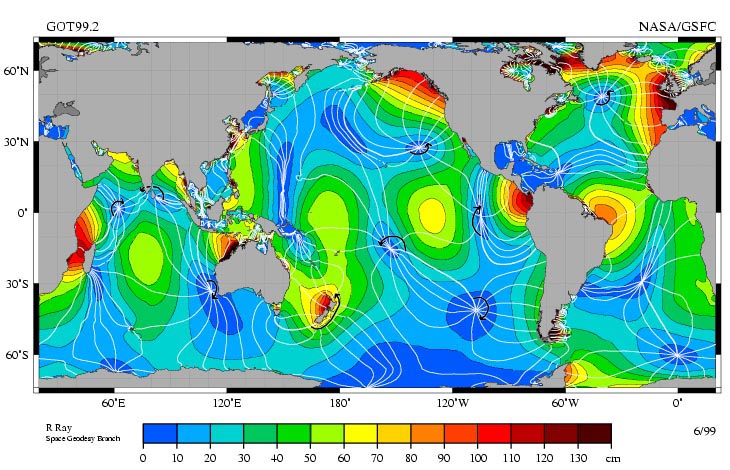
As well as tides, sea levels are affected by local variations of temperature, salinity, wind, air pressure, topography, Coriolis forces, centrifugal forces, thermohaline circulation, and even variations in local gravity.
When an agency such as the NOAA tells us that sea levels are rising, you can be sure that they have factored all this into their calculations.
Why is Britain at the center of world maps?
Rodney Jones, Been following science for 70 years!
Answered April 9th 2020
Thanks for the A2A…
The simple answer is convention, dictated by the fact that the prime meridian passes through Greenwich, near London.
A more complicated answer is that there are many maps which have different centres. And actually, if you look at a standard Mercator projection…
… putting the zero meridian in the centre means that part of Siberia is clipped and moved to the left of the map. To avoid this, some maps do this…
…but now Germany is in the centre. Which might be considered appropriate because Mercator was German!
But why Greenwich? In 1884, the International Meridian Conference – Wikipedia was held to standardise marine charts, and also to unify times for railway timetables. Before this conference, there were several contenders for the position of prime meridian, including Washington, Paris and Greenwich. Paris was the standard for all French charts. Here it is running through the Paris Observatory.

But by the time of the conference, Greenwich was the main contender as most seafaring charts around at the time were produced by the British, and of course, referenced the Greenwich meridian. The reason Greenwich was proposed and not London, is that it was (and still is) the location of the Royal Observatory and the Royal Naval College.
The vote for Greenwich was almost unanimous, with only San Domingo voting against. France of course abstained, and to this day, France avoids referring to the prime meridian as the Greenwich meridian, and some French map-makers still use the Paris meridian.
As a point of interest, GPS satellites use a set of astronomically determined co-ordinates, which because of uneven distribution of Earth’s mass, means that the zero meridian on a ‘geocentric reference ellipsoid’ is actually 102.478 metres to the east of the Greenwich meridian.
What would the UK’s climate be without the Gulf Stream?
Rodney Jones, Knows enough about climate to trust the experts
Answered March 28th 2020
Thanks for the A2A…
The UK is on a similar latitude to parts of Canada and Russia, and is actually more northerly than the American mid-west which is well known for it’s extreme winters. Without the Gulf Stream the UK (as well as Holland, France and Scandinavia) would experience crippling Siberian style winters.
Sadly, this is a real possibility because the Gulf Stream has lost 15% of it’s flow since 1950. Global warming is causing the glaciers and ice pack around Greenland to melt, releasing freshwater into the sea. This is more buoyant than salt-water, and is disrupting the flow. Most climate models predict this could cause the Gulf Stream to ‘switch-off’, and it could be that we’re already seeing the start of this process.
I should add that the Gulf Stream is bringing cooler waters back to the Gulf of Mexico, the Caribbean, and the US south-east, and helps moderate temperatures. The loss of the Gulf Stream would affect agriculture and fishing, and damage economies there as well as in Europe.
There would be no winners.
If the cruise industry was allowed to die, how much of an impact would that make for global warming?
Rodney Jones, Knows enough about climate to trust the experts
Answered March 22nd 2020
Well cruise ships are major polluters, so Coronavirus notwithstanding, if they don’t cleanup their act, then their demise would at least help slowdown global warming.
I don’t want to be a killjoy and I know a lot of people get a lot of pleasure from their cruising holidays, but checkout Luxury cruise giant emits 10 times more air pollution (SOx) than all of Europe’s cars – study. The world is still too dependent on fossil fuels, so it’s a case of striking a balance between acceptable and unacceptable sources of pollution.
How can I calculate the distance between the North Pole and a given longitude and latitude?
Rodney JonesAdd Credential
Answered March 20th 2020
It’s got be approximate because the Earth is not a perfect sphere. And you can ignore longitude since all points at the same latitude are the same distance from the North Pole.
We know that the circumference of the Earth is roughly 40,000 km, so the maximum distance from the NP is 20,000 km. And latitude goes from 0 – 90 degrees North, and 0 – 90 South. So given that 90 degrees is around 10,000 km, it’s a fairly simple calculation:
- If it’s a northerly latitude the formula is: (90 – latitude in degrees)/90 x 10,000.
- If it’s a southerly latitude, it’s: (90 + latitude in degrees)/90 x 10,000.
So New York is 40.8 degrees north, so (90 – 40.8)/90 x 10,000 tells us that New York is 5,467 km from the North Pole (roughly!)
Similarly, Sydney is 33.9 degrees south, so (90 + 33.9)/90 x 10,000 tells us that Sydney is 13,767 km from the North Pole.
Why should I believe something just because a scientist says it is true?
Rodney JonesAdd Credential
Answered March 13th 2020
Absolutely not. Nor should you accept the opinions of any other ‘expert’ purely on face value.
But before you become a hopeless cynic and reject their views out of hand, do bear in mind that scientists are the world’s biggest sceptics, and spend a large part of their lives questioning their own assumptions, challenging the theories and hypotheses of other scientists, and also opening up their own research to scrutiny.
So by all means challenge their opinions, but proceed carefully… if you want to challenge a ‘scientific theory’, you’ll probably be asked to come up with a better one. The scientific theory is the highest form of scientific knowledge, but if you’re successful in your challenge, you could find yourself with a Nobel Prize!
Why do conservatives distrust scientists?
Rodney Jones, British by birth, but also lived in America, France, Holland and Spain
Answered March 8th 2020
Richard Hofstadter wrote Anti-Intellectualism in American Life in 1964, which won him the Pulitzer Prize. It showed how anti-intellectualism is entwined within American culture, and suggested that it stems from religious evangelism and strong egalitarianism… ie. the American dream.
But is it reasonable to say that conservatives distrust scientists? Yes, I believe it is.
Anti-intellectualism seems to run along party political lines, and manifest itself in the way Republican voters choose ‘folksy’ people like Reagan, George W Bush, and now Trump; as opposed to Democrat voters choosing thinking people like Carter, Clinton, and Obama.
Furthermore, the Republicans have actually declared themselves to be firmly against higher education and critical thinking, as it’s ‘considered to undermine family unity’. This goes some way to explain why America is currently sliding down the intellectual rankings… 49th in the world in terms of adult literacy, and 41st in the PISA world rankings for Mathematics.
Now Trump want to reduce the education budget, so it looks like this trend isn’t going to improve any time soon!
Why does there seem to be so many climate change sceptics?
Rodney Jones, Knows enough about climate to trust the experts
Answered February 2nd 2020
Thanks for the A2A…
Firstly, this is the Dunning-Kuger effect:
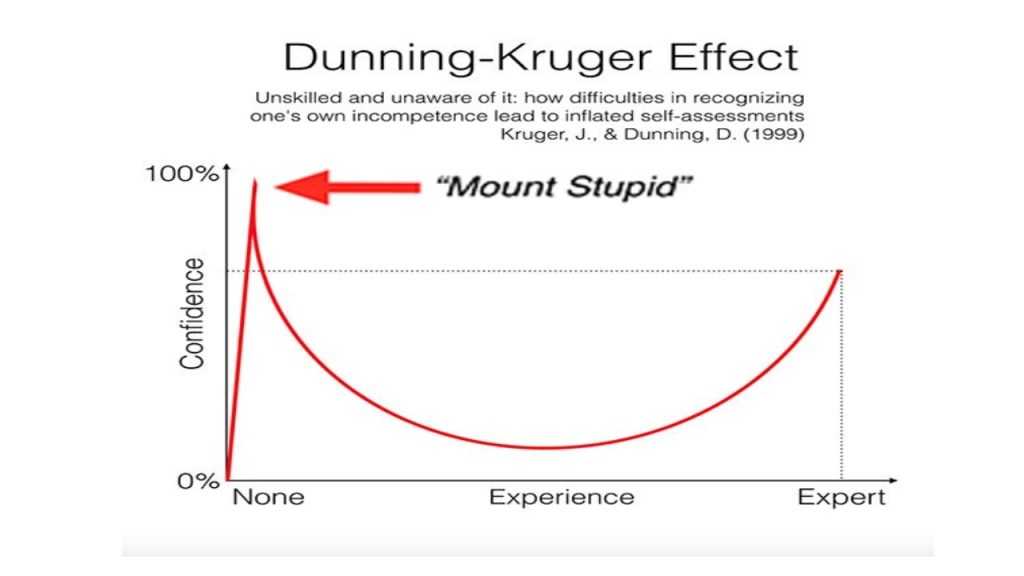
It illustrates a well know effect where the less people know about the subject, the more opinionated and vociferous they get.
The first type of climate change deniers fall into this category. They’ve heard a little about the comings and goings of ice-ages, and suddenly they’re an expert on the subject. You hear them in pubs and bars pronouncing on climate science, stating what is mostly fairly obvious, and clearly believing that real climate scientists have overlooked these things.
The second category are those who’ve been taken in by the lies and disinformation from the fossil fuel giants.
See this Scientific American article “Dark Money” Funds Climate Change Denial Effort
There are several of them on Quora. You can easily recognise their contributions as they try to overwhelm you by the sheer volume of ‘facts’, charts, links and references, and clearly hope that you don’t examine their science too closely. They are masters of the specious argument, out-of date, or just plain inaccurate statistics, out of context quotes, and references to discredited web sites.
Ultimately, I’m not sure how many climate change sceptics there are, but because they are going against conventional wisdom, they seem to be on a bit of a crusade and are disproportionately vocal and opinionated.
Anyone who’s willing to listen to them, should also checkout real climate science, before they make their minds up.
1 view · Answer requested by Andrew Goddard
Why do the Tories claim that 0-hour contracts are useful when in reality it is just exploitation of poor and vulnerable people?
Rodney Jones
Answered January 23rd 2020
I think this is the crux of why the Tories are still an electable party… they introduce legislation that erodes worker’s rights, consumer protections, environmental controls, etc. And then through a compliant press (the right-wing media sells 5 times more newspapers than the rest put together), they manage to persuade the voting public that the real problems are EU meddling, rampant immigration, etc.
As has been adequately demonstrated, the British public prefer to believe convenient lies rather than the inconvenient truth.
What argument convinced ex-flat Earthers that the Earth is indeed a globe and not flat?
Rodney Jones, Likes cosmology but wishes he could remember more.
Answered January 23rd 2020
Well it’s not much use pointing out to a believer that FE ‘science’ is flawed, as for most followers, Flat Earth an act of faith, and they don’t understand the science, for or against flat Earth.
But here’s the two arguments that I’ve used in discussions which for one reason or another, ended the discussion.
The first argument is that the night sky rotates around the north celestial pole (near Polaris) in an anti-clockwise direction. Yet in the southern hemisphere, the night sky rotates around the south celestial pole in a clockwise direction. This is not possible on a flat Earth.
The second one is to ask the other person if they’ve ever been to the coast and seen a sharp horizon. This would be impossible on a flat Earth… the disappearing-point would only be limited by the transparency of the atmosphere, so distant objects would just be increasingly diffuse.
Can we reach another galaxy in 100 years?
Rodney Jones · Add Credential
Answered January 2nd 2020
The question is ambiguous… do you mean 100 years travelling time, or do you mean will we have intergalactic travel in 100 years?
Since our nearest (major) galaxy is Andromeda which is 2.5 million light years away, I’m going to go with NO, and PROBABLY NOT.
Off topic, but fun way to get across the idea of how empty space is, is to ask people “If the Solar system was reduced to the size of a DVD… on this scale, how far is the Andromeda Galaxy?” I’ve heard answers like, “Oh, ermm 100 meters?”, “Five miles?”.
The answer is just under a billion miles.
If Betelgeuse explodes, will the global temperature be affected?
Rodney Jones, Likes cosmology but wishes he could remember more.
Answered January 2nd 2020
Hi and thanks for the A2A…
Betelgeuse is calculated to be around 640 light years away. The sort of supernova it’s capable of producing is considered to be dangerous within a 50 light year radius, so there would be little risk to life on Earth, and no reason to expect global temperatures to be affected.
It’s been in the news recently as it has dimmed noticeably in recent months, which could mean the onset of instability, which could in turn trigger a supernova. But it’s done this before! We’ve got a theoretical understanding of supernovae, but almost zero first-hand knowledge, so no-one really knows. It could go tonight, or it could last another 100,000 years!
Should the next country that lands on the Moon detonate something that is visible from Earth to prove the Earth is round?
Rodney Jones, Likes cosmology but wishes he could remember more.
Answered December 29th 2019
What a truly awful idea… Let’s spend zillions of dollars on nukes, and rockets powerful enough to send them to the Moon, let’s risk the possibility that the rocket fails soon after launch, and radioactive debris is scattered all over the Atlantic, then let’s contaminate the pristine Lunar environment with radioactivity?
And for what? To accommodate a handful of idiots with learning difficulties?
“Wow, did you see that flash on the Moon? I guess it proves that the Earth is round!”
“Why? We believe that the Moon is only 3,000 miles away, so how does it prove that the Earth is round? Are you trying to give us flat-Earthers a bad name?”
“Yeah, sorry… I wasn’t thinking. Anyway, it’s probably just a NASA plot”.
What were the biggest lies made during the Brexit campaign?
Rodney Jones
Answered December 22nd 2019
OK here’s a few goodies from the politicians…
- ‘Absolutely nobody is talking about threatening our place in the single market’ – Conservative MEP Daniel Hannan
- ‘Once we have settled our accounts, we will take back control of roughly £350m per week’ – Boris Johnson
- “There will be no downside to Brexit, only a considerable upside.” – David Davis
- “The day after we vote to leave, we hold all the cards and we can choose the path we want.” Michael Gove
- “Getting out of the EU can be quick and easy – the UK holds most of the cards.” John Redwood
- “I think we could very easily get a better trade deal than we have at the moment” – Douglas Carswell
- “There will continue to be free trade, and access to the single market.” – Boris Johnson
- “The free trade agreement that we will have to do with the European Union should be one of the easiest in human history.” – Liam Fox
- “I believe that we can get a free trade and customs agreement concluded before March 2019.” – David Davis.
- “Trade relations with the EU can be sorted out in an afternoon over a cup of coffee” – UKIP’s Brexit spokesman Gerard Batten
And the British right-wing newspapers have waged an anti-EU campaign of lies and distortion for years. For example a few year ago, The Sun said “Brussels: UK’s 600,000 benefit tourists is no problem”Then The Sun admitted 10 days later that “there’s no evidence of benefit tourists” and “Neither has the European Commission said this would be no problem”. The article was a total fabrication, but the retraction was tiny, and by that time the damage had been done.
Anyone remember these headlines?
- Hands off our light ale (Daily Express 12 May 2005)
- Now the EU is to ban the acre (Daily Express, 21 July 2008, p10 and p12)
- Pipe down! Brussels slaps a noise order on bagpipes (The Sunday Times, 20 April 2008, page 7)
- Bombay Mix to be renamed (The Sun, 18 July 2006, p27)
- Now Euro killjoys ban children’s party toys (Daily Express, 10th October 2011)
- Your 21-gun salutes are just too loud, EU tells the Royal Artillery (Mail on Sunday 5 March 2006)
- Church bells are silenced by fear of EU law (The Daily Telegraph, 17 October 2002, page 7)
- EU could force cut in drink limit (Daily Mail, 19 January 2001, page 10)
- New EU map makes Kent part of same ‘nation’ as France (Sunday Telegraph, 3 September 2006, p.9)
I’m constantly amazed that anyone thinks that the Brexit campaign was fair
How come universal healthcare “doesn’t count” as socialism?
Rodney Jones
Answered December 4th 2019
I’m not sure why ‘universal healthcare’ should be politicised. Just about every OECD country outside the USA has it, regardless of whether the government is right-wing or left-wing, It’s just part of looking after your poor, your sick, your injured, your unemployed, and just plain ‘down on their luck’. Isn’t this what civilised societies are supposed to do?
But then the other OECD countries don’t have the USA’s hugely powerful healthcare and pharmaceutical lobby to contend with.
Anyway, the word ‘socialism’ comes with too much baggage, and probably means different things to different people. Especially in the USA where the Republicans would like to persuade the voting public that it’s synonymous with communism.
We have both climate change fear mongers as well as denialists. The truth lies somewhere in the middle. What is it?
Rodney Jones, Knows enough about climate to trust the experts
Answered December 4th 2019
There are indeed two sides to this argument.
On one side you have people who understand the science, and use the weight of the scientific method to pursue the truth. And I’m not just talking about climate scientists; I’m including the related disciplines of meteorology, solar physics, atmospheric physics, chemistry, oceanography, paleo-climatology, dendroclimatology, glaciology, geology, etc., who contribute to this field of study.
On the other side you have the fossil fuel lobby trying to protect it’s profits, and you have a scientifically naive collection of people who’ve heard a little about the coming and goings of ice ages, and have convinced themselves that the climate scientists haven’t thought of this.
‘Denialists’ feel that Anthropogenic Global Warming is some kind of conspiracy involving the ten of thousands of people who work in this field, as well as all world governments (including the US until Trump came along). They don’t say how this could possibly be orchestrated, yet they prefer to believe this, than the documented proof that the fossil fuel giants are actually funding the denialists.
Checkout this Scientific American article “Dark Money” Funds Climate Change Denial Effort
I’m sorry, the two sides are simply science versus non-science, so the truth does not lie in the middle. The sooner people realise this, the more likely we are to prevent the worst consequences of climate change.
Which is more important to fight, climate change or Earth’s magnetic pole reversal?
Rodney Jones, Knows enough about climate to trust the experts
Answered December 1st 2019
Hi and thanks for the A2A…
This is like comparing chalk and cheese. Climate change is caused by human activity and treating the atmosphere as a rubbish dump, just as we have with the seas and the land. If we change our activities, we can avert the worst of the effects of climate change.
Magnetic pole reversal? We’re not causing it, and there’s not a thing we can do about it so we’re not even trying.
It does seem that currently, the location of the magnetic poles are moving, and disturbingly, the movement is speeding up, so some scientists think this may be a prelude to the magnetic poles ‘flipping’.
The Earth’s magnetic field is essential for life on Earth for two reasons: firstly, it diverts the worst of the cosmic radiation over the poles, and away from the surface of the Earth. And secondly, it diverts the Solar Wind over the poles, and protects our atmosphere from being ‘stripped away’, which is what some scientists believe happened on Mars.
But the poles have flipped many times in the past, and we still have our atmosphere and biosphere, so there’s no evidence that flipping represents a serious danger to life on Earth.
Wouldn’t it be more beneficial to put all of our resources into developing technology to remove the gases that are causing climate change?
Rodney Jones, Knows enough about climate to trust the experts
Answered November 27th 2019
Good question, and scientists are pursuing this. Checkout:-
Carbon dioxide capture and use could become big businessCapturing carbon dioxide and turning it into commercial products, such as fuels or construction materials, could become a new global industry, according to a new study.
Engineers develop a new way to remove carbon dioxide from airA new way of removing carbon dioxide from a stream of air could provide a significant tool in the battle against climate change. The new system can work on the gas at virtually any concentration level, even down to the roughly 400 parts per million currently found in the atmosphere.
Artificial photosynthesis transforms carbon dioxide into liquefiable fuelsChemists have successfully produced fuels using water, carbon dioxide and visible light through artificial photosynthesis. By converting carbon dioxide into more complex molecules like propane, green energy technology is now one step closer to using excess carbon dioxide to store solar energy — in the form of chemical bonds — for use when the sun is not shining and in times of peak demand.
In addition, scientists are looking ways of converting methane into CO2. I know this sounds counter-intuitive, but methane is up to 84 times for potent as a greenhouse gas than CO2. And in terms of climate economics, there is a financial incentive. If the market price of carbon offsets for CO2 reach $500 per ton (as is predicted), removing a ton of methane will be worth $12,000.
Many reports on global warming talk about “best case scenario”. What’s a likely middle-of-the-road scenario? What’s a terrible scenario?
Rodney Jones, Knows enough about climate to trust the experts
Answered November 26th 2019
Any global warming scenario isn’t going to be comfortable. The actual implications depend not just on the severity, but on the country’s economic vulnerability.
Best case scenario is that we manage to arrest the warming trend before it gets too bad. If you’re one of the 37 OECD countries, you’ll probably survive this mild warming. If however, you’re (say) a central American country totally dependent on one crop, and the crop can’t withstand climate change, then even mild warming could be bad.
Middle of the road warming? Possible consequences include wars and global tension over things like displaced populations, economic instability, food shortages, water rights, etc.
The ‘Terrible scenario’ is called thermal runaway. Warming causes methane currently locked in methane hydrates found in permafrost and on the ocean floors to be released. Despite the notoriety of CO2, methane is up to 84 times more potent as a greenhouse gas. So the release of new methane causes more warming, causing more methane to be released, etc.
A possible scenario is that the Earth becomes another Venus… nothing would survive.
I’ll say again… any degree of global warming is extremely unlikely to be good thing. Why anyone would advocate inaction, when the stakes are this high, is completely, utterly, beyond me.
Atheists who have read the Bible, what are your thoughts about it?
Well this atheist would love to know how so many people can consider the Bible to be the literal word of God, when it contains so many contradictions. It also contains many entries of questionable relevance, such as:
Leviticus 25:44 states that you may possess slaves, both male and female, provided they are purchased from neighbouring nations
Exodus 21:7 says you can sell your daughter into slavery
Leviticus 11:10 states that eating shellfish is an abomination
Leviticus 19:19 states that you should not plant different crops in the same field
Leviticus 19:27 expressly forbids men shaving their temples.
It’s a collection of truths, myths and folk tales, cherry-picked at various times by men intent on creating a cohesive religious narrative. Unfortunately, it hasn’t been updated for nearly 2,000 years and it shows.
As Mark Twain noted, “The Bible… is full of interest. It has noble poetry in it; and some clever fables; and some blood-drenched history; and some good morals; and a wealth of obscenity; and upwards of a thousand lies.”
Why did my professor say the Moon does not rotate around the Earth, but instead the center of mass of the Earth-Moon system?
Rodney Jones, Likes cosmology but wishes he could remember more.
Your professor was spot-on… and in a sense, both the Moon and the Earth rotate around the centre of mass (called the barycentre), and it explains why we have two tides per day.
The lump on the moon side of the Earth is due to the moon’s attraction, and is obviously the first tide.
And if we think of the Earth-Moon as a single system, it’s barycentre is slightly different to the Earth’s own centre of mass… OK, not by much, but it’s enough to cause the water on the far side to be flung outwards slightly… the second tide.
Is the Earth gradually slowing down?
Rodney Jones, Likes cosmology but wishes he could remember more.
The question is ambiguous… if you mean the Earth’s rotation on it’s axis, the answer is yes it is slowing down due to tidal ‘friction’ with the Earth’s moon. In the last 600 million years, it has slowed from a 21 hour period to the current 24 hours. The loss can now be measured by atomic clocks, and it has slowed by 1.7 milliseconds in the last century.
OTOH, if you mean the time to complete one orbit of the sun (currently 365.25 days)… this is not expected to change significantly in the foreseeable future.
What the best way to do hdr?
Rodney Jones, 50 years of SLR ownership… slides and digital
Answered just now
The best way to do HDR (well the only way really), is to take at least three shots of the subject. One at the correct exposure, and one slightly over-exposed (say +1 or +2 EV), and one slightly under-exposed (-1 or -2 EV).
When these images are combined in a suitable HDR app (or Photoshop, etc.), the resulting image shows detail in the highlights and shadows that go beyond the normal dynamic range… hence High Dynamic Range.
Don’t confuse this technique with software that uses Tonemapping to give the illusion of HDR. I have no problem with this type of software (I use Photomatix myself), but this is not real HDR (despite popular misconceptions).
What happened to common sense? In America, they have voted for a dangerous buffoon as president. In the UK, we are leaving the EU and turning ourselves into a 3rd world nation.
Rodney Jones, British by birth, but also lived in America, France, Holland and Spain
Answered just now
It seems to me that the less scrupulous interests in society today (and I don’t just mean politics… it extends to religion, big business, the media, you name it), have realised how successful you can become just by targetting the stupid, the gullible, the wilfully ignorant and the just plain bigoted.
There is a sizeable section of the population that doesn’t want to hear that the problems that face us all (climate change, over-population, refugees, terrorism, etc.) are complex. These people are very susceptible to the sort of rhetoric we’ve seen a lot of in Britain and the USA recently, where they are told (for example), if we just kick out Johnny Foreigner, Britain/the USA could be great again.
I’m not sure what the answer is but clearly, better education would be a good start!
What’s one inaccuracy in a science fiction movie that drives you crazy?
Rodney Jones, Likes cosmology but wishes he could remember more.
Answered just now
Of course this is nit-picking as it rarely undermines the main plot, but something that’s quite common in SF TV and movies (something that Star Trek is particularly guilty of), is when a space ship changes course, it does so like turning the wheel of a car… you take off in the new direction and cease going in the original direction.
In space you lack the friction of rubber to road (or ailerons and rudders in the air), so you may rotate the ship to point in the new direction, and even start accelerating in that direction, but you’re still travelling at (say) 150,000mph in the original direction… except now sideways!
As I say, it *is* nit-picking, but addressing these small details may add to a film’s feeling of authenticity.
Where would England stand as an independent country on the global stage?
Rodney Jones, lived in England
Answered just now
I’m constantly staggered by the number of people on Quora who still think that England is synonymous with Britain (or the United Kingdom).
And from the question, it’s unclear whether the OP means economically, geo-politically, militarily, etc?
And I didn’t know the answers to any of these off the top of my head, but 30 seconds on Google yielded that the UK is 5th in the world economically, 6th militarily and probably around 8th and falling, geo-politically.
Still ‘punching above its weight’ but definitely in decline. All the indications are that Brexit is speeding up the decline.
Why did Parliament abolish the death penalty when the public was in favour of it?
Rodney Jones, lived in England
Answered 2m ago
I assume that you mean the death penalty for Murder which was abolished in 1965? The UK kept the death penalty for things like treason and ‘arson in the dockyards’ until 1998.
But really the issue was one of ‘enlightened government’… doing the right thing, even though it’s not necessarily popular at the time. And sure enough, the British public’s opposition didn’t last long.
Let’s face it, nothing would get done if the government had to gauge ‘the will of the people’ by having a public referendum, every time a new piece of legislation is proposed.
Clement Attlee said (and later, so did Margaret Thatcher) that referenda are “a device of dictators and demagogues”.
Case in point (and apologies for changing the subject slightly), is that Britain is now facing ‘Brexit’, where people were asked to reduce a number of staggeringly complicated issues (where even experts struggle to understand the full ramifications) down to a YES/NO choice. All because it was politically expedient to have a referendum.
Whatever happened to enlightened government?
Why does Britain keep occupying Gibraltar when it is Spanish territory?
Rodney Jones, British by birth, but also lived in America, France, Holland and Spain
It’s a pity some people don’t check Quora or (say) Wikipedia before they ask naive questions.
Gibraltar is not on Spanish territory…. the territory was ceded to the British ‘in perpetuity’ during the Treaty of Utrecht in 1713.
And if the Spanish people think Gibraltar should be returned to them, then they should be prepared to return Melilla and Ceuta to Morocco, and the exclave of Llivia to France.
What are some tips for an American traveling for the first time to London, England and Edinburgh, Scotland?
Rodney Jones, lived in England
I love Edinburgh, but I’m going to talk about London because there are many misconceptions about being a tourist in London… even here on Quora!
Firstly, London is three cities (really)… it comprises the cities of London, Westminster and Southwark. The City of London attractions include St Paul’s Cathedral, Tower of London and Tower Bridge, but is mostly the commercial hub with lots of high-rise office blocks.
The City of Southwark is south of the river and has the cathedral, some old pubs, some nice riverside walks, and a reconstruction of Francis Drake’s Golden Hinde. Oh and Europe’s tallest building, the Shard of Glass.
The City of Westminster has probably the most tourist attractions with more riverside walks, the Houses of Parliament (and Big Ben), Buckingham Palace, Westminster Abbey, Piccadilly Circus, Trafalgar Square, and of course the ‘West End’ with its theatres and restaurants. It includes the best shopping areas including some high end shops on Regent Street, Bond Street and Piccadilly.
But suggestions that London is a sprawling city are misleading, as St Paul’s Cathedral to Southwark Cathedral is only a mile and a half, and St Paul’s to Westminster Cathedral is only three miles; so (IMHO), Central London should be explored on foot. And I notice that maps of the London Underground system now include walking times between stations.. checkout http://content.tfl.gov.uk/walkin…
Having lived in London, off and on, for about 20 years, I still get a blast by (say) visiting the Tate Gallery, and afterwards just walking in the vague direction of (say) St Paul’s Cathedral, but with no real agenda. There are always pleasant surprises… shady squares, Georgian mews, historic buildings, statues, etc. And hardly a tourist in sight… try it!
What’s the fastest way to politely turn away missionaries?
You could wait until they get into their spiel, and say “Excuse me but God chose to make me an atheist… who are you to question the will of God?”
When, how and why was the synthesizer invented?
Phew, that’s a big ask…
The ‘Why’ is perhaps the easiest to answer: whether you love or hate Musique Concrete and the compositions of people like Steve Reich, Karlheinz Stockhausen, Terry Riley, etc., experimental musicians have been pushing the envelope of sound generation for more than 100 years. Their collaborations with electronics engineers resulted in devices such as the Theremin, the Ondes Martinot and the Trautonium in the 1920’s, and the Ondeolin and Claviolin in the 1940’s.
Not synthesisers in the accepted sense, but clearly their sounds were produced non-acoustically, ergo, synthetically.
I’m not sure of the accepted etymology of the word synthesiser (synthesizer in the US), but I guess in most peoples heads, the word started to be used to describe the work done in the 1960’s by Bob Moog and Don Buchla in the USA, and Peter Zinovieff (EMS) in the UK. Later innovators include Alan Pearlman (ARP), Dave Smith (Sequential Circuits) and John Simonton (PAiA)
Most of the electronic building blocks of the synthesiser (oscillators, amplifiers, filters, ring modulators, etc.) existed well before this, but the real revolution was when Moog and Buchla independently started to use voltage control, whereby these same building blocks could now be thought of as modules, giving way to a flexible architecture.
Each module had a ‘control’ input and/or a ‘signal’ (ie. Audio) input; and all had an output. However, the beauty of the modular architecture was that the distinction between control and signal could be blurred. For example, the output of an oscillator is conventionally thought of as a tone in the audio spectrum. However this tone could be fed into the control input of another oscillator… if the frequency is low, the result is frequency modulation like vibrato. If the frequency is high, the result can be a harmonically complex waveform.
To facilitate this architectural flexibility, the modules could be connected in various ways, with Moog and Buchla preferring external ‘patch wires’ and EMS the ‘routing matrix’. However most production synthesisers chose to hard wire the modules in a configuration mostly suited to imitative synthesis (organs, pianos, brass, strings, etc.) rather than the more ‘avant garde’ (bizarre?) sounds preferred by the experimental musicians.
So the ‘Why’ is already covered. The ‘When’… I’ll go for early sixties. And the ‘How’ is mostly evolution, punctuated with moments of revolution.
Why does changing the pitch of voice sound weird?
For example, if I change the pitch of a song digitally, even if it’s a semitone, the voice parts sound weird (the “weirdness” goes up proportional to the semitones changed). But if I listen to that same song’s “half tone down” version (e.g. the band played it like so in a concert) the voice is normal, even if the notes match. Why is this so and why doesn’t the instruments get affected by this that much?
OK, I’ll pitch in (tee hee)
There are resonant frequencies that are present in all human voices. They are called formants and they result from the shape of the mouth, throat, nasal cavities, etc., and they are pretty well constant for a given individual. So if someone sings a scale and the vocal spectrum is analysed, the pitch is seen to vary with the note of the scale, but the formants stay mostly where they were.
So the problem with pitch shifting (be it analogue or digital) is that it moves the formants as well as the voice, and this makes everything sound artificial. The more the pitch is shifted, the more artificial it sounds. And yes it was used for the sound of the Chipmunks, as well as the Munchkins in the Wizard of Oz, and in the studio is actually referred to as Munchkinization.

