Introduction
My name is Rod Jones, and perhaps some of you may know me from Quora where I’ve recently discovered that my contributions have been read nearly 4 million times, with more than 92,000 upvotes… very gratifying!
My stuff on Quora has been as diverse as politics, climate change, cosmology and map-making, and mostly I find myself defending scientific orthodoxy from the misconceptions, deceptions and outright lies that come from conspiracy theorists and science deniers in ever increasing numbers. So this article is a bit of a departure for me, and I hope, goes to the heart of what ails modern society.
The problems the world faces are of course many and varied, and challenging in different ways. But there is an underlying issue, a common denominator if you like, as to why the problems are not being addressed with sufficient urgency. And that is the failure of democracy itself.
Democracy
We’ve all seen the quotes…
“Democracy is a form of government that substitutes election by the incompetent many, for appointment of the corrupt few” – George Bernard Shaw
“It has been said that democracy is the worst form of government… except all the others that have been tried.” – Winston Churchill
“Democracy must be something more than two wolves and a sheep voting on what to have for dinner” – James Bovard
“The best argument against democracy is a five minute conversation with the average voter”. – Winston Churchill
As a system of government, democracy is seriously flawed… it just happens to be, as Churchill said, better than any other system. The biggest flaw is that like any other opinion based system, such as ‘Man of the Match’, ‘Sports Personality of the Year’, etc., it works best when the voters are well informed. If people don’t understand the subject matter, their opinions, and therefore their voting intentions can be shaped by external factions for their own purposes.
We all know about the failure of democracy in Germany in the 1930s when an evil regime rose to power. This doesn’t mean that the population of Germany was evil, but too many were passive, or disinterested, and let their opinions be shaped by Hitler’s propaganda machine.
Modern democracy is actually a process of delegation. It’s a pragmatic solution to the idealised version of allowing every voter to give his/her opinion on every piece of policy or law making. Instead we get to choose people we trust to be our proxies; we vote for them in elections, and we trust them to represent our interests in Parliament. Many issues discussed and debated in Parliament are too complex or abstruse to be understood by most people anyway. Good government recognises this, and allows our MPs free reign to discuss and debate issues on behalf of the people, and only rarely will it decide that an issue is one of public interest, and declare a referendum.
The most recent one being the EU referendum (Brexit). Sadly, the UK has now left Europe without any trading agreements, and the final deal fell well short of the promises made to the British public. The complexities continue to confound the experts, and with hindsight, it now seems clear that this wasn’t a suitable subject to be referred to the people.
But Brexit aside, staying abreast of current affairs isn’t easy; as we’ve seen, some of the issues are deceptively complex and sometimes seemingly contradictory, and it doesn’t help when some factions set out to confuse and even deceive us. Most of us are apolitical creatures, and find it difficult to maintain interest in all topics, so we hope our proxies will continue to do the right thing. On issues closer to our hearts, we mostly rely on the media to try and stay up to date, so when we are asked to vote in elections or referenda, we have an informed opinion.
The Media
So the media carries the burden on behalf of democracy itself, of keeping the populace informed, as well as keeping the politicians (relatively) honest. Sadly, sometimes the media isn’t up to the job.
When we access the media in it’s various forms, what we really want are objective facts. Instead, too much of what we read, see and hear is opinion dressed up as fact. Even genuine reporting too often includes the author’s biases and prejudices. In fact, because of the internet and the proliferation of lobbying bodies, pressure groups, special interest groups, etc. as well as media biases, it is paradoxically, harder than ever to find out what is really true.
So it’s no surprise that we’re seeing lowering of trust in science and expert opinion; and a corresponding rise in belief based systems such as QAnon, Flat-Earth, Chem-Trails, Creationism, Anti-Vaxxers, etc. These people are now well organised, and their rhetoric is plausible enough, especially to people without a grounding in the sciences or critical thinking, that they are making huge gains.
A similar thing is happening with complex issues like law, economics, politics, diplomacy, etc. There are many powerful individuals and special interest groups, all with hidden agendas who are exploiting, and often even adding to this uncertainty, with the intent of persuading people round to their minority viewpoint.
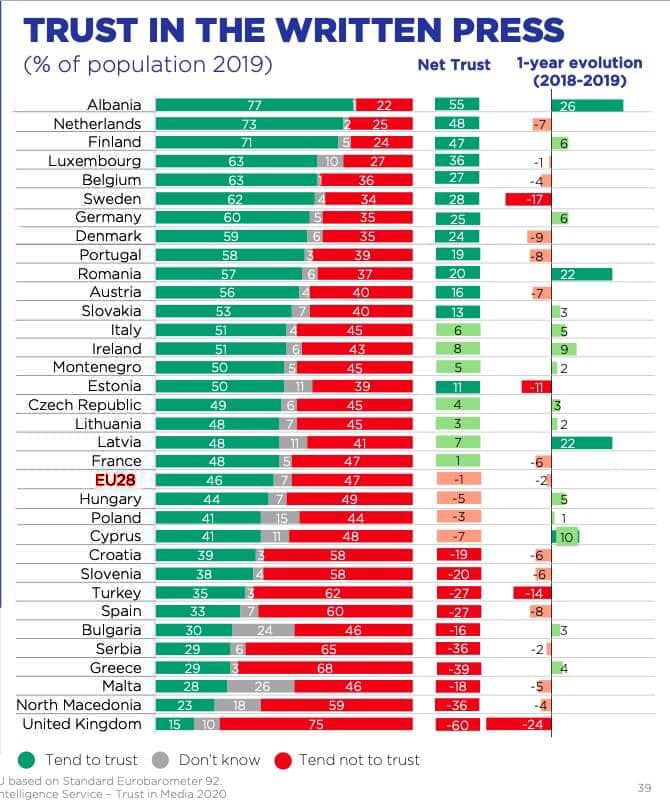
When it comes to developing well balanced and fact-based opinions on important issues, the British public has an additional problem because the UK press is currently considered to be the least trustworthy of all European nations.
So where does the public go to understand the real issues? If they are regular readers/viewers of their preferred media, then they probably feel comfortable with what they’ve read, and so feel that they already have an informed opinion. Most of them would only rarely use a different source to corroborate what they’ve read.
The fact that they base their opinions on a written media that they also have little trust in, can only be described as cognitive dissonance. It also turns out that the UK public is right to have little trust in their media. There is a web site called www.mediabiasfactcheck.com, dedicated to educating the public on media bias and deceptive news practices. And since they trash the reputations of the media in all countries, and across the political spectrum, there is no reason to think that they themselves have any particular bias.
Let’s see what they say about the UK’s leading newspapers.
In order of circulation…
The Sun (1,4 million)
Overall, we rate The Sun Right-Biased based on story selection and political affiliation that favours the right. We also rate them Mixed for factual reporting due to overly sensationalized headlines and numerous failed fact checks
The Daily Mail (1.2 million)
Overall, we rate Daily Mail Right biased. We rate them as Questionable due to numerous failed fact checks and poor sourcing of information.
The Daily Mirror (500,000)
Overall, we rate The Daily Mirror Left-Center Biased based on story selection that moderately favours the Left, and Mixed for factual reporting due to poor sourcing and several failed fact checks.
The Times (400,000)
Overall, we rate The Times and Sunday Times Right-Center biased based on story selection and editorial positions that favours the right, and High for factual reporting due to a clean fact check record.
The Daily Telegraph (360,000)
Overall, we rate The Telegraph Right Biased based on story selection that strongly favours the right, and Mixed for factual reporting due to poor sourcing of information and some failed fact checks.
The Daily Star (330,000)
Overall, we rate the Daily Star UK Right-Center biased based on story selection, and Questionable based on frequent use of sensational headlines, routine publication of conspiracy theories and pseudoscience, as well as a long track record with failed fact checks and fake news.
The Express (320,000)
Overall, we rate the Daily Express Right Biased based on editorial content, and Mixed for factual reporting due to publishing conspiracies & pseudoscience as well as a few failed fact checks.
The Guardian (140,000)
Overall, we rate The Guardian Left-Center biased based on story selection that moderately favours the left, and Mixed for factual reporting due to numerous failed fact checks over the last 5 years.
The Independent (60,000)
Overall we rate The Independent Left-Center Biased due to story selection that moderately favors the left. We also rate them Mostly Factual in reporting, rather than High due to two failed fact checks.
For reference, this what they say about some TV news outlets:
BBC News
Overall, we rate the BBC Left-Center biased based on story selection that slightly favours the left and High for factual reporting due to proper sourcing of information.
Fox News
Overall, we rate Fox News strongly Right-Biased due to editorial positions and story selection that favours the right. We also rate them Mixed factually and borderline Questionable based on poor sourcing and the spreading of conspiracy theories that later must be retracted after being widely shared. Further, Fox News would be rated a Questionable source based on numerous failed fact checks by hosts and pundits, however straight news reporting is generally reliable, therefore we rate them Mixed for factual reporting.
Al Jazeera
Overall, we rate Al Jazeera Left-Center biased, based on story selection that slightly favours the left, and Mixed for factual reporting due to failed fact checks that were not corrected, and misleading extreme editorial bias that favours Qatar.
NBC News
Overall, we rate NBC News Left-Center biased based on story selection and word choices that moderately favour the left, and High for factual reporting due to proper sourcing and a reasonable fact check record.
CNN News
Overall, we rate CNN left biased based on editorial positions that consistently favors the left, while straight news reporting falls left-center through bias by omission. We also rate them Mixed for factual reporting due to several failed fact checks by TV hosts. However, news reporting on the website tends to be properly sourced with minimal failed fact checks
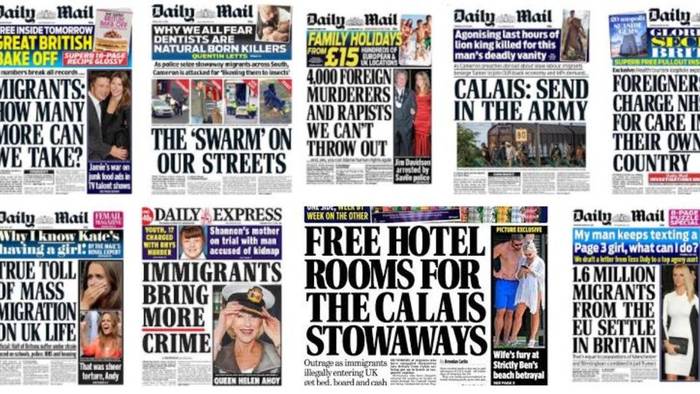
We are used to political bias in our media; we expect the populist press to pander to people’s prejudices – tell them what they want to hear. They target people who don’t fact check their ‘news’, What we should not tolerate is when they fabricate stories in attempts to polarise opinion. According to www.mediabiasfactcheck.com, organs like Fox News, The Daily Mail and The Sun are particularly culpable in this regard.
Here’s some (mostly) Daily Mail headlines.
And here’s some statements (all false) from Fox News.
- Coronavirus Pandemic ‘Hasn’t Been The Disaster’ Feared: ‘Short Term Crisis May Have Passed’ – Tucker Carlson Apr 8th, 2020
- “There are actual cities” like Birmingham, England, “that are totally Muslim where non-Muslims just simply don’t go in.” – Steven Emerson January 10, 2015
- “There is no good data showing secondhand smoke kills people.” – John Stossel, Dec. 4, 2014
- “NASA scientists fudged the numbers to make 1998 the hottest year to overstate the extent of global warming.”– Steve Doocy, June 24, 2014
- “The president of the United States (Obama) will be taking a trip over to India that is expected to cost the taxpayers $200 million a day.” – Michele Bachmann, Nov. 3, 2010
Back to the UK press… only two newspapers come out of the Media Bias Survey with any credit at all; The Times, and The Independent; whereas arguably The Star and the Daily Mail because of their sensationalised headlines, poor sourcing of articles, and opinion-based journalism, arguably shouldn’t be considered as newspapers at all. Anyway, checkout the www.mediabiasfactcheck.com website for the many gruesome stories of fabricated articles. Sadly, the result is that the UK public is one of the worst informed in Europe.
Part of the problem is that the UK press is not adequately policed. The Leveson Enquiry into the phone-hacking scandal of 2011, recommended that the UK should have a regulatory body with “punitive powers, arbitration, prominent corrections and apologies”. Sadly the body that replaced the old Press Complaints Council, the Independent Press Standard Organisation (IPSO) falls way short of these powers, and the inevitable result is the UK’s position in the above chart.
EU disinformation
We tend to forget that anti-EU sentiment was originally nothing to do with party affiliation. Both Labour and Conservatives at the time of the referendum were officially pro-Europe. However, the UK’s right-wing press have waged a war of words against EU membership for years, and opinion has gradually become politically aligned. This position was consolidated when Boris Johnson took over as UK Prime Minister and picked a Eurosceptic cabinet.
Remember these headlines?
Hands off our light ale (Daily Express 12 May 2005)
Now the EU is to ban the acre (Daily Express, 21 July 2008, p10 and p12)
Pipe down! Brussels slaps a noise order on bagpipes (The Sunday Times, 20 April 2008, page 7)
Bombay Mix to be renamed (The Sun, 18 July 2006, p27)
Now Euro killjoys ban children’s party toys (Daily Express, 10th October 2011)
Your 21-gun salutes are just too loud, EU tells the Royal Artillery (Mail on Sunday 5 March 2006)
Church bells are silenced by fear of EU law (The Daily Telegraph, 17 October 2002, page 7)
EU could force cut in drink limit (Daily Mail, 19 January 2001, page 10)
New EU map makes Kent part of same ‘nation’ as France (Sunday Telegraph, 3 September 2006, p.9)
They may not seem much in themselves, but even those who start from a neutral or even vaguely pro-EU position, if they are subjected to headlines, articles and general anti-EU bias for several years, it’s not hard to imagine how people’s views on the EU are shaped.
The right-wing tabloids seem to have lost sight of their journalistic brief; they are trying to influence national events instead of just reporting them. They have, sometimes perhaps unwittingly, become organs of propaganda rather that organs of news.
Anyway, checkout the Euromyths website for the hundreds of myths, exaggerations and outright lies about EU legislation.
Truth and lies
So what happened to ‘truth’? Are we a post-truth society? In actual fact we know that some people and organisations have always been economical with the truth, and we’ve learned to take their utterings with a pinch of salt. Estate agents for example, used car salesmen, politicians, advertisers…. remember slogans like “Maltesers… the chocolates with the less fattening centres”, “you’ll be lovelier each day with fabulous pink Camay”, “Milky Way… the snack you can eat between meals”, etc? Forget caveat emptor at your peril!
Unfortunately, there was a more sinister side of things.
The US tobacco industry was getting some bad press about the correlation between smoking and heart and cardio-vascular diseases. Their answer was to hire the PR firm Hill and Knowlton who came up with the idea of the scientific sounding Tobacco Industry Research Council, which aggressively promoted the idea that there was no connection between smoking and these diseases.
Then there was the petrochemical industry who needed an ‘anti-knock’ additive for gasoline, so despite the known health risks, they opted to use lead tetra-ethyl, when there were healthier (but less profitable) alternatives.
Along comes a scientist called Clair Cameron Patterson who discovered elevated amounts of lead in the environment, became critical of the petrochemical industry, and suddenly found himself unable to get a research contract. In 1971, he was excluded from a National Research Council (NRC) panel on atmospheric lead contamination, even though he was by then the foremost expert on the subject.
In fact the petrochemical industry offered him money to pursue any line of research, as long as it wasn’t into lead contamination.
Climate change is currently another in a long line of pro-business denials. Except this time, the big business lobbies are much better organised. There are more right-wing ‘think tanks’ and ‘research foundations’ than most people imagine, all dedicated to funding climate change denial. The Scientific American says “140 foundations funneled $558 million to almost 100 climate denial organizations…”. See this article: “Dark Money” Funds Climate Change Denial Effort.
Essentially, big business is lying to the public to protect their profits, which they consider to be more important than people’s lives. And more important than leaving a habitable planet for our children and grandchildren.
If things weren’t grim enough, then along comes Donald Trump; a lying, amoral, multiple bankrupt, narcissistic, hypocritical, misogynistic, ethically challenged excuse for a human being (no, I don’t like him), who by telling his support base what they wanted to hear rather than facts, he somehow became the president of the USA. Within days of his taking office, he was lying about how he really won the popular vote (he didn’t), how his inauguration ceremony was bigger than Obama’s (it wasn’t). His campaign manager and spokesperson, Kellyanne Conway famously came up with the phrase ‘alternate fact’ when he (Trump) was caught out in a blatant lie. Since then his detractors have logged 18,000 lies from him… which works out at 23.8 lies per day, one lie per hour.
In the UK, we have Boris Johnson who was sacked for lying when he was a Times journalist, sacked for lying when he was a front bench MP, and famously lied when he told the nation before the EU referendum that EU membership was costing the country £350 million per week… a tactical porky that ended up plastered on the side of the Brexit buses, and arguably swung the referendum in favour of ‘leaving’. Even Nigel Farage was embarrassed about this one!
After Theresa May stepped down as UK Prime Minister, in the absence of anyone better, the Tories made Boris party leader, and so he inherited the job of Prime Minister. As well as his catalogue of lies, he tried to prorogue Parliament in an attempt to force through a ‘no-deal’ Brexit that was so far removed from the promises made before the referendum, that 76% of the electorate were against it. He was forced to back-track and Parliament was re-opened. He then decided to call a General Election in December, and he should have been thrown out on his ear for his lies, deceptions, unconstitutional behaviour, and his lack or respect for Parliamentary protocol. Instead he won by a landslide. A reflection, not of any great affection the public has for him, but of the power of the right-wing media.
It’s clear from the way the electorate can be duped, and just like what was adequately demonstrated in America, modern society is one where people seem to prefer comfortable lies (especially ones that support their prejudices), over inconvenient truth.
Brexit
I decided that this should have a section on it’s own as the entire four year saga has been rife with lies and deceit, and as mentioned earlier, especially from the Eurosceptic right-wing press.
Clement Attlee said (and later, so did Margaret Thatcher) that referenda are “a device of dictators and demagogues”.
If a government wants to take the nation’s temperature on important issues, they would normally commission a study with a body like the Office of National Statistics or the National Centre for Social Research. They (the government) are often called upon to make unpopular decisions; it’s OK to hate the government if they make a decision that you disagree with… we get over it. But if on the other hand, you have a referendum, and then choose to make far-reaching legal or constitutional changes following a marginal result, then congratulations… half the country now hates the other half and you have a recipe for civil strife. The only time a government should act on the results of a referendum is when it’s a super-majority, of something of like two-thirds.
The Tory partys’ own policies state that for issues of national importance, the result would be acted upon only in the event of a super-majority, and with at least 40% of the electorate voting. This was the case for recent referenda for Scottish Independance. The Brexit referendum was advisory and non-binding and therefore didn’t require a super-majority. So it’s a puzzle why this government has gone against it’s own policy, and taking the costly, complex, and divisive step of leaving the EU, based on a marginal vote, in what was afterall, a non-binding referendum.
My personal opinion on Brexit is that it doesn’t have an upside. Bureaucratic inefficiencies aside, the EU is a good thing to be part of. We’ve seen many time that a historically and culturally diverse continent like Europe has the potential for these differences to lead to misunderstandings, conflicts of interest, economic sanctions, and even war. This is effectively neutralised in a united Europe, where we have common goals and a forum for policy-making, discussion and problem resolution.
Furthermore, when we finally leave the EU, the UK loses it’s biggest marketplace. As individuals, we also lose the right to free movement and the right to live and/or work in any EU country. Most of the Brexit voters I’ve engaged with are unable to articulate reasons for their choice… just a vague feeling that Britain’s sovereignty is being compromised, and the suspicion that foreigners taking our jobs.
They long for a return to the ‘halcyon’ days of the early 70’s before we joined the EU, when Britain was an independent sovereign nation, and we had blue passports. People seem happy to risk an uncertain future for the tenuous idea of putting the ‘Great’ back in Great Britain. Actually they are seeing history through rose-tinted glasses because in reality, in the early seventies, just before we joined the EU, the UK had galloping inflation, a relatively low standard of living, and our industries were on their last legs because of a combination of poor management, under-investment, and industrial action.
On the subject of immigration and the perceived influx of foreigners to the UK, there is no question that the media love to misrepresent this one, so we should all be careful what we read. A few years ago, The Sun claimed that our NHS and welfare services were being overrun with ‘benefit tourists’. Some of you may remember the headline “Brussels: UK’s 600,000 benefit tourists is no problem” (See this article).
Well it turns out that the article was a complete fabrication. They (The Sun) admitted 10 days later that “there’s no evidence of benefit tourists”and “Neither has the EU said this would be ‘no problem’”. But the retraction was too small and too late, so of course the damage had already been done.
It also turns out that a lot of the law-making that ‘leave’ voters objected to was done by the European Court of Human Rights, administered from Strasbourg, and quite independent of the European Union.
Anti-Europe propaganda from the rest of the right-wing press was described earlier, but note that this was completely one-sided; there was no comparable campaign of fabrication, lies and distortions from the ‘stay’ supporters. Note also that the right-wing press accounts for 85% of the newspapers sold in the UK, so with a media opinion so hugely skewed in favour of Brexit, the referendum result was perhaps inevitable… possibly we should be surprised that the 52/48% margin was so small!
As well as a questionable economic future, Brexit will create many other uncertainties, including the question of border controls between Eire and Ulster, and the serious possibility of a dis-United Kingdom if Wales and/or Scotland vote for independence. Imagine passport controls on the Severn Bridge; on the M6 near Gretna Green, and customs officers boarding the London – Edinburgh train at the Scottish border!
I agree that financially, Britain probably doesn’t get as much out of the EU in subsidies, as it puts into it (although nothing like as bad as Boris’s £350 million per week deficit), but this is just the nature of things. Rich nations should subsidise the poorer nations. This makes for political and economic stability, and ultimately everyone benefits. It’s just another form of foreign aid… something which all rich nations subscribe to. Anyway, the deficit is more than made up for with ease of access to the European marketplace. Furthermore, it turns out that the cost of extricating ourselves from the European Union is nearly equal to 47 years of contributions (£203 billion versus £215 billion).
But ultimately, I ask myself… if leaving the EU is so desirable, why have UKIP, the Brexit Party, and Eurosceptic Tories all failed to come up with anything in the way of tangible benefits? Instead, all they have given us a tissue of lies.
- “Absolutely nobody is talking about threatening our place in the single market” Conservative MEP Daniel Hannan
- “Once we have settled our accounts, we will take back control of roughly £350m per week”Boris Johnson
- “There will be no downside to Brexit, only a considerable upside.” David Davis
- “The day after we vote to leave, we hold all the cards and we can choose the path we want.” Michael Gove
- “Getting out of the EU can be quick and easy – the UK holds most of the cards.” John Redwood
- “I think we could very easily get a better trade deal than we have at the moment” Former Conservative and UKIP MP Douglas Carswell
- “There will continue to be free trade, and access to the single market.” Boris Johnson
- “The free trade agreement that we will have to do with the European Union should be one of the easiest in human history.” Liam Fox
- “I believe that we can get a free trade and customs agreement concluded before March 2019.” David Davis.
- “Trade relations with the EU can be sorted out in an afternoon over a cup of coffee” UKIP’s Brexit spokesman Gerard Batten.
I smiled when I read recently that a What UK Thinks poll asked people “Currently EU citizens have the right to live and work in Britain and British citizens have the right to live and work elsewhere in the EU. Should this movement continue?” They found 67 per cent in favour. Yet another example of cognitive dissonance!
The tail wagging the dog
There have always been differences of opinion on important topics, but now we have on one side… those who see through the lies, and are outraged to see people being duped and manipulated; and on the other side, we have the dupees, who as well standing firm on the issue, now end up resenting and defending suggestions of gullibility. The emotional temperature has increased, and both sides of the debate become more entrenched. Rational discussion, and either compromise or resolution of differences is now even more unlikely.
A consequence of all this deceit is that regardless of who the lie is from, or what it’s about, ultimately it has the effect of dividing society; the voting public in both the UK and the USA is already demonstrably polarised on all sorts of important issues.
The real loser though is democracy itself. Because the public now has difficulty knowing what to believe, rich and powerful individuals as well as special interest groups, are exploiting this uncertainty to push their own agendas on the public, with the result that they have a disproportionate influence on British affairs. It’s the classic case of the tail wagging the dog.
It’s well known for example, that several of the major UK newspaper owners such as the Rupert Murdoch, Barclay Brothers, Lord Rothermere and Richard Desmond, are strongly anti-Europe. One of the reasons is that the EU will not be pushed around by these people in the same way that they manipulate the British government. Another reason is that the EU is threatening to tax the offshore holdings of the uber-rich. The media barons are using the power of their newspapers to subvert the democratic process for their own selfish reasons.
I honestly believe in the democratic process more than I believe in any single issue. If I felt that Brexit was a genuine reflection of what the British public want, I’d support it even though I didn’t vote for it. Sadly, that is not the case. I firmly believe that the referendum result is based on lies and deception from factions that do not have Britain’s best interests at heart.
These factions are also getting to choose which issues the public should focus on. If they don’t fit in with their agenda, larger issues needing attention are often being obscured and therefore overlooked.
It seems only a few years ago, Tony Blair was castigated by the press and nicknamed BLiar because he exaggerated the possibility of Weapons of Mass Destruction in Iraq. Yet in the December 2019 election, the UK electorate actually chose an inveterate liar as Prime Minister. On the other side of the Atlantic, Donald Trump lies approximately every hour since his inauguration. The UK press has abandoned it’s traditional role of keeping politicians ‘honest’, in favour of pushing the minority interests of their owners on an unwitting public. Instead of being part of the solution, the UK media is now part of the problem. Arguably, we wouldn’t be facing a crippling ‘no deal’ Brexit if we had a more ethical media.
In answer to the question raised earlier… “are we a post-truth society?”, we are currently foundering in a sea of lies, deceit, disinformation, distortion, exaggeration, fake news and alternate truths. We all struggle to separate fact from fiction. We have become so exposed to deception, that even if we’re not already there, we are rapidly becoming a post-truth society.
Conclusions
Right now, Britain is out of Europe, although there was a period of transition so we’re not feeling the full impact of this decision. But already polls are showing 57% of the electorate would currently prefer the UK to ‘stay’ in the EU, and only 35% ‘leave’; 88% are against Boris Johnson’s deal with the USA to import food produce, and as mentioned above, 67% would prefer the freedom to travel, live and work in any EU country.
So Brexit is demonstrating the abject failure of the democratic process. Britain is no longer a major world power, and at the same time as other nations are building trading alliances so that they can compete in a global sense with nations like China, Russia and the USA, as well as emerging giants like India, Brazil and Mexico, Britain has apparently chosen to ‘go it alone’. It could be one of the worst decisions Britain has ever made.
Sadly, given how divisive and acrimonious the whole process has been, it seems unlikely that any UK prime minister will be looking to reverse this decision on the short term, so it could be years or even decades before Britain rejoins the EU.
So what can be done to make democracy to work again? Well in a nutshell, democracy needs an informed populace; an informed populace needs a trustworthy media; for the media to remain trustworthy, press standards must be maintained.
A trustworthy media would mean that the facts are accessible to everyone, and the opinions, lies and deceptions exposed for what they are. I think that we’d see more transparency in business and politics, and hidden agendas that ultimately go against the public interest would become a thing of the past.
Furthermore, global issues such as Climate Change would be more likely to be understood, and get the urgent attention they need.
In the short term, and in the absence of a reliable press, when people read something new, they should ‘fact check’ for themselves before they form an opinion. Checkout websites like www.snopes.com, www.urbanlegends.about.com, www.fullfact.org, www.factcheck.org, www.hoaxbuster.ciac.org, www.politifact.com.
Longer term, keep the pressure on IPSO and complain to them whenever you see lies and distortions in print. Support organisations such as Hacked-Off (campaign for a free and accountable press). Lobby your MP for a better policing agency.
And don’t forget to vote with your feet… please don’t support newspapers that lie to you.

