A layperson’s guide to the scientific method.
Modern science
Science has come a long way from the hubris and certainties of the 19th century. “We now know almost everything there is to know” was the conventional view a century and a half ago. Right now it seems that the more we learn, the more we realise how much more there is to know. So there is little regard in modern science for ‘facts’, ‘absolute truths’ and ‘proofs’ (someone once said “proofs are for mathematicians and bottled liquors”!).
Instead, modern science considers that the highest form of scientific knowledge is the scientific theory. Wikipedia says “A scientific theory is a well-substantiated explanation of some aspect of the natural world that is acquired through the scientific method and repeatedly tested and confirmed, preferably using a written, pre-defined, protocol of observations and experiments. Scientific theories are the most reliable, rigorous, and comprehensive form of scientific knowledge.”
Science recognises that some things may never be completely understood. String Theory anyone? Quantum Theory? Theory of Evolution? As our knowledge increases, we can refine these theories (and we do), but at best, they can only explain things we can observe, measure and/or replicate. Anyone can speculate on such questions as “what was there before the Big Bang”, or “what would living in an n dimensional universe by like?”, but it doesn’t add to the body of knowledge, so has little scientific value.
So how does a scientific theory work? As much as humans in general love the status quo and a nice quiet life, science owes a lot to the people who look at prevailing scientific knowledge and ask if it truly explains all observed phenomena.
Gravity is a good example. Aristotle’s view on gravity was that is that all bodies move toward their natural place, and in the absence of a medium that would restrict their motion, bodies would accelerate at a rate proportional to their weight. This was the prevailing view for two thousand years.
Then along comes Galileo who realised that if the bodies are subject to the same force, they will accelerate at the same rate, regardless of weight (mass). To make his point, he drops two orbs of different weight of the top of the Leaning Tower of Pisa, and observes that they hit the ground at the same time.
There was further work on the subject by people like Kepler, but then it was Newton’s turn. He is considered by many to be the father of today’s scientific method. The falling apple story is probably apocryphal, but he was astute enough to realise that there is no special property to the Earth, and that in some sense, the Earth and the apple were attracted to each other. So he postulated that all objects had a gravity directly proportional to their mass. He also knew that somehow, the attraction is ‘diluted’ by distance, and he eventually come up with the ‘inverse square law’ which effectively states that the degree of attraction is inversely proportional to the square of the distance from the centres of mass. So if a person weighs 100 kg on the surface of the Earth (some 6,000 km from the Earth’s centre of mass), if you double the distance to 12,000 km, the person would only weigh a quarter of their original weight, ie 25 kg.
Early in the 20th century, a bored patent clerk in Bern started thinking about light and mass and gravity and time. He was of course Albert Einstein. He’d already come up with his Special Theory of Relativity, which explains how things behave as they approach the speed of light. And he knew that Newton’s work explained ‘how’ gravity works but not ‘why’. Something that Newton himself was unhappy about.
In 1912 Einstein came up with his seminal General Theory of Relativity, which essentially said that what we think of as gravity is actually a distortion of space-time surrounding an object, and proportional to the object’s mass. Newton’s theory still worked for most everyday purposes, but General Relativity predicted (for example) that light would be bent around massive objects. A few years later during the 1919 solar eclipse, photos were taken that showed stars slightly displaced from their actual positions, proving that Einstein was right.
The problem with General Relativity is that it’s incompatible with Quantum Mechanics, so it will eventually be replaced with a better theory. In fact there is currently an emerging theory called Quantum Gravity. And so it continues.
The rise of conspiracy theories
It’s common (dare I say fashionable?), to consider that because things like Evolution, Climate Change, Big Bang, etc. are ‘only’ theories, any layperson’s opinions on these subjects are as valid as the accepted scientific versions.
Climate Change is the obvious one… because we all know about seasons, we all have a sense of what causes weather phenomena, and we’ve all heard about the comings and goings of ice ages. So for a number of people, the thinking is why can’t the Bloke down at the pub’s theory be just as good as the accepted scientific theory?
It doesn’t help that the everyday use of the word ‘theory’ has caused it to diverge from it’s original use as in ‘scientific theory’. I guess we’re all equally guilty, but the everyday usage of ‘theory’ has become a synonym for ‘hypothesis’, ‘conjecture’ or just plain ‘guess’.
This kind of thinking was investigated by by social psychologists David Dunning and Justin Kruger, and can be understood from this graph called the Dunning-Kruger Effect:
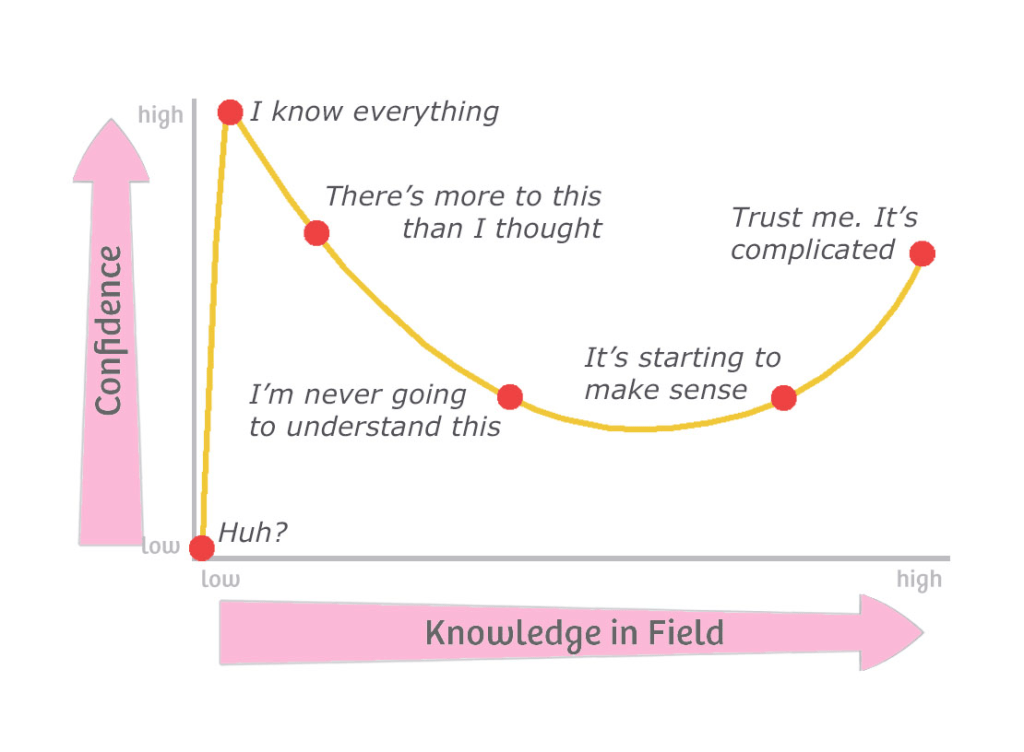
It can be seen from the graph that confidence is highest when a person’s knowledge of the subject is small.
Sadly, we live in an age where examples of this type of thinking abound… anti-vaxxers, chem-trailers, flat-Earthers, Moon-landing deniers, Creationists, etc. For some people, the conspiracy story resonates more than conventional explanations, and they either can’t or won’t check the underlying science for themselves.
And their views were recently given some legitimacy by some of Donald Trump’s outpourings…
- Climate change was a Chinese conspiracy,
- Vaccines cause autism,
- Fracking has zero health risks,
- Wind farms are bad for people’s health,
- Environmentally friendly light bulbs can cause cancer.
Most importantly, during the Covid-19 pandemic, Trump constantly undermined the efforts of his own science advisors like Anthony Fauci, by voicing his own opinions… for example advocating hydroxychloroquine for treatment of Covid, and suggesting the use of disinfectant to kill the virus. Furthermore, his early denials about the seriousness of the pandemic, the precautions to take, and indeed whether or not there even was a pandemic, was arguable responsible for the unnecessary deaths of half a million people.
There have always been conspiracy theories; Moon landing denial for example, started almost immediately after the Apollo missions. And with the advent of the internet, conspiracists are getting organised – there are many web sites that provide arguments, facts, figures, charts and even photographs in support of their views.
They love to cherry-pick bits of well-established science, so as to give their theories some credibility, but mix it up with a type of techno-babble, often so meaningless that it’s difficult to argue with. For example, this is from the Flat Earth Society web site to explain why the Sun (which on their flat Earth model is always above the Earth) seems to rise and set:
“As the sun descends it will create a tangent into the horizon. The perspective lines nearly merge, causing the receding body to appear to collapse in on itself. Next the light of the receding sun is dimmed to blackness by a non-transparent atmosphere”.
Note the use of big words to further increase their credibility. What you will not find on these sites is any plausible science.
It’s clear that these people don’t understand the scientific method… the need for rigorous protocols of observation and measurement, repeatable experiments, published results, peer review, and constant challenge from emerging and/or competing theories. Something that’s totally lost on conspiracy theorists is that the best way to challenge a scientific theory is simply to come up with a better scientific theory. Instead they delude themselves into thinking that the best way to challenge conventional science is with non-science.


I was unaware of the Dunning-Kruger graph, and it certainly hits the nail on the head, but then, so does pretty much everything you said here, and for that reason, I would love your permission to quote/link to what you’ve had to say in this post.
LikeLike