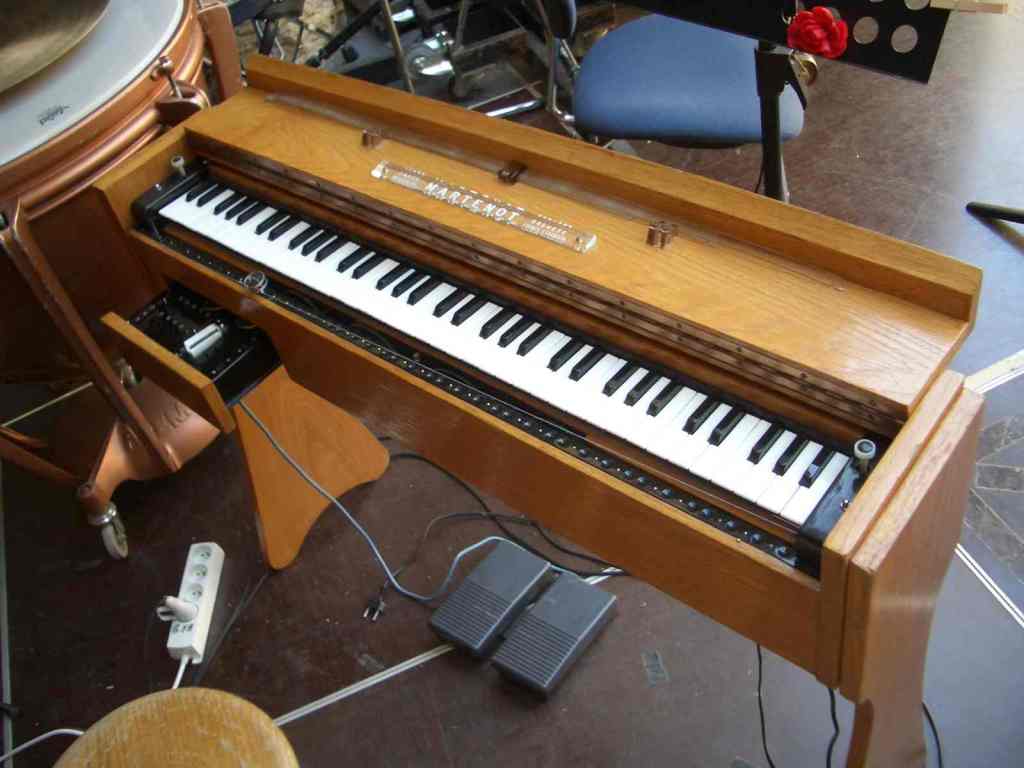
Whether you love or hate Musique Concrete and the compositions of people like Steve Reich, Karlheinz Stockhausen, Terry Riley, etc., experimental musicians have been pushing the envelope of sound generation for more than 100 years. Their collaborations with electronics engineers resulted in devices such as the Theremin, the Ondes Martinot and the Trautonium in the 1920’s, and the Ondeolin and Claviolin in the 1940’s.

These we not synthesisers in the accepted sense, but clearly their sounds were produced non-acoustically, ergo, synthetically.
I’m not sure of the accepted etymology of the word synthesiser (synthesizer in the US), but I guess in most people’s heads, the word started to be used to describe the sort of complicated contraptions produced in the 1960’s by pioneers like Bob Moog and Don Buchla in the USA, and Peter Zinovieff (EMS) in the UK. Later innovators include Alan Pearlman (ARP), Dave Smith (Sequential Circuits) and John Simonton (PaiA).
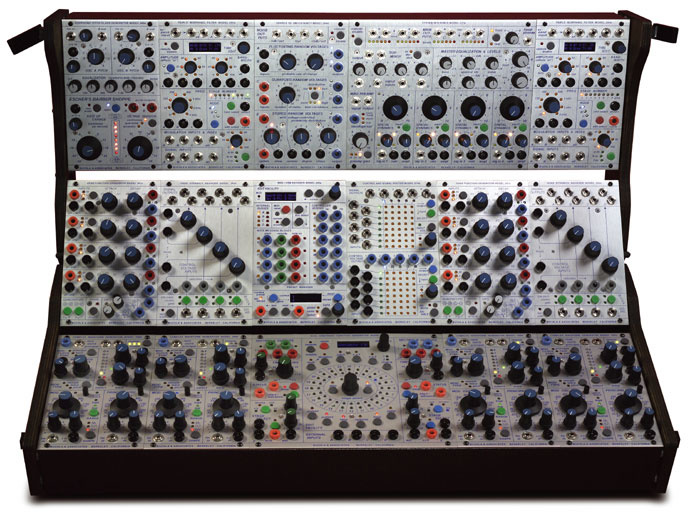
Most of the electronic building blocks of the synthesiser (oscillators, amplifiers, filters, ring modulators, etc.) existed well before the ‘60s, but the real revolution was when Moog and Buchla independently started to use voltage control, whereby these same building blocks could now be thought of as modules, giving way to a flexible architecture.
Each module had a ‘control’ input and/or a ‘signal’ (ie. Audio) input; and all had an output. However, the beauty of the modular architecture was that the distinction between control and signal could be blurred. For example, the output of an oscillator is conventionally thought of as a tone in the audio spectrum. However this tone could be fed into the control input of another oscillator… if the frequency is low, the result is frequency modulation like vibrato. If the frequency is high, the result can be a harmonically complex waveform.
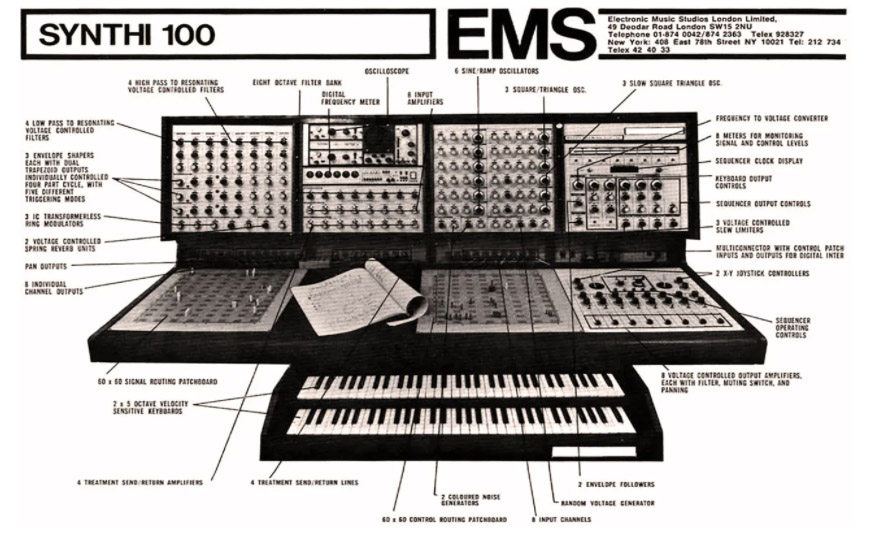
To facilitate this architectural flexibility, the modules could be connected in various ways, with Moog and Buchla preferring external ‘patch wires’ and EMS the plugboard or ‘routing matrix’. Early production synthesisers were huge, complex and expensive. Here’s a copy of the promotional brochure for the Synthi 100 developed by EMS of London.
And here’s the sort of Moog used by Walter (later Wendy) Carlos in the late sixties, for his series of interpretations of the works of Bach, Scarlatti, Monteverdi, Beethoven and others.
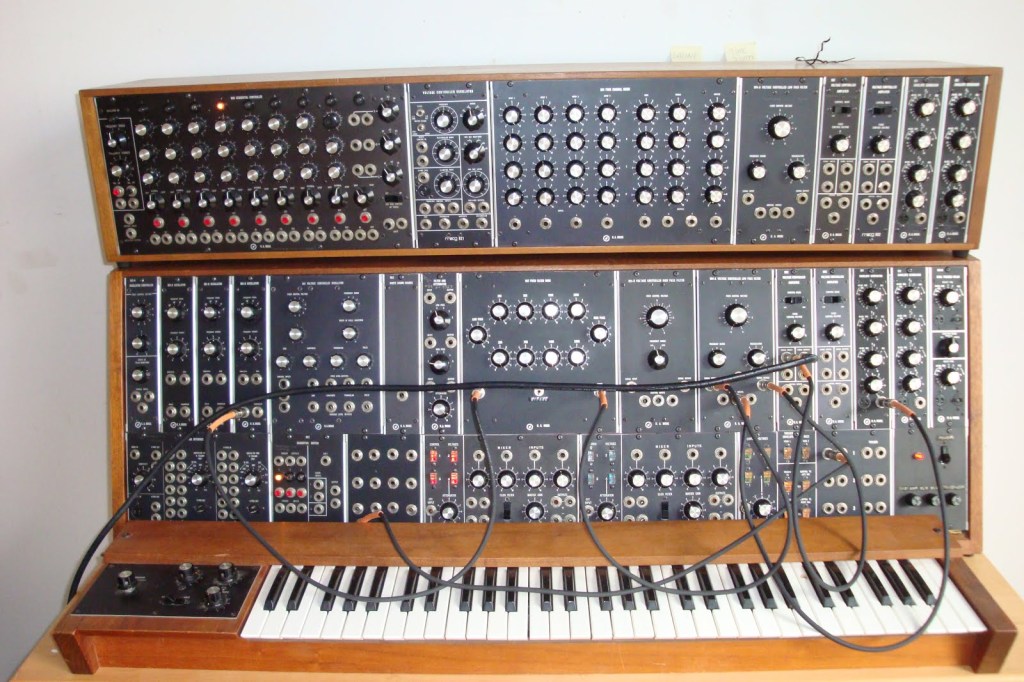
Clearly the only places where you would find such instruments were in universities, some of the bigger studios, and occasionally in the home studios of rich musicians like Keith Emerson. Manufacturers quickly realised that the commercial potential for these monsters was quite limited.
So in collaboration with several musicians, Bob Moog and other manufacturers adopted the concept of ‘normalisation’, where the most common configuration of modules was ‘hard wired’, removing the need for patch chords and plug boards, and making for a more intuitive architecture. This was mostly suited to imitative synthesis (organs, pianos, brass, strings, etc.) rather than the more ‘avant garde’ (bizarre?) sounds preferred by the experimental musicians.
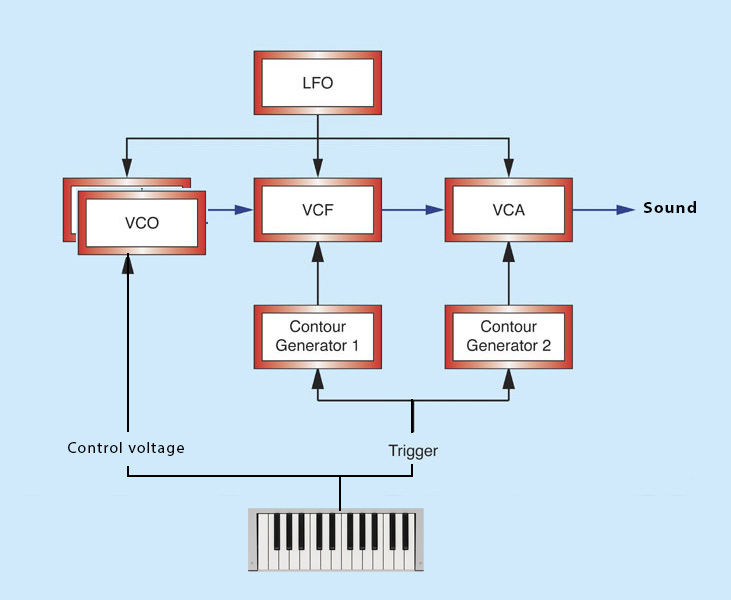
This is a typical normalised synthesiser architecture, resulting in a not-too-intimidating front panel something like this…
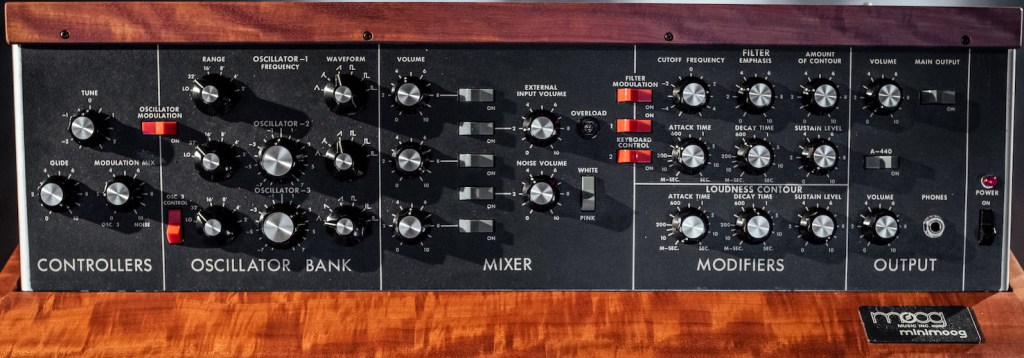
The limitations of this generation of synthesisers were firstly that they were monophonic, ie. could only sound one note at a time; and secondly, whatever panel settings you made to get a particular sound were lost when you changed to a different sound. Often the sounds couldn’t be reproduced exactly, even if you noted all the settings on one of the included ‘patch sheets’.
As we reached the mid-seventies, and entered the age of ‘large scale integration’ where thousands of electronic components were encapsulated on a chip a few millimetres across. The result was the electronic circuitry was simplified to the point that it was now possible to build ‘polyphonic’ synthesisers, where they would simultaneously sound 4 or more notes.
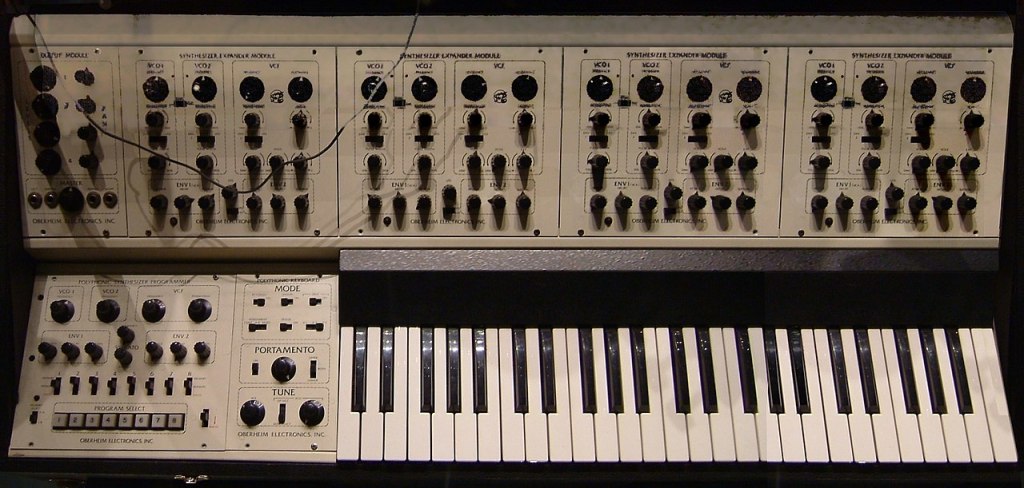
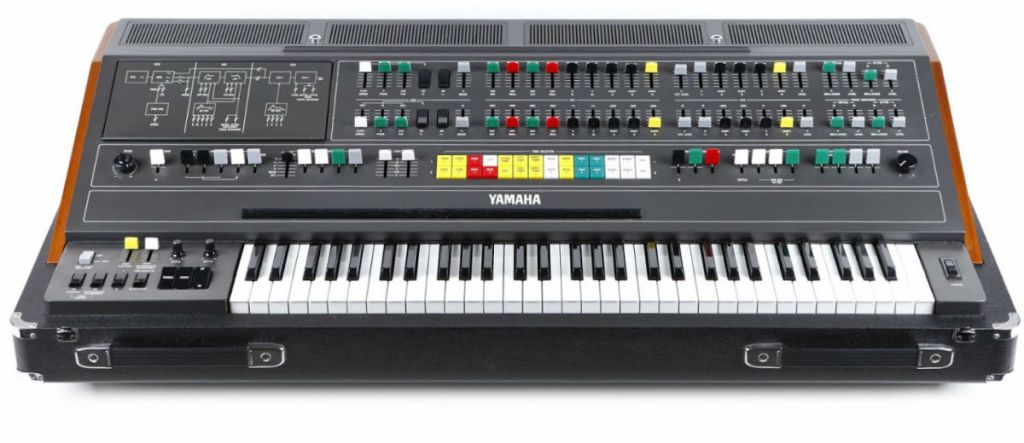
Early versions by Oberheim, E-Mu and Yamaha were still very expensive, being essentially multiple monophonic synths in one box.
And about the same time, the affordability of microprocessor chips meant that the sound parameters could be digitised, and saved to computer memory… enter the age of the programmable polyphonic synthesiser!
Arguably the first ‘affordable’ programmable polyphonic synthesiser was Sequential Circuits’ Prophet 5, with (as you may have gathered) 5-note polyphony. BTW, Moog’s Polymoog doesn’t really qualify because it was really a hybrid instrument and borrowed some design elements from the electronic organ.
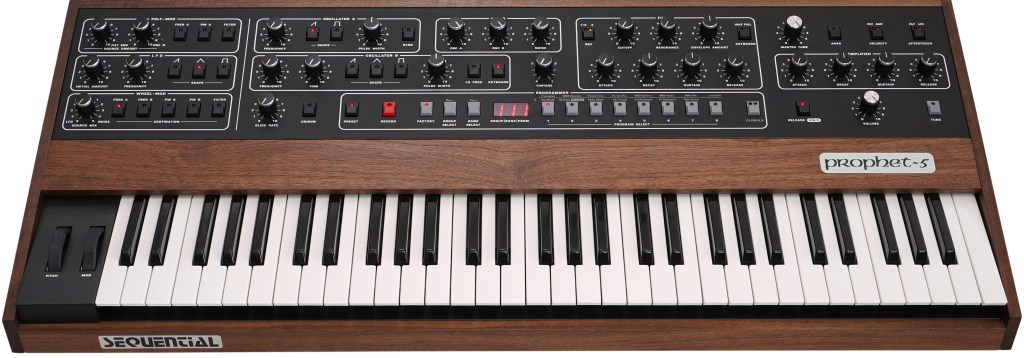
Engineers started making improvement to the user interface so that instruments were more ‘expressive’. We started seeing ribbon controllers, pitch and modulation wheels and levers, and X-Y joysticks. The keyboards of the more up-market instruments started to be velocity responsive, and some included ‘after-touch’.
Further innovations allowed for ‘multi-timbrality’, where two or more different sounds could be played simultaneously. This allowed users to set ‘split points’ where (for example) you could play a bass sound with your left hand and a brass sound with your right. And two or more sounds could be ‘layered’ to create some very rich and complex sounds. Effects such as chorus, reverb, echo, distortion, and even speaker simulations, normally only found in rack-mount studio modules started to be included.
And by now, we were well into the digital age, and not just for saving the sound parameters. Voltage control was inherently temperature sensitive and some of the earlier synthesisers had poor reputations where the pitch of the instrument would ‘drift’ during a performance. So we started to see hybrid designs where the sound production still used analogue circuitry, but the control of the various modules was digital.
From there it was a small jump to using micro-processors so that sound production was digital as well. The digital signal would be converted back to analogue just before the outputs. It’s amusing to note that a lot of people didn’t like the sound of the all-digital synthesisers, so this phase was quickly followed by ‘analogue modelling’ synths, which digitally emulated some of the little quirks and imperfections of analogue circuitry.
Polyphony increased as components got cheaper and production increased, and right now 128-note polyphony, and 16-part multi-timbrality isn’t unusual. This may sound slightly over-engineered until you think that a lot of song-writing is done on computer based sequencers or DAWs (Digital Audio Workstations), where the keyboard is called upon to replay not just polyphonic parts, but up to 16 different (polyphonic) tracks.
Getting personal
I’ve always enjoyed music as long as I can remember. And I’m from the generation that turned music on it’s head. Popular music was once the preserve of professional songwriters such as Leonard Bernstein, Cole Porter, George Gershwin and suit-wearing songsmiths from London’s Tin-Pan Alley writing their admittedly well-crafted songs for the likes of Frank Sinatra, Connie Francis, Alma Cogan, Dickie Valentine and Pat Boone. But from the mid-fifties, we suddenly had rock and roll with Elvis, Bill Haley, Little Richard and Jerry Lee Lewis, and on our side of the water, Lonnie Donegan, Tommy Steele and Cliff Richard. This spawned a whole swathe of homespun vocal groups and skiffle bands. In my home town of Derby, in the early sixties when I was in my mid-teens, you were unusual if you weren’t talking amongst your friends about starting your own band.
Anyway, it wasn’t too surprising to find that the old guard were on their way out, giving way to the likes of Buddy Holly, the Drifters, Del Shannon, The Shadows, The Beatles, the Beach Boys, Roy Orbison, the Stones, The Animals, The Who, The Kinks, etc. They were the new kids on the block, and things would never be the same.
My major musical influences were most the above crowd, plus emerging sounds like Pink Floyd, Jimi Hendrix, and the American west coast bands like The Doors, The Byrds and Jefferson Airplane.
I was always interested in electronics and my early exposure to these bands was listening to them on military-surplus headphones plugged into home-made crystal sets, one valve short-wave radios, and onwards to home-made one and two transistor radios. It was a short step from there to start making electronic sound generators, so I could (and did) regale the neighbourhood with very loud sci-fi type noises. And from there to building my first electronic keyboards. By this time, I was listening to a lot of keyboard orientated music from the likes of Pink Floyd, Deep Purple, The Nice, Yes and Tangerine Dream.
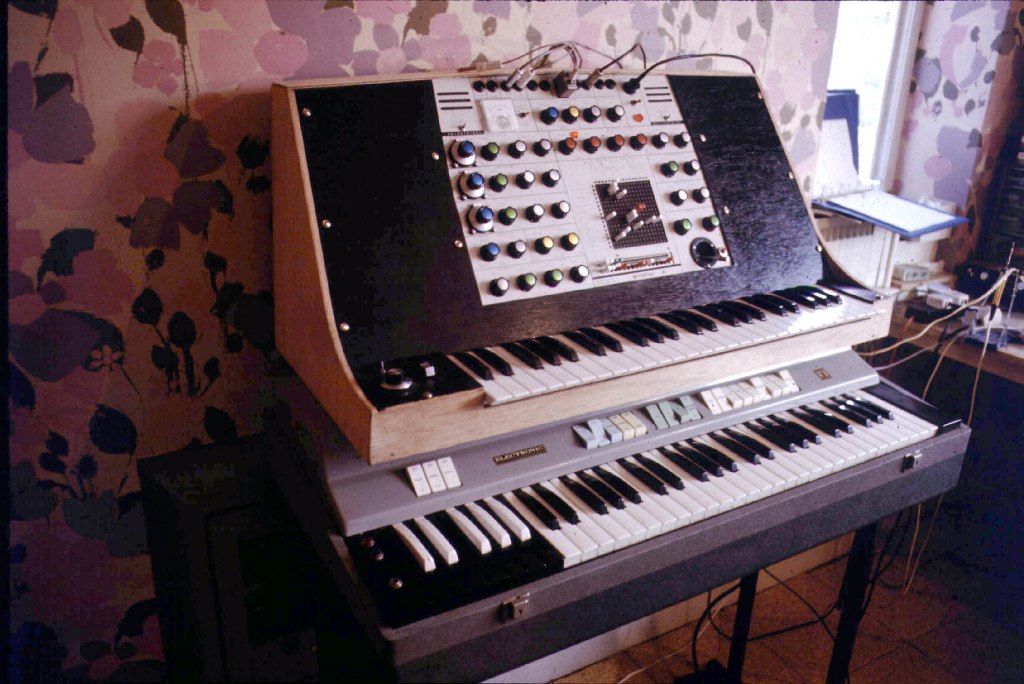
In 1975 I was put in touch with a techie at the Putney based EMS who made the VCS3 synths that Pink Floyd used extensively. Through him, I bought the electronic box of tricks from a Synthi AKS synthesiser where someone had managed to burn out the electronics.
Over the autumn/winter of 1975, I rebuilt the electronics, added a keyboard, stuck it in a box and it looked like this (the thing on top of the organ).
Not satisfied with that, and mercilessly exploiting my friendship with the EMS techie, I bought and/or built more modules and enhancements, and eventually turned it into this, which was by now a serious piece of kit.
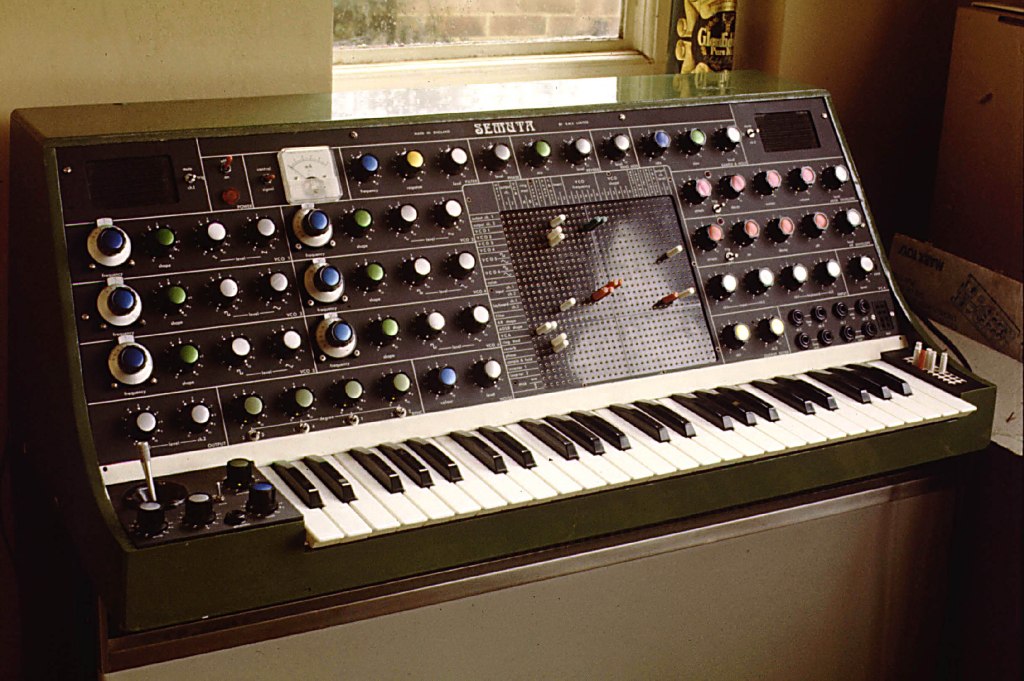
The front panel was my design in heavy aluminium alloy, and the lettering was a labour of love, all done by hand using Letraset sheets. The instrument was primarily monophonic, but it had enhancements that allowed a duophonic mode… if you played a chord shape, you’d hear the top and bottom notes.
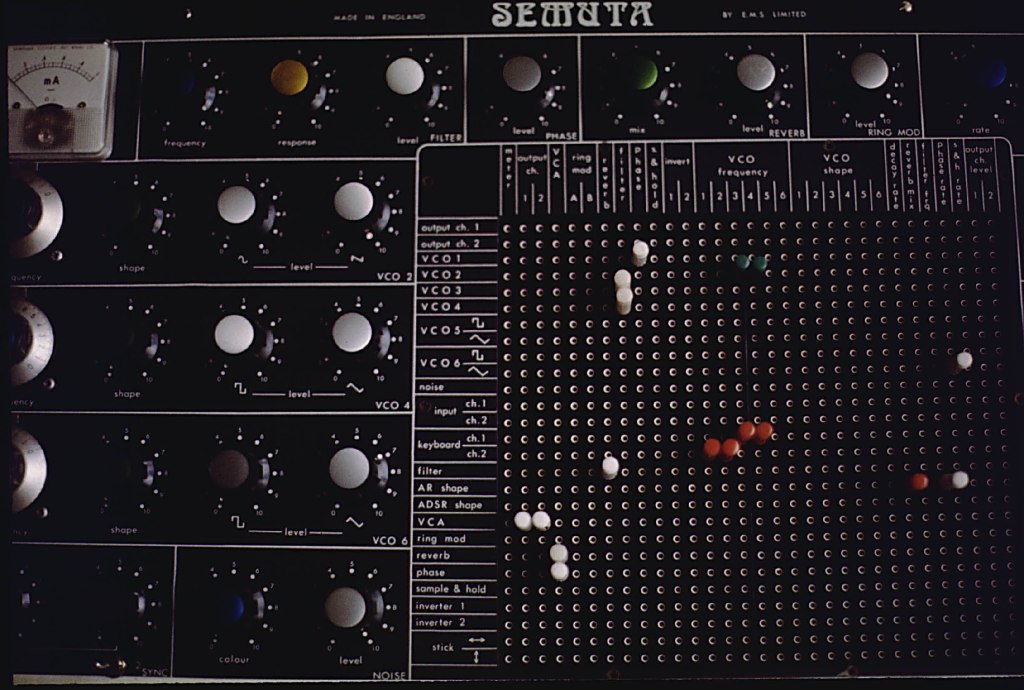
The finished instrument ended up with a load of EMS enhancements to improve things like temperature stability. It had 6 VCOs (voltage controlled oscillators) with Vernier controls, a VCA, a 12dB/octave filter, a four octave keyboard, various forms of oscillator-sync, a ring modulator, AR and ADSR envelope shapers, a noise generator, Sample and Hold generator. I kept the original spring-line reverb, and included a phaser from an ETI magazine project.
The extra modules required that I upgrade the Synthi‘s original 16×16 plug-board into the 27×31 custom-built one seen above.
With 6 VCOs and oscillator sync, plus the wonderful EMS filter, the synth could make a sound like the end of the world! I christened it ‘Semuta’ after the narcotic music in Frank Herbert’s ‘Dune’.
But… I was developing musically, so I wanted a polyphonic instrument. Sadly I had no money, so I was forced to sell it (actually, I sold it for a fortune in late 1970s money – more than I’d ever spent on a car!), and this allowed me to buy a Crumar string synth, as well as the nice and underrated Korg 700S.
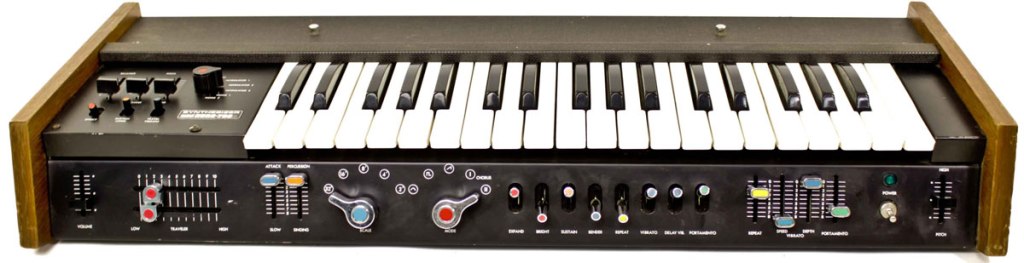
This combo kept me going for a year or two, but the industry was developing rapidly, and with the passing of each year, you tended to get more and more synth for your money, so it was eventually replaced by an ARP Quartet and a Minimoog; then a Casio CZ5000 and a Sequential Pro-One, and since then it’s all been a bit of a blur. But sadly, the one constant was that I always had to sell to finance the next investment.
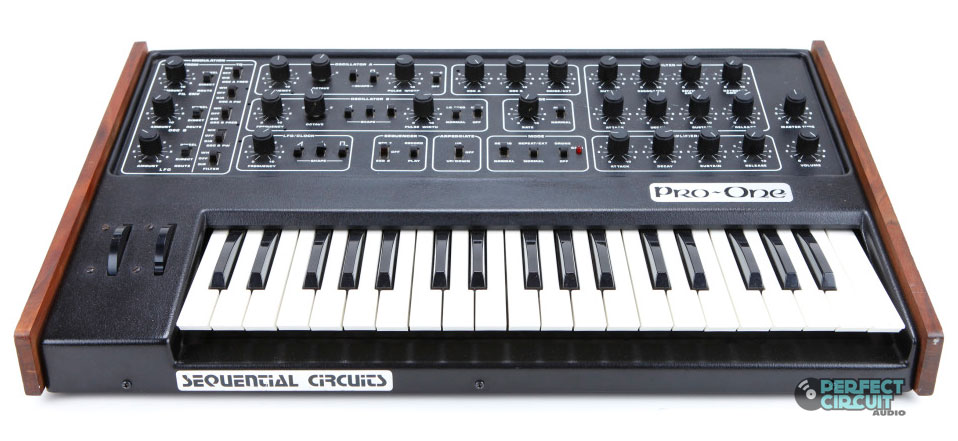
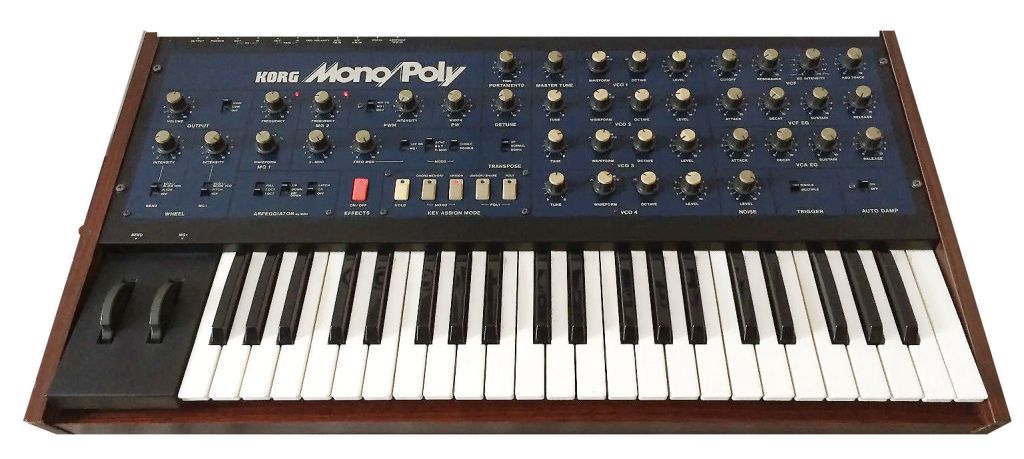
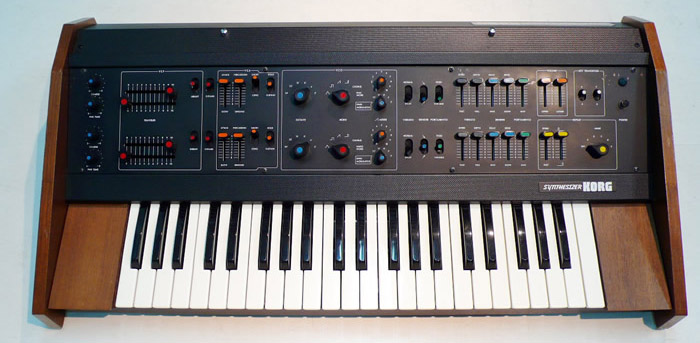
Which meant letting go of some pretty good gear. Synths I’ve owned over the years that I wish I could have kept include the final version of my EMS Semuta (I often wonder where it is now), the Minimoog, the Sequential Pro-One and a Korg Mono/Poly. Oh, and the excellent but obscure Korg 800DV. Synths I’ve had to sell but didn’t miss particularly include the ARP Quartet, the Casio CZ5000, the Roland D10, and the Korg DS-8.
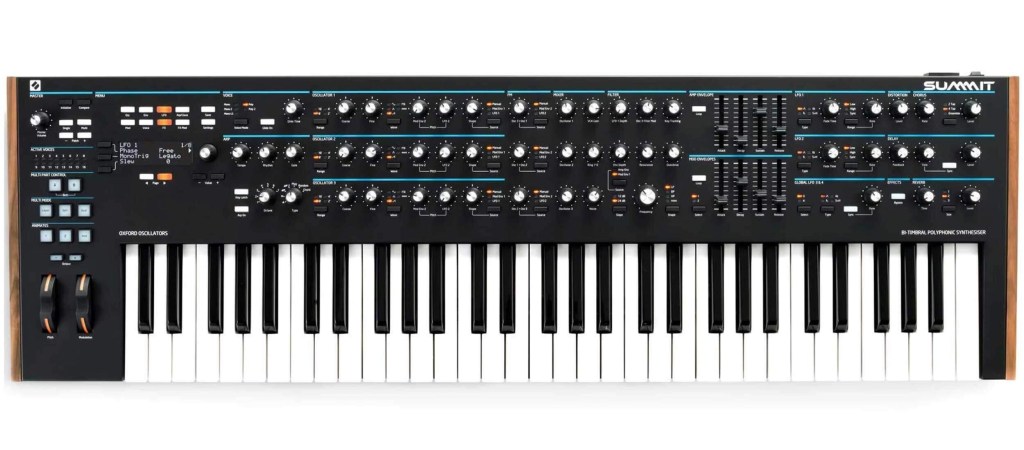
Right now I have a Korg Z1 with it’s multiple modelling architecture, my gigging work-horse the Roland Juno DS, and two recent investments… the fabulous analogue-sounding Novation Summit, and the even more amazing and versatile Yamaha MODX6.
The Yamaha MODX6 with it’s AWM2 and FM-X sound engine, Motion Control, Smart Morphing, Vocoder, Envelope Follower, Phrase Sequencer, Superknob(!), it’s vast library of arpeggios, and drum rhythms, is a monster synth that I can’t see myself outgrowing for some considerable time. Oh, and not forgetting the up to 8 ‘scenes’ per performance, where each scene represents a different configuration of settings such as modulations, rhythms, arpeggios, effects, mixes, etc.
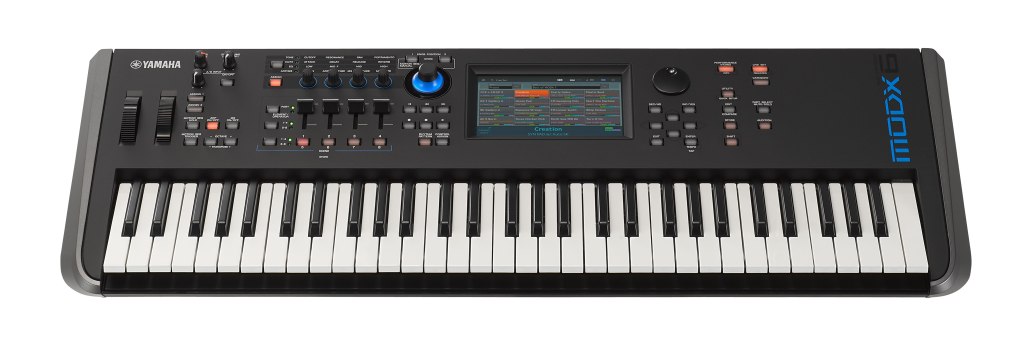
I’ve had it for three months now and it sounds fantastic, but in terms of it’s potential… I feel that I’ve only scratched the surface!

