It’s a sad reflection on modern society that increasing numbers of people choose to believe unsubstantiated stuff they see on the internet. They find that the stuff put out by flat-Earthers, anti-vaxxers, climate change deniers, chem-trailers, etc. resonates with them more than (say) the advice of experts, rational argument, and (dare I say) real science, despite the often overwhelming consensus amongst the experts.
Regarding Covid-19, many prefer to believe that curfews, masks, social distancing, vaccines, etc. are just a way of controlling the populace. In fact the pandemic seems to have brought the conspiracy theorists from out of the woodwork. In the last few months, I’ve read…
- It’s a left-wing hoax
- It’s no worse than flu
- The virus was bio-engineered
- Spikes are due to increased testing
- Hydroxychloroquine is an effective treatment
- Masks don’t work
- It’s caused by 5G networks
- It’s a hoax by Anthony Fauci and Bill Gates to empower wealthy elites
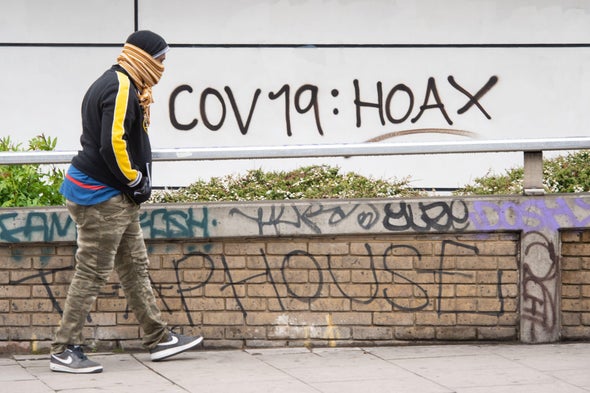
Some people are making up their minds based on disinformation, and often scant data, and no amount of real evidence will change their minds. In an ideal world, we would all ignore theses people and their opinions, but I do accept that it’s often a struggle to know what or who to believe. Especially at times like these with a relatively new virus, where new factors are emerging all the time, and when even the experts disagree occasionally!
It’s because of all the nonsense (non-science?) out there that I thought I’d have a go at separating fact from fiction. If you get your scientific opinions from social media, or the likes of Donald Trump or David Icke, then you should probably stop reading now!
Note that most of the information that follows was gleaned from the World Health Organisation, and institutions like the NHS, the CDC, The Mayo Clinic and the John Hopkins University, many of whom are in the forefront of research into the virus. My sources are listed at the end.
The Pandemic
Covid-19 is forcing us to accept a new normal. No-one knows how long it will be with us, but it may well here for the indefinite future. There is no reason believe that it will peter out like SARS or H1N1. It is organically and pathologically different to any previous pandemic, and fundamentally different to flu, including the Asian, Hong-Kong and Spanish flu varieties of the last century. We can’t fight it, so until we can acquire some sort of immunity, we have to live with it.
Managing the virus
I see only three realistic strategies for managing the virus…
1) Protect the vulnerable, but otherwise let it rip through the population, until it eventually dies out as a result of herd immunity.
2) Manage it with social distancing, mask wearing, hygiene and common sense.
3) Vaccinate everyone
Taking the options one by one…
1) Experts think that defeating the virus by herd immunity works when 60% to 80% of the population has the antibodies, and after more than six months exposure, most countries are currently no more than 8% – 10%, so it could take years to get there. Furthermore, it’s just emerging that people are getting reinfected, which implies that immunity only lasts for a few months; if this is the case herd immunity will not cause the virus to die out.
2) Most countries have adopted this approach, with full lock-down, or at least strict controls at the start of the pandemic, just to bring the infection levels down and to avoid health services being overwhelmed. Then a gradual relaxing the controls when the numbers are down, and micro-managing the situation with local lock-downs and stricter controls, whenever spikes start popping up.
3) An effective vaccine is the ultimate solution for getting life back to normal, but it could be months or even years away. Some experts say it may not confer total immunity, and some even think an effective vaccine may not be possible.
All affected countries are watching each other’s management of the virus, and we can at least draw on the experience of the more successful countrys strategies, and not just for healthcare. And by the way, it’s a misconception that Sweden is, or was pursuing a policy of herd immunity. Their philosophy was merely one of common sense and voluntary social-distancing; not closing schools and businesses, but banning gatherings of more than 50 people. However, Anders Tegnell, one of the leading architects of their strategy has said that with hindsight, too many people died, and they should have taken more care to protect the vulnerable.
If the UK briefly considered herd immunity, they quickly realised that this approach would overwhelm the health services. As far as I know, all the major industrialised nations all consider heard immunity to be a non-starter.
Virulence
The ‘infectiousness’ or ‘ease of transmission’ of a disease is called the R0 number, and assumes an infected person behaving normally, amongst a population not taking any special precautions against the virus. The R0 for normal Flu is around 1.3, so if a person carrying the disease is out in public, he or she will give it to (on average) 1.3 other people. Each one of those will give it to 1.3 more, and so on. After the 10th cycle, there will now be around 54 people with Flu.
The R0 for Covid-19 or Coronavirus is thought to be around double, so let’s call it 2.6. Doesn’t sound much does it? The infected person going amongst an unprotected public will now give it to 2.6 people. But if you crunch the numbers, after 10 cycles the illness has now been passed on to 23,000 people!
Furthermore, people succumbing to flu are asymptomatic for 2 – 4 days… with Covid-19 they can still be in circulation for up 14 days before developing symptoms.
Note… The R0 number is defined as “the expected number of secondary cases produced by a single (typical) infection in a completely susceptible population”. In other words, it should be a constant. Regular Flu has an R0 of 1.3, Tuberculosis is around 4.0, and the staggeringly virulent Measles is around 15.
However, some people, including the media use the R0 number as a sliding value to reflect the effective rates of transmission, after measures to control the spread have been factored in. For example, we often see statements like “The R0 in Greater London is now down to around 0.8”. I was unhappy with this as it meant that there were two different usages for R0. I researched this and found that there is a term for the ‘the effective rate of transmission’ (and one that the media should be using); it is Rt(R subscript t), or occasionally Re (R subscript e).
Superspreaders
Based on what we now know about how the disease is transmitted, including factors such as hand washing, mask wearing, proximity, ventilation, time of exposure, as well as things like talking, singing, shouting, kissing, and possibly sexual contact, it’s clear that an R0 for Covid-19 of 2.6 is just an average.
For example if a person carrying the disease goes to a crowded party, it’s possible, even likely that he/she will give it to a lot more than 2.6 people; the effective R0 for this person in this situation could well be in the order of 30 to 40, and the party becomes a superspreading event.
Furthermore when the authorities have declared that gatherings of more than (say) 6 people are illegal, anyone who attends such a party is more likely to have scant regard for rules and guidelines on hygiene, mask-wearing, social distancing, as well as future illegal gatherings. Such people, if they are amongst those who picked up the virus, for as long as they are asymptomatic they will have higher R0s and should be thought of as superspreaders. These people may be in the minority, but they have a disproportional impact on the spread of the disease.
Pathology
The Case Fatality Rate (CFR) of Covid-19 is in the range 0.9% to 10% of infected people, depending on age and underlying health, but averages at around 3% across the population.
But the fatality rate isn’t the whole story. People who’ve had ‘mild’ cases describe symptoms of extreme fatigue, coughs, fever, shortness of breath, and chest pains. Many have needed hospitalising. Very mild cases may only last a few days, but for most, it’s an unpleasant 8 to 14 days of illness, and then 14 days quarantine. More severe cases may last three to six weeks plus quarantine. Many have likened it to the ‘worst flu of my life’.
Early in the development of the pandemic, doctors, epidemiologists and immunologists were unanimous in thinking that patients who produced high quantities of antibodies early in the infection would become free from disease. It’s now emerging that the immune system’s response to Covid-19 can be to overreact and it seems that the inflammatory processes necessary to fight the infection are often causing long-term harm to the patient. Checkout Cytokine Storms.
After ‘recovery’ from infection, there are increasing numbers of reports of residual problems including chronic fatigue, lung damage (Post Covid Fibrosis – possibly requiring surgery and/or organ transplants), kidney damage, Myocarditis (inflammation of the heart), and what a lot of sufferers describe as ‘brain fog’… an inability to concentrate and/or remember things. Many people are still off work several months after the initial illness. An Italian study found that 87.4% of recovered Covid-19 patients “reported persistence of at least 1 symptom”.
From a Guardian article…
Conventional wisdom suggests that when a sickness is mild, it’s not too much to worry about. But if you’re taking comfort in World Health Organization reports that over 80% of global Covid-19 cases are mild or asymptomatic, think again. As virologists race to understand the biomechanics of Sars-CoV-2, one thing is becoming increasingly clear: even “mild” cases can be more complicated, dangerous and harder to shake than many first thought.
Doctors now know that Covid-19 not only affects the lungs and blood, but kidneys, liver and brain – the last potentially resulting in chronic fatigue and depression, among other symptoms. Although the virus is not yet old enough for long-term effects on those organs to be well understood, they may manifest regardless of whether a patient ever required hospitalization, hindering their recovery process.
Another troubling phenomenon now coming into focus is that of “long-haul” Covid-19 sufferers – people whose experience of the illness has lasted months. For a Dutch report published earlier this month (an excerpt is translated here) researchers surveyed 1,622 Covid-19 patients who had reported enduring symptoms; the patients, who had an average age of 53, reported intense fatigue (88%) persistent shortness of breath (75%) and chest pressure (45%). Ninety-one per cent of the patients weren’t hospitalized, suggesting they suffered these side-effects despite their cases of Covid-19 qualifying as “mild”. While 85% of the surveyed patients considered themselves generally healthy before having Covid-19, only 6% still did so one month or more after getting the virus.
So even ignoring the mortality rate, it’s clear that Covid-19 is not a trivial illness. Factor in the emerging problem of residual effects from the virus, as well as the high degree of virulence, and it means that the virus cannot be compared with seasonal bugs like colds and flu. Without measures to control the rate of spread, Covid-19 will have a major impact on the health of the workforce of every affected country for the indefinite future, and I doubt that there are many economies that could withstand this for long.
The most authoritative and non-technical article on Covid-19 pathology is this:- https://post.parliament.uk/short-and-long-term-health-effects-of-covid-19/
Most countries have considered it worthwhile immunising populations against diseases such as polio, tuberculosis, diphtheria, smallpox, etc., and given the factors above, it’s understandable why most nations are considering Covid-19 to be at least as serious.
Covid-19 is not like other recent pandemics. I remember both Asian and Hong-Kong flu, but the reason why there was no lockdown and no general panic is that the mortality was 0.3%… not much different from normal flu. I imagine the reason why it was considered a pandemic was that the R0 was higher than normal flu. In the case of C-19, asymptomatic phase is much longer, the contagiousness is worse, and the mortality rate is higher. Triple whammy!
Facemasks
Firstly, just about every country has satisfied themselves that masks do work. They don’t offer major protection for incoming bugs, but they prevent most droplets going out. Despite what some world leaders and prominent personalities may say, there is no question in the realms of real science that overall, they limit the spread of the infection. And when everyone wears a mask, there’s a chance of stopping the bugs both outgoing and incoming.
Some facts about masks…
The Covid-19 virus in the range 0.06 micron and 0.14 micron in diameter, and the mesh of any mask is much too large to stop the transmission of individual viruses. But that’s not the intention; Covid-19 like most viruses needs moisture to survive; stripped of their cosy mucus environment they will quickly die, so individual viruses are not the real problem. Droplets of moisture containing the virus are what causes transmission of the disease, and masks are designed to filter these… up to 80% for regular masks, and up to 95% for N95 and FFP3 masks.
The Covid-19 virus in the range 0.06 micron and 0.14 micron in diameter, and the mesh of any mask is much too large to stop the transmission of individual viruses. But individual viruses aren’t the problem; it’s colonies of virus that cause the disease to be passed around. Covid-19 like most viruses needs moisture to survive, and without their cosy mucus environment they quickly die. Droplets of moisture containing the virus are what causes transmission of the disease, and masks are designed to filter these… up to 80% for regular masks, and up to 95% for N95 and FFP3 masks.
Note that some masks like the FFP2 and FFP3 masks are designed for medical professionals and vulnerable individuals for their own protection. They have an exhalation valve that allows unfiltered air to come out of the mask, so they are no good for the protection of others. They should be used in high-risk situations to protect the user, but not for general (ie. public) use. In fact medical professionals often use a conventional mask underneath the FFP3 mask.
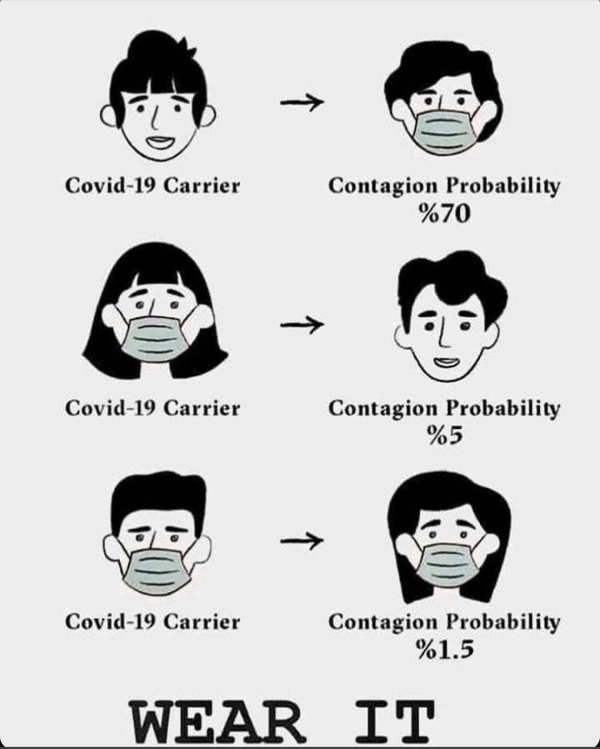
Some sporting masks also have an exhalation valve, and shouldn’t be used when close contact with others is possible. Th e advice to most of us is to use ordinary paper or fabric masks, whenever social distancing isn’t possible. As mentioned above, when both outgoing and incoming bugs are filtered, even with cheap disposable masks the total protection is close to 100%.
One last thing… the spread of the virus through coughs and sneezes was stressed at the start of the pandemic, but it’s clear that by that stage of the illness, the sufferers are already feeling the effects of the virus and have mostly self-isolated. It’s now emerging that a significant percentage of transmission is done by people who are asymptomatic and therefore still in circulation. They are not coughing and sneezing, but they are possibly leaving traces of the virus wherever they put their hands, hence the need for frequent hand-washing. The other method of transmission that I feel has been understated, is just talking in social and workplace situations. Like it or not, we all spray when we speak, so it seems self-evident that anything that contains these droplets will restrict the spread of the virus.
There is no question in the minds of epidemiologists and people who really understand the science… masks really do save lives!
The future
The correlation between the rate of new infections and the degree of ‘lockdown’ is quite striking.
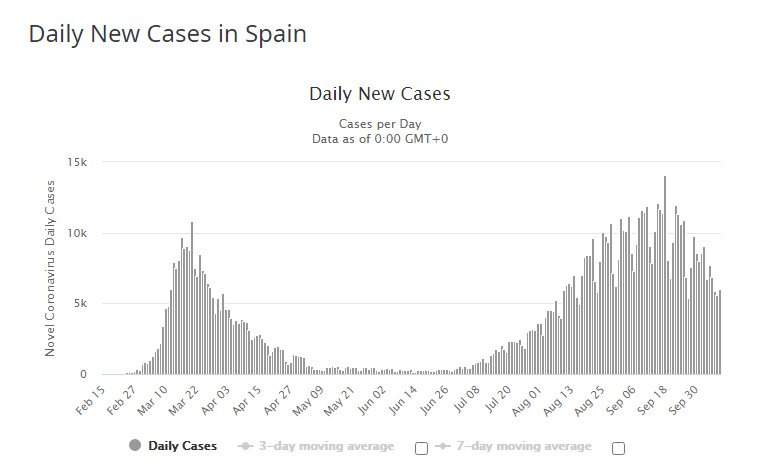
- F
ebruary 17th, first cases in Spain
- March 14th, full lockdown. Only essential business open, only travel permitted is to local shops.
- May 18th, some relaxations, some non-essential businesses reopen, bars and restaurants open (outside only), local travel. Masks and social distancing enforced.
- June 21st, National travel, regulated indoor dining, all businesses allowed to resume.
- July 1st, international travel resumes.
- July 27th, UK introduces quarantine for people returning from Spain.
So until there is a vaccine, we must choose between a future of indefinite cycles of boom and bust, just like this one; or a future like the period between May and June where new infections are kept to a minimum, but at a cost of behaving responsibly, and living with some constraints.
The world population at the moment is just under 8 billion, So far some 30 million (or 0.3%) have caught the disease, but without a vaccine, eventually everyone will have been exposed to it. Without improvements in the management of the virus, something like 3% of those that catch the disease will die from it. That’s potentially 220,000,000 lives lost, worldwide.
It will take years or even decades to reach this position, but the social and economic consequences together with the huge loss of life are inestimable. What is certain however, is that the possibilities include global recession or depression, the failure of some nation’s welfare systems, and the wholesale failure of businesses, starting presumably with the leisure industry. Longer term consequences will inevitably include mass unemployment, poverty, starvation, civil unrest and martial law.
Most countries apart from the almost criminally inept USA, Brazil, Belarus, etc. have adopted the strategy of managing the pandemic by having rules about masks, social distancing, social gatherings, etc., and then trying to avoid the return to full lock-down by managing any ‘spikes’ on a local basis. This is a compromise that keeps the economy going, and is probably the best that can be done until there is an effective vaccine.
Unfortunately, their efforts are being undermined by sections of the public clearly reluctant to modify their behaviour, who have contributed to recent spikes in most countries. It’s almost impossibly to watch the news without seeing footage of barbecues, beach gatherings, crowded bars and raves; all ignoring rules of social distancing. They are either determined not be ‘inconvenienced’ by the pandemic, or they are in the low-risk group and are prepared to take their chances of getting sick. Either way, their activities are spreading the virus and generating resentment amongst the rest of the population.
A classic example is the recent Sturgis motorcycle rally in South Dakota… a ten-day event of people in close proximity, most not wearing masks. Estimates about the consequences vary, but some put the number of unnecessary infections as high as 260,000, potentially 8,000 deaths, and a price tag of $12 billion.
I do sympathise with the world’s youth… their single lifestyles are compromised by the virus, as is their progress in education as well as their fledgling careers. I also sympathise with young adults starting families, with mortgages and heavy commitments in these times of financial uncertainty. I sympathise with the not so young adults, mostly still with mortgages and heavy commitments, but now becoming ‘at risk’ to Covid-19 and wondering about their long term employment prospects, as well as seeing their pension funds shrinking. But mostly I sympathise with the elderly, because they are in the high risk group, as are their partners and most of their friends. They are also acutely aware that the pandemic could outlast them.
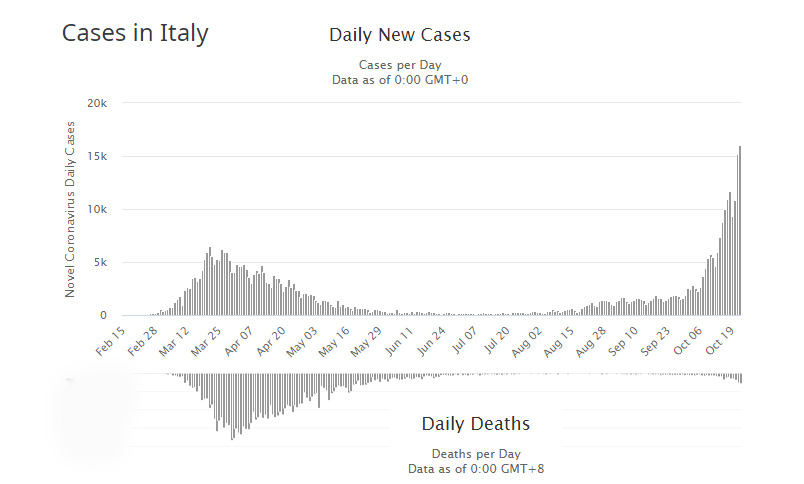
Above is a chart of the history of the disease in Italy (note that I’ve exaggerated the vertical scale of the deaths for readability – deaths actually peaked at around 900 in late March). It’s clear from looking at the two main peaks, that either the mortality rate of Covid-19 has dropped considerably, or that disproportionate numbers of younger people are being infected. And I’ve read no suggestion that the mortality rate is dropping, or that healthcare has improved dramatically. We are in the middle of a global pandemic, but sadly, too many people are unwilling to accept that this comes with some ‘inconveniences’, and we must get use to a ‘new normal’. The virus will not go away of it’s own accord, but If everyone used common sense, then new infections would be kept to a minimum, businesses could stay open and we’d all be able to enjoy a degree of freedom.
Those who go around saying that cure is worse than the problem, and refuse to modify their behaviour are being selfish, and they are exacerbating an already bad situation. They are forcing the authorities to react to spikes by imposing new rules and restrictions, and in the end everyone loses.
Perhaps it would help if this section of the public somehow felt a little less invulnerable. Possibly before they go clubbing, partying and generally dropping their defences, they should think of Covid-19 not so much as a bad cold or seasonal flu, but more like Viral Pneumonia with possible long term consequences.
Make no mistake; with it’s combination of high contagiousness, long incubation period, mortality rate, and longer term effects, Covid-19 is a big deal. Our main hope is an effective vaccine, and/or new drugs for treating the illness. In the meantime, it’s clear that we can’t rely on politicians to lead us through it, so the impact of the pandemic is really down to decisions each one of us makes. Even without laws and regulations, the numbers can be controlled if people behaved with a little more altruism, and a degree of common sense. Both of which sadly, seem to be in short supply.
As I finish writing this, I thought I’d include some details of the latest ‘spikes’ for the UK, France, Spain and Sweden (as at Sept 25th, 2020).
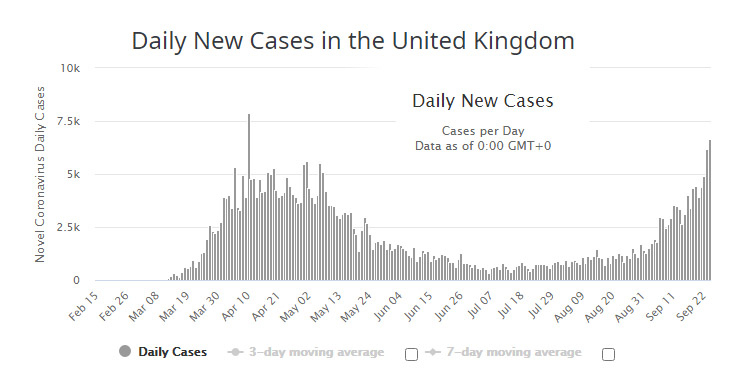
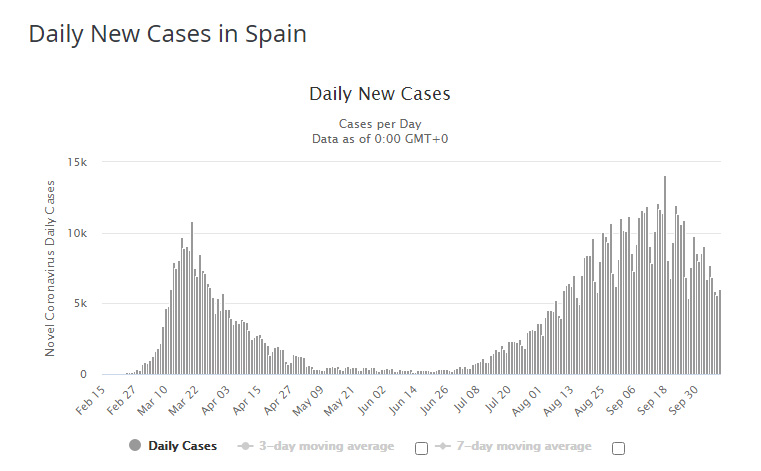
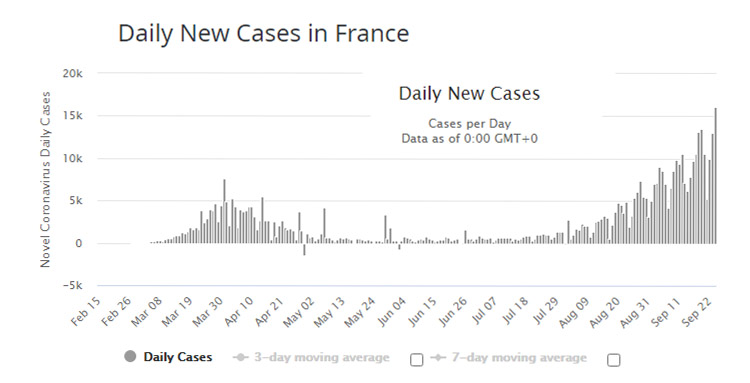
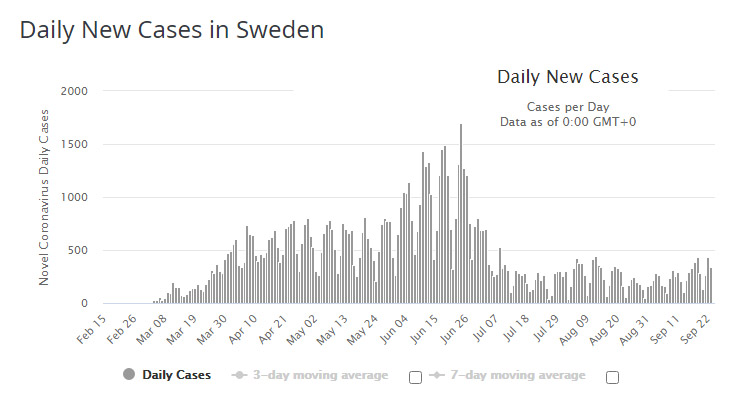
The clear take-away from this is that self-regulation and common sense is the key to managing the virus, and that Sweden is somehow better at it than most other countries.
Sources:
https://www.healthline.com/health/cold-flu/mask
https://www.frontiersin.org/articles/10.3389/fimmu.2020.01708/full
https://www.cdc.gov/nchs/nvss/vsrr/covid_weekly/index.htm#Comorbidities
https://www.healthline.com/health-news/what-its-like-to-survive-covid-19

