Why does the sound of thunder get “stretched out” the further away you are from the strike?
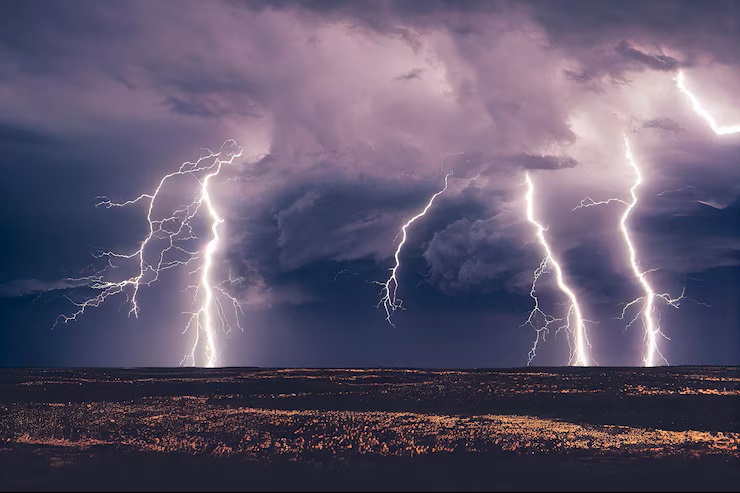
Funny you should ask… I grew up under the misapprehension that it was echoing around the area, reflected off hills, cliffs, buildings, trees, etc.
Then one day, I was in a very flat part of the world and noticed that thunder sounded the same there as anywhere else. Then there was a ‘Duhh…’ moment when the penny dropped.
Thunder is the sound of the rapid expansion of the heated air of a lightning strike… and a typical lightning strike, either cloud to cloud or cloud to ground, will have some horizontal dimension.
So the ‘stretched out’ is due to the speed of sound. You are hearing the nearest part of the lightning strike first and the furthest part last. Lighting strikes can be huge, and ones 50 miles long are not unheard of, but the average lightning strike is 6 miles long, so depending on where you’re standing, the sound from start to finish could be up to 30 seconds.
Time Zones
The Earth rotates every 24 hours, and is 24,000 miles in circumference at the equator, so this means (at the equator at least) the Sun moves through 1,000 miles in roughly 1 hour. We have divided the circle into 360 arbitrary divisions called degrees. On Earth we call this longitude, and by convention, it goes from 0 to +180 (going east), and 0 to -180 going west, so the Sun moves through 15 degrees every hour.
As a result, we have split the map of the Earth into (roughly) 24 time zones, approximately 15 degrees wide (1,000 miles at the equator). Unfortunately, countries are often odd shapes and rarely conform to the lines of longitude that delineate the time zones.
This leads to some anomalies, such as ‘fractional’ time zones. Instead of +1, +4, etc., Iran have chosen to be +3½, and Afghanistan +4½, some large countries have multiple time zones; the USA and Australia have 5 time zones, including in Australia’s case, 2 fractional time zones. And yet China, spanning 60 degrees of longitude only has a single time zone.
The Central European Time zone (CET) spans some 33 degrees, from Poland (24° E), to Spain (9° W). So sunset and sunrise across the region can be very different… for example on a typical day in October, Skopje in Macedonia: Sunrise 6:53 AM Sunset 5:43 PM. Santiago de Compostela in Spain 8:54 AM, sunset 7:41 PM… the same time zone, but a two hour difference in sunset and sunrise.
Orbital mechanics
I often thought I’d like to get a handle on orbital mechanics, but thought the maths would be horrendous.
And then I saw something in print that made me think about it. It was the oft-repeated piece of conventional wisdom about a returning space craft. If it comes in a too steep an angle, it will burn-up, if it comes at too shallow an angle it will ‘skip off’ the atmosphere, never to be seen again.
I started thinking about this latter point. Low Earth Orbit (LEO) is an arbitrary region normally considered to be 100 – 1,000 miles above the Earth. The ISS for example orbits between 230 and 286 miles above the Earth. LEO, which accounts for most manned missions, requires a typical orbital speed of 17,000 mph. But Earth’s escape velocity is 25,000 mph so for something to ‘skip off’ into deep space, where would the extra 8,000 mph come from?
It turns out that convention wisdom is misleading at least. If it came in at too shallow an angle, the craft would briefly become aerodynamic as it entered the upper atmosphere, and it could (sort of) skip-off, but not into deep space. It would just start a more elliptical orbit with a perigee (that part of the orbit nearest the Earth) at the height it ‘skipped’, but a new apogee (furthest point of the orbit) depending on the angle of the skipping.
In practice, it probably would mean the loss of the crew because things like fuel, oxygen and food will have been finely tuned. And even if they were able to de-orbit that next time at perigee, the recovery vessel/crew would probably be in the wrong place. But… and this is my point, the craft is still in orbit.
It turns out that any acceleration or deceleration during an essentially circular orbit, will make the orbit elliptical. This is the basis of de-orbiting, where the de-orbit burn causes the craft to slow-down and into a parabolic trajectory that intersects the ground. It’s also the basis of something called the Hohmann transfer which allows a craft or satellite to go from an initial LEO to an HEO. It would need a critical engine burn to create an orbit with an apogee at HEO. When the craft gets to the apogee, it does a deceleration burn to return to a roughly circular orbit.
I also realised that the speed to maintain a circular orbit decreases with height. LEO is around 17,000 mph; HEO is around 7,000 mph. And the altitude at HEO (geosynchronous) is around 22,500 miles.
Our deep space missions such as visits to the Moon, Mars, asteroids, and the moons of other planets, also mean starting at LEO, then doing a Hohmann transfer to create an elliptical orbit that intersects with where the destination (Moon, Mars, etc.) will be when the craft gets there. This is also true of the Pioneer and Voyager missions to get as far as Jupiter, where they then used gravitational assists to gain velocity, and are now on their way out of the Solar system, having achieved escape velocity. Voyager 2 for example is currently moving at 35,000 mph.
There are no straight lines in space… gravity is everywhere, so everything is orbiting something!
The Apollo missions relied on technology the equivalent of the Commodore PET or the Apple II for computer control; it was called the Apollo Guidance Computer (AGC). The crew had to determine the craft’s true position with a sextant, and then enter occasional course corrections into the AGC.
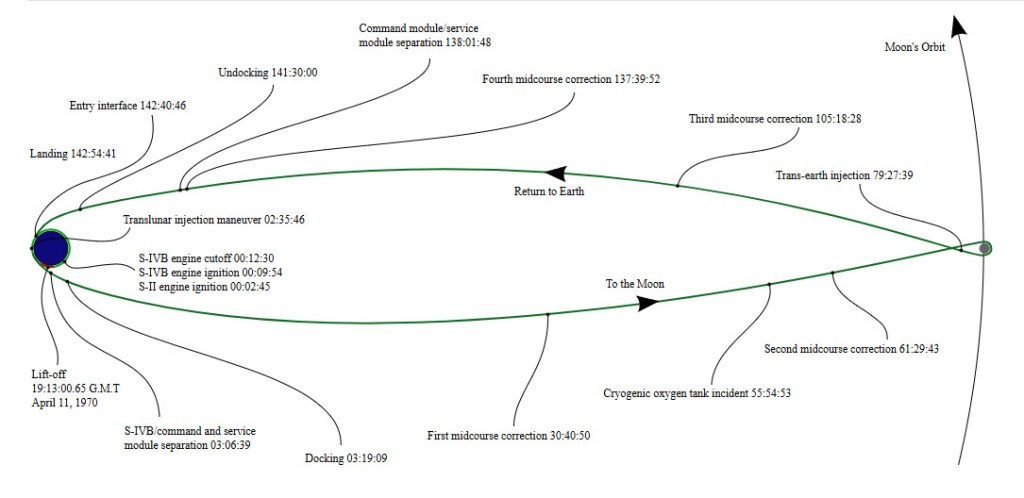
Further reading:
The Apollo flight journals: https://www.nasa.gov/history/afj/index.html[RJ1]
The Apollo mission: https://en.wikipedia.org/wiki/Apollo_11
Then there’s the Sun. The Earth orbits the Sun in a stable and slightly elliptical orbit, only 1.7% from a perfect circle. One might think, because of the size and gravitational pull of the Sun, it would be relatively easy to send a spacecraft there. The reality is very different… the Earth’s orbital speed is 67,000 mph. A rocket launched and accelerated to Earth escape velocity would still be carrying too much sideways velocity to go there, and would just end up in a more elliptical heliocentric orbit.
The Parker Solar Probe launched in 2018 used NASA’s heaviest rocket, the Delta IV, and still needed to perform seven separate gravity-assist flybys of Venus to slow down enough to enter the Sun’s outer atmosphere for it’s mission objectives.
And talking of gravity assists. When I was following the Voyager missions in the 1980s, it was never clear to me how falling into the ‘gravity well’ of a planet would boost the speed of a craft, because you’d then lose the extra speed leaving the ‘well’.
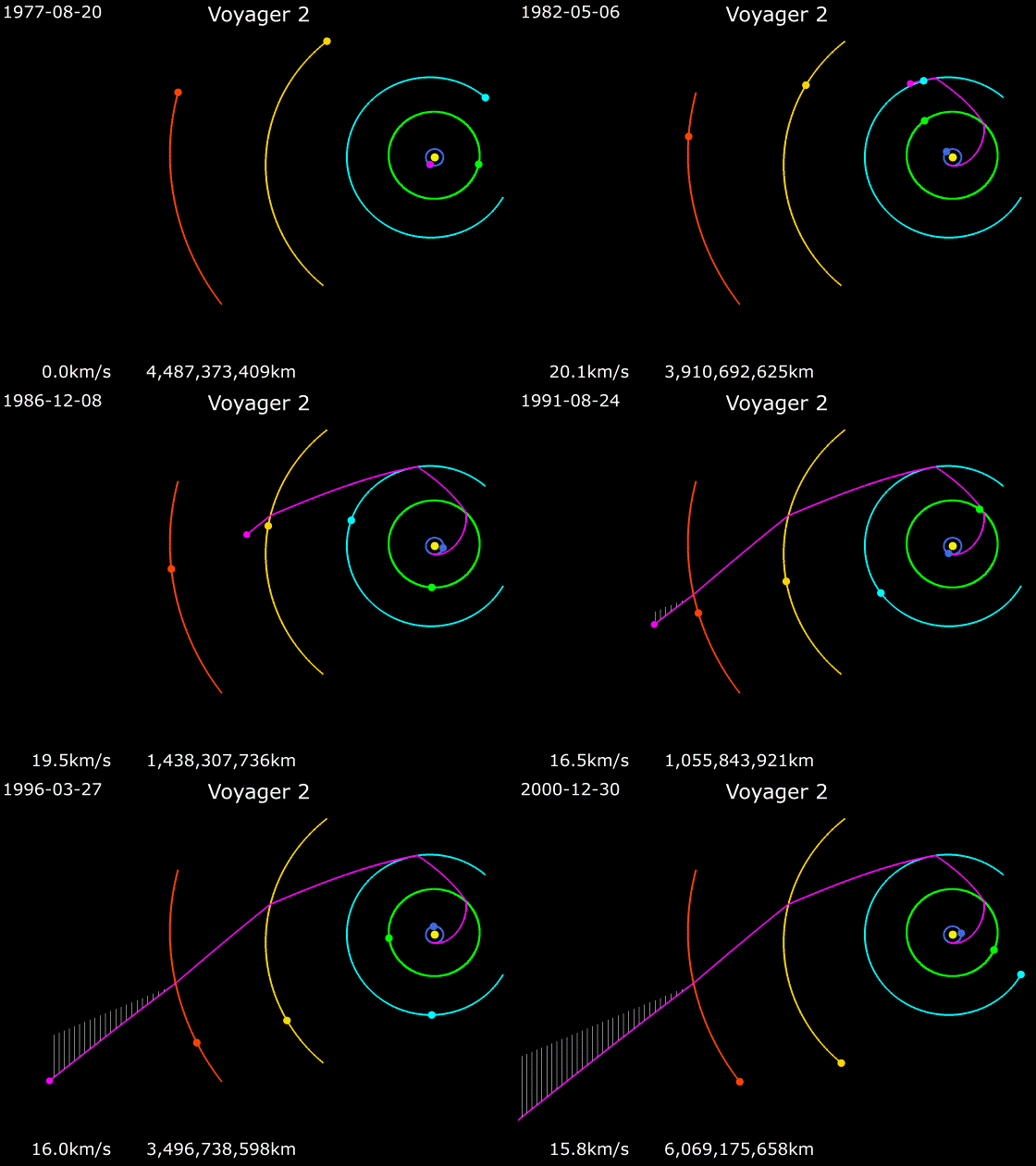
The key to understanding this is that the term ‘gravity assist’ is a little misleading; what’s actually happening is that the craft approaches behind the planet, then picks up the planet’s gravity and gets swung round to a new trajectory, but… and here’s the key to it… in doing so, it steals a little of the planet’s orbital energy, and is now travelling faster than it was.
And as with the Parker Solar Probe, by approaching the leading side of the planet’s orbit, gravity assist can be used for slowing a craft down.
And moving neatly to the subject of Black Holes…
Black Holes
I say neatly, because most of the Orbital Mechanics discussion applies to Black Holes.
A black hole is when a star of sufficient mass ends its life, it explodes in a supernova, and the remaining mass collapses to the point where the laws of physics break down, and it has no physical dimension – a singularity.
I know the media likes to portray black holes as cosmic vacuum cleaners; the ultimate doomsday machines, sucking-up entire star and planetary system as they go on their merry way.
But that’s not really the case. They orbit their galaxies in much the same way as stars do, and if the Sun were to be replaced with a one-solar-mass black hole, the Earth would continue in its present orbit. Most black holes will have objects orbiting them in completely stable orbits. They have escape-velocities, and some even have the remnants of a planetary system that survived the supernova.
The main danger of black holes is that even though they have collapsed into a singularity, they are gravitational monsters, typically from 10 to 100 time the mass of the Sun. So they will attract other nearby objects. But referring back to orbital mechanics, the relative motion of these objects would mean that rather than spiralling into the black holes, they are merely ‘captured’ by the black hole, and will probably enter a stable, if highly elliptical orbit.
The other danger is because a black hole is a singularity, the gravitational (or tidal) gradient is sudden. At around 30 km from a 1 solar mass black hole, the gravity at your feet is several times the gravity at your head. So at 1,000 km, you’re safe, 100 km – safe, 50 km – safe, 10 km – dead.
One more thing… the event horizon (or Schwarzschild radius) of a black hole is of course, the point of no return, where nothing, not even light can escape. The event horizon of a small (1 solar mass) black hole is just under 3 km, and the event horizon of a million solar mass monster (like in the centre of galaxies) is 2.95 million km. This means that actually, the tidal gradient on the small black is much greater than the large one. This leads to the odd situation that you could survive the trip to the event horizon of the monster black hole – and even enter it. Even if you could never go home!
How fast does electricity travel?
When we think of electricity travelling in a wire, we may be inclined to think of electrons zooming through the wire at close to the speed of light. So it comes as a shock to some of us to learn that electrons move along the wire at just a few centimetres per hour.
And it turns out that the cable doesn’t even carry electricity in the conventional sense. The cable merely acts as a ‘wave guide’ and it’s the electromagnetic field surrounding the cable that actually carries the current.
This field is created at the speed of light, so effectively electricity travels at, or very close to the speed of light, but the point is, it’s not electron flow in the conductor that does the work.
Sci-fi plot device
Invent a time-machine, go back in time, put some money in the bank and be fabulously wealthy when you return to the present. Great idea, right?
Wrong! Firstly, there’s the logistics. We don’t have the time-scales that work in Sci-fi stories, but let’s say we were able to go back 2,000 years to Roman Britain… what would you take with you? Present-day sterling or even Euros wouldn’t get you very far. How about a gold bar… not much use banking that; 2,000 years later you’ve still just got a gold bar. Maybe locate some 2,000-year-old Sestertii, and take those. OK, now we’re talking; stick those in a Roman Bank, and return to your own time and see how rich you’ve become. YES! But wait a minute… you paid £300 for each coin before you went back, and now you’ve just got bank credit in Euros! OK, how about converting the gold bar to Denarii when you’re back in time? Sadly, gold was worth less then and doesn’t buy many Denarii.
It’s difficult to imagine a winning scenario when you’re making an investment, and letting it do all the work. Even if you had a currency that was legal tender over a useful time period, it’s one of the unspoken laws of economics that you’ll find any safe investment has lagged behind inflation, so whatever you end up with has less buying power than when you made the investment. Unless of course, you’re willing to speculate, and risk losing all your money.
The best idea is the premise of Back to the Future… go back a few years with a sporting almanac, or invest in Microsoft when they were a startup!
Steering a straight line
The penny dropped on my first cruise, when I noticed on the cruise information channel, that our heading varied slightly every day. Obvious when you think about it, that to steer in a straight line on a sphere (aka. great circle route), your angle to the magnetic north is constantly varying.
In actual fact, if you just maintained a fixed compass heading for long enough, then one of three things will happen. 1) if your heading is an exact right-angle to the north magnetic pole (so 90° – easterly, or 270° – westerly), you will circle around the magnetic north pole until you return to you starting position. 2) If it’s less than a right-angle, you will spiral upwards until you reach the NMP. 3) if it’s more than a right-angle, you will spiral downwards until you reach the south magnetic pole.
In the old days, sailors would follow a compass heading until using celestial navigation, the error was noticeable, and they would make course corrections. So steering a great circle route would in practice be a series of short curves. Since satellite navigation, you enter your destination or waypoint, and the resulting course is closer to a straight line, but since your position relative to the GPS satellite(s) is constantly changing, a straight line is actually a series of micro-adjustments. And of course it needs to take into account wind, currents, and the fact that the Earth is not a perfect sphere, and nor is the surface of the sea a uniform height.
The inverse square law
It’s reasonably intuitive to accept that gravity diminishes with distance, but why the “inverse square law”? And then I read about a guy who was burning some rubbish on a bonfire, and he’d inadvertently left a box of .22 bullets in the rubbish and didn’t realise until he heard a funny ‘popping’ sound, followed by zinging in the trees around him, and he quickly ran indoors.
I started thinking about the sphere (OK, in real terms, a hemisphere!) of danger centred on the bonfire. At 6 ft, the sphere would have a surface area of 4πr2, so 12.56 x 36 = 452 ft2. At 6 ft, a grown man would present a pretty big target. At 60 ft, the sphere would have a surface area of 45,239ft2, so a much smaller chance of being hit; the surface area had increased by r2, so the danger had diminished by 1/r2… the inverse square.
The same would be true of anything that spreads outwards from a single point… light, radio waves, gravity, etc., the danger/brightness/intensity will be inversely proportional to the square of the distance.
Why is the sky blue?
If you asked this at school, your teacher would probably say something like this:
“Yes, it’s because blue light is scattered more than red light”
…which probably means he doesn’t know either, because it doesn’t really help!
If you look at the regular science web sites like Wikipedia, you get similar explanations, and quickly descends into abstruse discussions like…
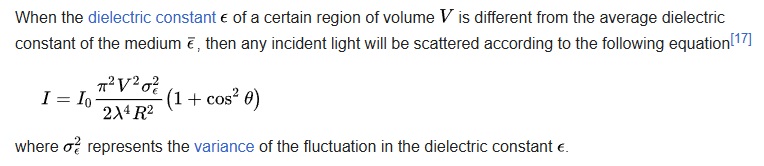
The ‘Duhh’ moment for me was the simple realisation that without any scattering, the sky would essentially be transparent, and away from the Sun, the sky would be black.
The scattering is due to light hitting gas and other molecules in the atmosphere. Blue light dominates because the scattering is inversely proportional to the wavelength of the light; blue light is at the short wavelength end of the light spectrum and so gets scattered more. Of course, violet is even shorter, but our eyes are less sensitive to the violet range. It probably goes without saying that if the scattering was the same for all wavelengths, the sky would be white.
When the Sun is near the horizon at sunrise and sunset, the sky appears richer in reds and oranges, because the sunlight that reaches us has travelled on a much longer path through the atmosphere, and most of the blue light has been scattered out.

