Forward
I decided to jot down some thoughts about my father who died some 40 years ago. I realised that if someone didn’t, as the surviving person who knew him best, the memory of the person he was would largely disappear with me. I’m also aware that his story is similar to that of many thousands of other men of his generation, who through circumstances beyond their control, had largely unfulfilled lives and to some extent, became forgotten men… at best, just family footnotes.
My Dad was married during the war, a father by the end of the war, demobbed from the army at a time when millions of others were all looking for work in civvy-street, ended-up doing heavy, dirty work on a three-shift system for thirty-odd years, and then died on his 65th birthday, enjoying not a single day of what would have been a well-earned retirement.
Looking back to my childhood, I realise now that he had spent most of his life running just to stand still.
The Beatles got it right when they said “that a man must break his back to earn his day of leisure”.
Before fatherhood
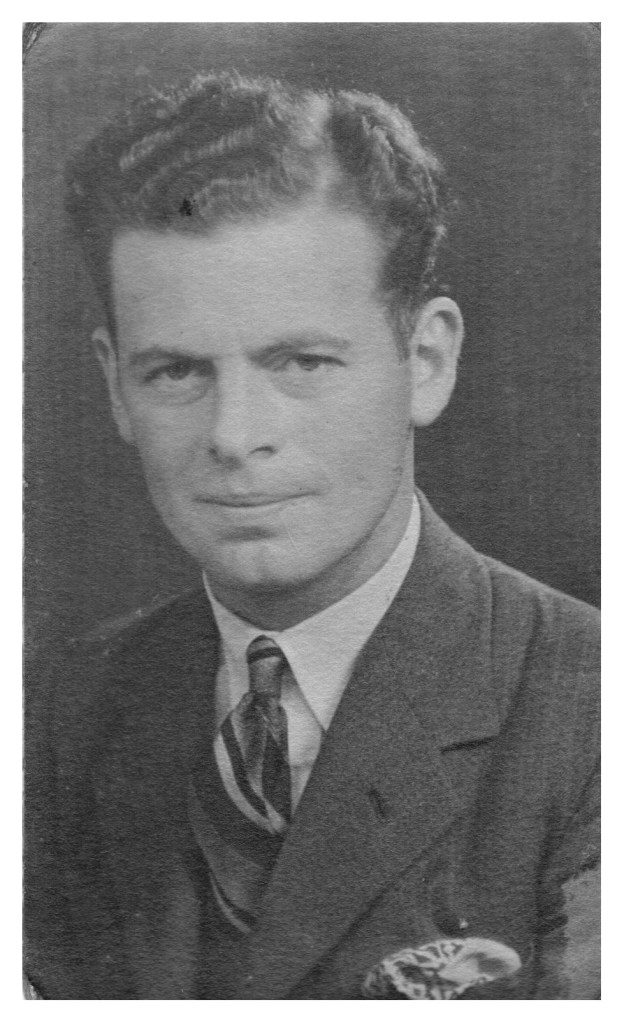
He was born Thomas Charles Wilson on December 5th, 1914, son of Thomas Charles (yeah I know… people were a little conservative naming their kids in those days) and Elizabeth Wilson (nee King). His father’s occupation was described as chauffeur, his grandfather on his father’s side, as coachman, and his grandfather on his mother’s side, as farmer. I’m not aware if his mother or grandmothers ever had careers, but somehow, I doubt it. He was an only-child who spent his childhood in West Derby, a largely working-class suburb of Liverpool.
At some point, and for reasons lost to me, he became known to the world as Jack Wilson. I’m not sure what he did in the few years of adulthood before the war, but at the onset of the war, he joined the Corps of the Royal Electrical and Mechanical Engineers (REME). His barracks were near Derby, which is how he eventually met my mother.
I know he saw active service in Libya, and I used to enjoy looking through his albums of colourised photos of Venice, where he presumably stopped en-route to and from Libya. I once asked him (as a kid of probably around eight) if he got injured during the war. “Only once when I was carrying a plate of sausages and someone stabbed my thumb thinking it was another sausage”. I was proud of this little anecdote, and used to relate it to family and friends (who’d probably heard it a hundred times!).
Before I continue, just a little about my mother. In 1942, she married a soldier called Bill, who was killed in a ‘friendly fire’ accident just days after their honeymoon. So when my Mum met my Dad, in 1943, she hadn’t really gotten over losing Bill. She wasn’t ready for big commitments, but Dad was persistent. With hindsight, it’s obvious that their marriage was built on shaky foundations. It didn’t help that her family and friends all still loved and missed Bill, and didn’t really warm to my Dad. But in any case, she married him in September 1944 and by Easter of the following year, found she was pregnant (with me!)
Sadly (at least to hear my Mum say it), my Dad was horrified to learn that he was going to be a father! I’m not sure what this says about their approach to family planning, but I can sort of sympathise; six years of war-time austerity, the separation, worry about the safety of loved-ones back home during the blitz, the stress of a war-time posting near the front line, etc. I imagine he was just looking forward to a period of normality with the woman he loved, and suddenly he’s a father with responsibilities, but no job. Anyway, I was born in my grandparent’s house, just after the war ended in September 1945. My Dad was still abroad at this time.
A family man
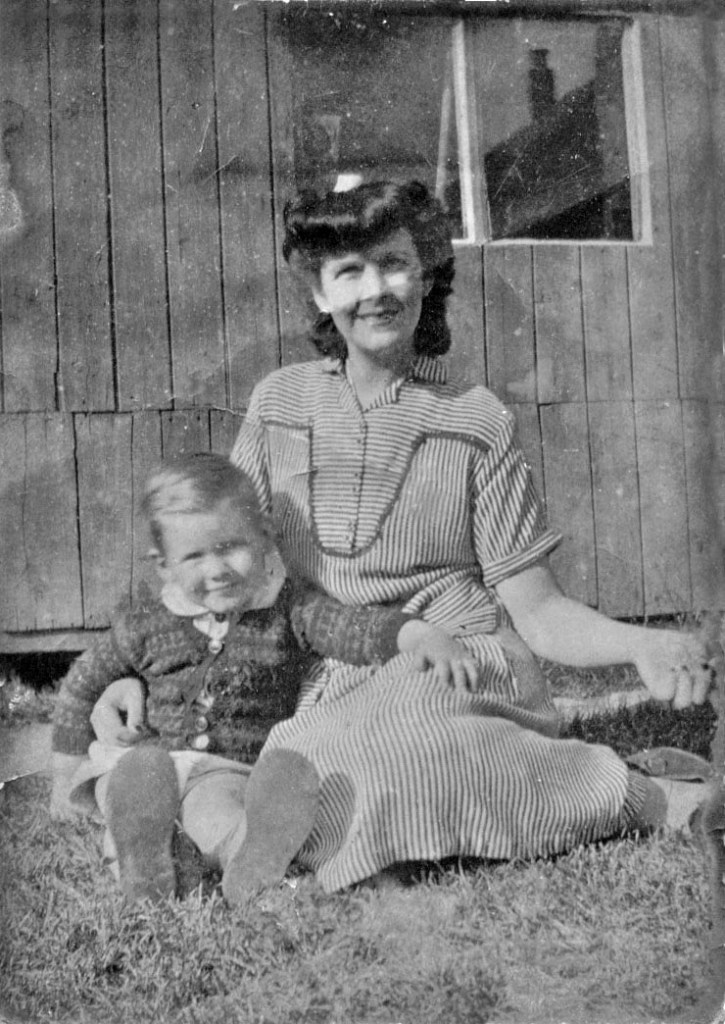
I only found out after he died, going through his old text books in the loft, that in his spare time during the war, he had studied areas of interest that he didn’t get chance to at school; science in general, and chemistry in some depth. I took chemistry and physics ‘O’ level, and after a cursory inspection of the text books, I realised this was pretty advanced stuff. I suspect if he’d been allowed, he would have easily qualified for a BSc in chemistry. I imagine that’s the field he’d hoped to get into in civvy street.
Sadly, the reality was somewhat different. When he was demobbed, Mum, Dad and baby me first went to Liverpool where we stayed with his mother, while he looked (unsuccessfully) for work. They then returned to Derby and lived with my grandmother and grandfather, with him still looking for work. I’m not sure how long it took him, but he eventually found a job with the British Railway Locomotive works in Derby as a fitter. It was a dirty, heavy job, and presumably nothing like the sort of career he’d hoped for. Furthermore, because of under-investment in the railway system, it was necessary for the workforce to work a three-shift system, so they got maximum utilisation of the factory floor space. And like most blue-collar jobs in those days, it didn’t pay particularly well, so I’m sure he would have done overtime when it was available.
My earliest recollections are of him coming home dirty, exhausted and not surprisingly, irritable. He and my Mum used to bicker and argue about silly stuff; His wages didn’t go very far, so money shortages probably didn’t help. Looking back, it was obvious that they both had different reasons to be disenchanted with their situation.
My sister Sharon was born about 5 years after me, and again he was an absentee father, electing to spend the time of my Mum’s confinement with his mother in Liverpool. One of my earliest memories is of Mum and I riding back from the hospital in a taxi with my new sister Sharon.
Over the ensuing years, despite the tiredness, disruption to normal life caused by his shift working, and later the ill-health, I can’t really claim that he took his irritability out on me or my sister, but suffice it to say that he was mostly a negative figure in my life. There were plenty of clips around the ear, or slapped legs, but very little in the way of fatherly love. And of course, woe betide anyone who woke him when he was sleeping off his previous shift. It’s probably fair to say that during his working week, he was like a bear with a sore head, so there was little in the way of quality, family time. The weekends were slightly better, but often eroded by his sleeping off the Friday night-shift.
This situation continued for another 8 years, without much improvement in family harmony, until in 1959 when I was 13, he and my Mum were divorced. Anyway, I’m going to stop dwelling on the negatives, as I don’t think this reflects the person who he was inside. What follows are some of my fonder memories of my childhood, and specifically, my relationship with my Dad.
Holidays and interests
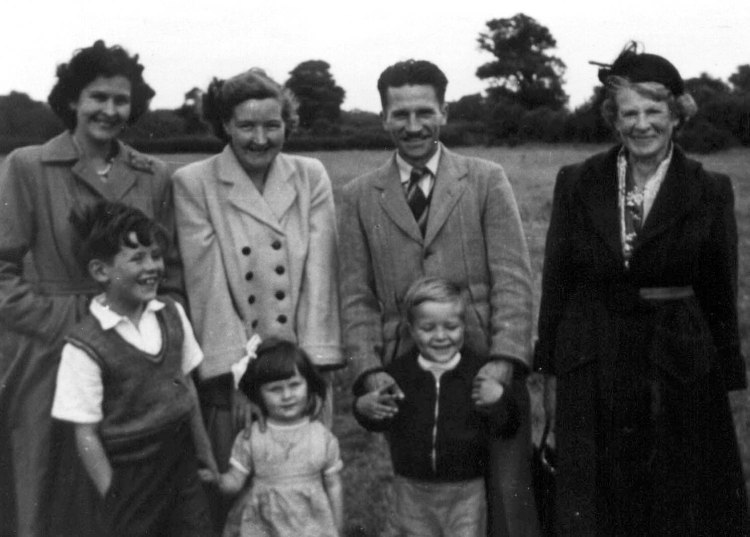
OK, so most of the time, there wasn’t much in the way of fun for my Dad, nor for my Mum, who for most of my childhood had day jobs or evening jobs, and sometimes both, just to try and make ends meet. The highlights in their lives were probably the regular (monthly?) get-togethers with their friends Mick and Kath Doré, and their kids Tony (a couple of years younger than me), and Julie (a couple of years younger than Sharon). These social events would have to coincide with shift changeover for both my Dad, and also for Mick Doré who at the time, also worked at the Derby Loco works.
There was still very little money around for either family, but courtesy of cheap rail travel, the two families started having regular Sunday hikes in the Derbyshire hills. At the end of a long day, we’d get back to one or the other of our houses, exhausted but with huge appetites.
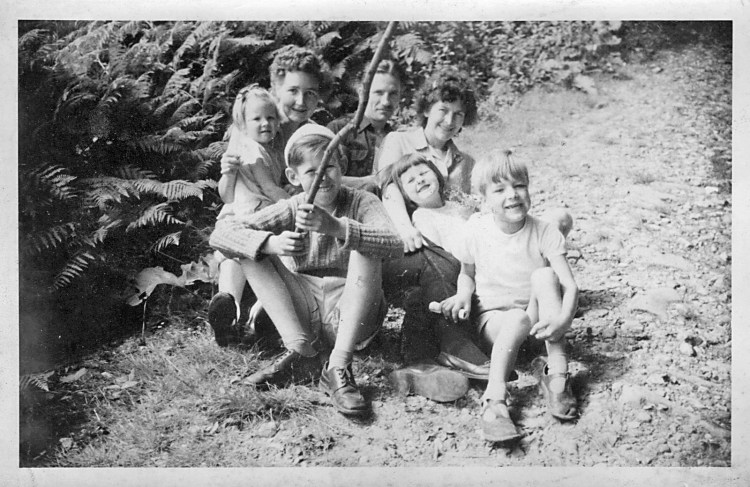
The Mums would disappear into the kitchen, and half an hour later, dinner would be served… a mountain of chips (cooked in dripping of course), and a pile of bread and butter. We’d tuck in with gusto, and we’d pity the toffs in Surrey and Berkshire, who were probably unaware of such pleasures!
And pursuing the theme of “We made our own entertainment in those days”, one of the ways our family would spend a summer evening was to take a corporation bus around Derby’s ring-road. It would take about an hour, and we’d end up back where we started. On rare occasions, we might break the journey and stop off at a pub, where Mum and Dad would sit inside the ‘Snug’ nursing a small beer for an hour or so, and Sharon and I would sit in the beer garden with a glass of orangeade and a packet of crisps.
Regarding conventional family leisure time, most of the time, this would just be trips to the local parks, and if we were lucky, Mum would have packed a few sandwiches for a picnic. Our local park had large lake with boat hire. Just occasionally, we’d be treated to a trip round the lake in the motorboat. In terms of holidays, it was mostly just the odd day-trip to Skegness, Rhyl and Colwyn Bay; and New Brighton and Southport if we were visiting Liverpool.
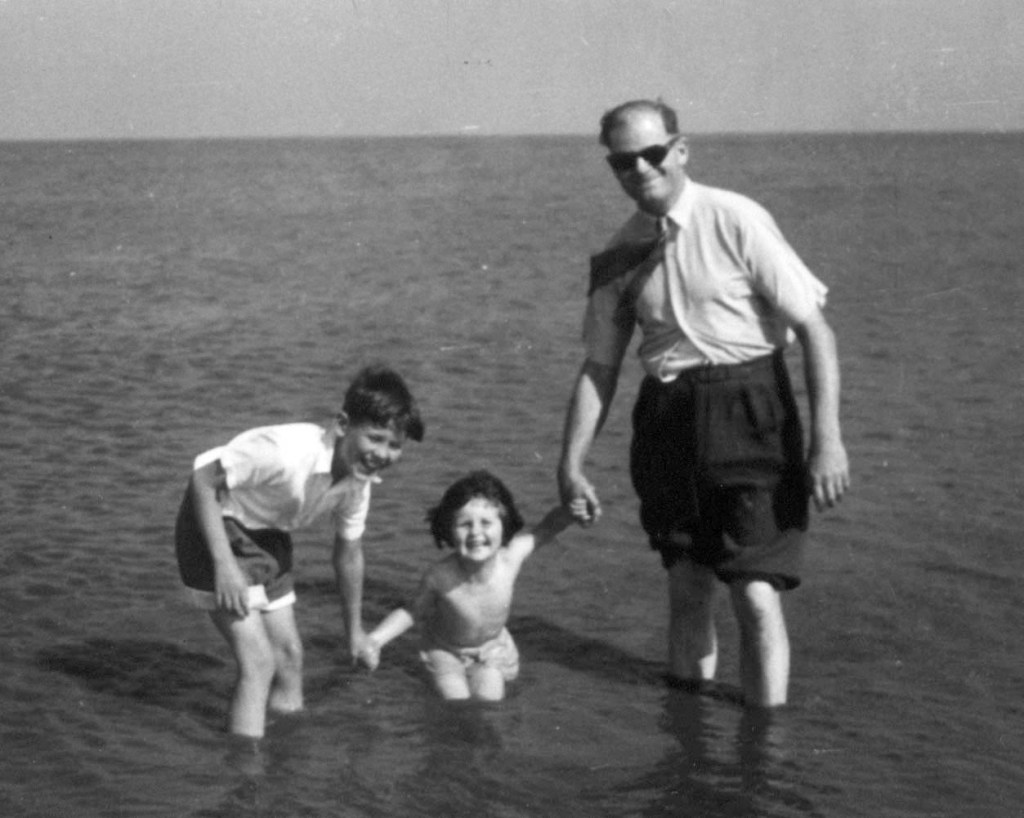
I have fond memories of both Southport and Skegness, where in both cases, the sea was sometimes so far away we had to take a ride in a weird ex-military amphibious vehicle called the DUKW (colloquially known as the Duck) just to reach it.
By the mid-fifties our family’s earnings had improved to the point where we could afford a television (on the never-never of course), and by virtue of free rail travel, we started having annual holidays.
In 1955 we had two weeks in a caravan at ‘Two Chimneys Caravan site’, Praa Sands near Penzance, and my abiding memory is of the excitement of the journey there. It involved a six-hour overnight train trip, so Sharon and I were put to bed early, probably around 6 o’clock, but of course we were far too excited to sleep. Around midnight, a taxi arrived and took us to the station, we boarded our train and took over a compartment, had a late picnic supper, and then slept as best we could. We arrived in Penzance at first light… far too early for the caravan, so we spent an hour or two down by the harbour poking sticks at the sea anemones and crabs in the rock pools, while the town gradually woke up.
Summer of 1956 found us at the ‘Trevelgue Holiday Park’ near Newquay. These were light hearted times, and I have fond memories of evening walks just Dad and I, exploring grassy headlands and rocky coves, examining rocks for fossils and minerals, watching the waves, and even a little sea-fishing in a borrowed rowing boat. In 1958 we had a nice holiday in Combe Martin in Devon, again on a caravan site, but this time with the Dorés.
Dad was largely responsible for my enduring love affair with London. My first memory of going there was what must have been May 1953, when we went to see the street decorations just before the queen’s coronation. Some of my most exciting memories from my childhood are arriving at St Pancras Station with all the bustle, and the hot and noisy steam locomotives; and then making our way to Oxford Street and Lyon’s Corner House for a late breakfast of baked beans on toast!
When I was older, he’d take me round the South Kensington museums. My stand-out memories include the Brontosaurus skeleton and the Blue Whale in the Natural History Museum; the Geology Museum for its huge crystals, assorted weird and wonderful fossils, meteorites and especially the large lump of pitchblende (complete with Geiger Counter) on the upstairs balcony; but my favourite was the Science Museum with its Foucault Pendulum, and all the motorised exhibits with buttons to press. I also used to enjoy the optics exhibits, the cloud chamber, and the hourly high-tension spark, which sounded like a shotgun going off. Fantastic stuff!
It was probably around this time, that Dad’s health problems became intrusive. He had poor eyesight but refused to wear glasses, and poor teeth but refused to go to a dentist. His work had given him a double hernia, and because of his pathological aversion to dentists and hospitals, he did nothing about it. Unfortunately, this forced a sedentary lifestyle on him, and he became overweight. Looking back, I believe he also started with Angina about this time, as he often complained of ‘feeling seedy’, and probably took a fair amount of time off work (without sick pay in those days of course). It didn’t help that he was also a heavy smoker.
On the few occasions at home when he had some leisure time (and was fit enough to enjoy it), he was a different person. He’d used his wartime contacts to accumulate all sorts of weird government-surplus hobby stuff, and he’d often take me to R F Potts on Babington Lane, Derby, and on our trips to London, to the ex-WD (War Department; a precursor to the MoD) shops in Praed Street and Tottenham Court Road (especially Proops)… always on the lookout for weird stuff.
When Sharon was a baby, her cot was in the ‘box room’ of the house. I had the rear double bedroom (with the airing cupboard, the hot water cylinder, and a noisy cold-water tank). Mum and Dad had the front double bedroom. I mention this because as soon as Sharon was old enough, she was given a bed in my bedroom, and Dad took over the box room for his ‘laboratory’. This is where his ex-WD acquisitions ended up, and it was like Aladdin’s Cave to me.
I especially remember the large cabinets of interesting chemicals; nitric acid, sulphuric acid, hydrochloric acid, metallic potassium and sodium, yellow phosphorus, mercury, magnesium ribbon… and a large jar of cordite (apparently from a naval shell). Oh, and he also had a hand grenade, and a German incendiary bomb that he’d disarmed and removed the explosives (I’m not making this up).
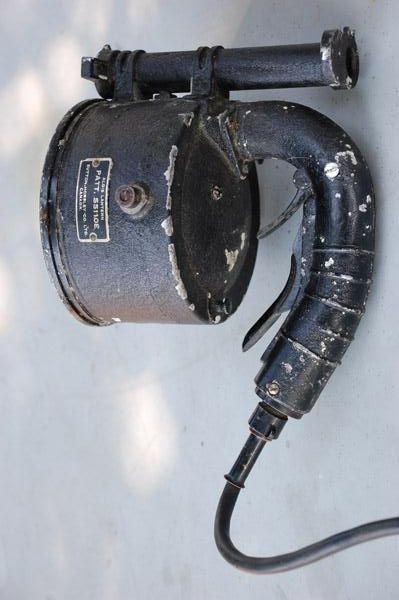
I remember him having a huge transmitter-receiver covered in knobs, dials and meters, taken from a German U-boat, so all the controls and labels were in German. He also had a periscope from a British tank, an Aldis Lamp from the Royal Navy, a large ex-RAF model glider used for target shooting, a huge ex-military box-kite, and all sorts of high-tension electrical stuff for making large sparks. He had a clunky infra-red night vision monocular, and a wonderful Edwardian brass microscope with a collection of all sorts of exotic slides.
Instead of a barometer to predict the weather, our house had an altimeter from an RAF Wellington bomber! They worked on the same principle – air pressure, but of course ours was calibrated in 1,000’s of feet rather than millibars. But hey, we were probably the only house in the street to have one.
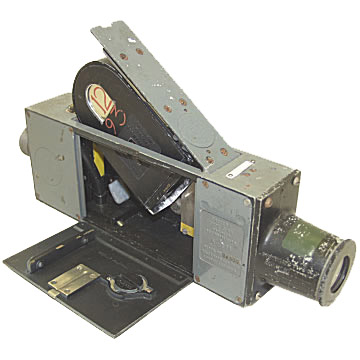
Dad had somehow acquired a gun camera from a Hawker Hurricane. This is a wing-mounted camera that operated when the machine guns are triggered, so as to record enemy ‘hits’. Anyway, he’d mounted his on a substantial wooden tripod, complete with an array of power supplies, timers, stepping motors, and other electronics. It all looked very impressive, and I imagine that he planned on making his own movies, but I don’t think he ever got it working. Possibly he would have had problems getting the film cartridges, and I suspect it would have only recorded a couple of minutes of film per cartridge. And no sound of course.
He had a bit of a reputation as the local ‘boffin’, and on one occasion, he was asked to organise our street’s Guy Fawkes display. A collection made sure that there was enough money for plenty of traditional fireworks, but he decided to include some home-made ones, that would probably be illegal in these days of health and safety. There were various wizz-bangs and jumping-jacks that always seemed to make a bee-line for ladies skirts. And he’d made a rocket, probably around six feet tall, and four inches in diameter, that was to be the highlight of the evening… it shot up to around 100 feet, and then it seemed to topple slightly, it turned sideways, and then accelerated at a rate of knots across the rooftops. We later found the spent carcass in what was left of a neighbour’s greenhouse!
Sometimes, Dad would involve me with this sort of thing; I remember helping him make the coloured stars for his rockets. They were little balls of potassium nitrate, powdered charcoal and sulphur, held together with a light gum, and with short Jetex fuses to get them started. Added to the mix were the chemicals for colour. If I remember correctly, Sodium salts burn yellow, Strontium red, and Barium green. And of course, Magnesium burns bright white.
Another bonfire night I remember, Grandma and Granddad (on my mother’s side) were invited, and Dad had arranged for Grandma to be the guest of honour, with a chair in the garden, and next to it was a black box with a button on it. When she pressed the button, the bonfire burst into flames… Dad had created the electrically started bonfire!
Yet another November 5th was at the Dorés house… his ‘Jack-in-the-Box’ fizzled, and didn’t do much until there was a mighty explosion, and the breeze-block it was sitting on was blown to pieces. I guess we were lucky that no-one was hurt. He also used to have his own little ‘accidents’ and lost his eyebrows on more than one occasion, for example, when using a pestle and mortar to mix his concoctions.
Occasionally, there were experiments with optics, polarisers, shocking coils, etc., and I used to love his demonstrations with chemicals. He’d select a brown jar with sinister dark lumps inside, contained in oil. He’d take it out into the garden, and then use a scalpel to remove a small piece or sodium or potassium (both are very soft metals), and then drop it into an old washing-up bowl full of water. In the case of sodium, it would react with the water causing it to melt and zoom around the surface like a demented ball-bearing. Potassium would be similar, but with the advantage that it would burn with a purple flame as it zoomed around. On occasion he’d try to clean-up the sodium or potassium, because sitting on a shelf for months or years, even under oil, it would oxidise and develop a crusty layer. He’d scrape of the crusty stuff and when dropped into water, it would go off like Roman candles. Great fun!
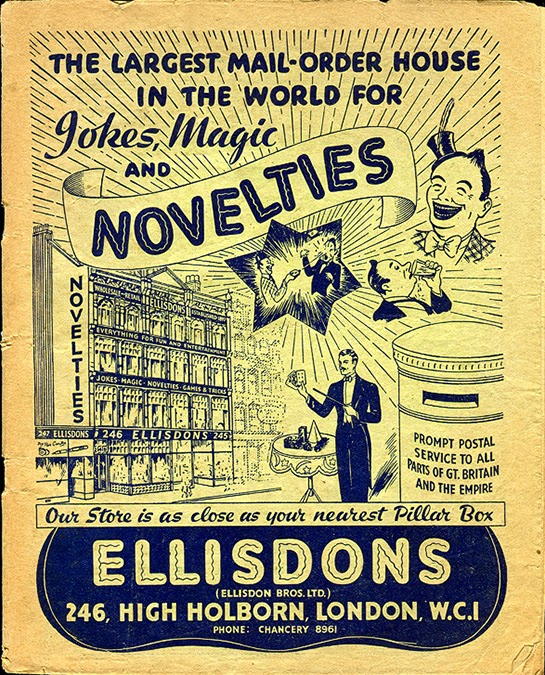
He had a collection of conjuring tricks, and to impress Sharon and I, he’d sometime show us disappearing knots, pull pennies from our ears, a disappearing sixpence, later found inside a matchbox, inside a small sack, and other clever stuff. Remember Ellisdons of Holborn anyone?
One day, he came home from work with a second-hand reel-to-reel tape recorder, and we were all fascinated to hear our own voices as others heard them. He also managed to play them backwards to much hilarity!
Sometime in the evening, he and I would go outside and he’d point out constellations, planets and nebula in the night sky, and I remember him pointing out the Giacobini–Zinner Comet. He had a telescope with excellent optics (probably a gun-sight), and it was good enough to see the odd globular cluster, the phases of Venus and the Galilean Moons.
He helped my make my first crystal-set… essentially a simple radio with no power supply; it picked-up radio-frequency transmissions with enough energy to drive a set of headphones. I remember the former for the coil was a toilet-roll tube! Dad seemed to know, or had looked-up, how many windings of what gauge copper-wire was necessary to pickup medium-wave transmissions of the BBC Light Program, the BBC Home Service and BBC Radio Three. In the days before germanium diodes, it used a Cat’s-Whisker… a moveable wire touching a piece of lead-ore (galena) that acted as a semi-conductor. You kept jiggling it until you found a sweet spot, and got good clear reception!
On another occasion he set up the U-boat receiver to see if we could pick up the signal from the recently launched Russian Sputnik. I used to love these interactions, but as cherished as these moments were, and it may now sound melodramatic, I was always aware how infrequent they were, and would wonder how long before the next one.
Other hobbies that he’d occasionally involve me with were balsa models with Jetex engines (boats and gliders), photography, fishing, kiteing, and even a little woodwork.
He often gave thoughtful and interesting birthday and Christmas gifts… my first camera, a sailing yacht, remote controlled cars, a remote-controlled helicopter, a model factory workshop with a grinding wheel, a buffing wheel, a powered hacksaw, and a stamping machine, all powered by an electric motor. I also remember an alpine railway set with a little rack and pinion car, and ramps which tilted up and down. Also, a grain hopper with a little wagon, where as long as the hopper was full, the wagon would go up and down emptying the hopper – perpetual motion! There was a hand-cranked 8mm projector with lots of silent cartoons; gyroscopes; and my favourite, a fairly sophisticated Meccano No. 6 set. Oh, and there was a Tri-ang ‘00’ gauge train set, where he’d occasionally buy me a set of points, some buffers, a signal box, or some extra track. This was something he’d occasionally join in with.
An enduring Christmas memory was getting interesting electric gadgets as presents, but finding that I couldn’t use them, because no-one had remembered the batteries! I have strong memories of wandering around the streets of Alvaston and Allenton on Christmas morning, looking for a shop or a garage that was open.
Another favourite toy of mine was a working scale model of a crane (it was a Jones KL44 if anyone’s interested). Dad had bought me a grab-bucket that fixed onto the regular hook. It meant that I could use it to scoop up sand or gravel and, errm, create a new pile a couple of feet away (these were innocent times!) The problem was there was never anything to scoop. Dried peas were perfect but Mum usually couldn’t spare them; rice was OK but it got everywhere. We eventually settled on lentils… the weird thing is, in the 70-odd years that I knew Mum, she always had lentils in stock, but to my knowledge never once cooked with them!
As mentioned above, Dad was an only child, but it always seemed that there was no lack of cousins, nephews, nieces, uncles and aunts, and even great aunts. Mum, Dad, Sharon and I would often visit Liverpool, and we’d normally stay with his mother on Beaverbrook Road, West Derby. She was a lovely lady, but lived a very austere existence. The house had no upstairs toilet, the downstairs toilet was just off the kitchen, and inside there was a toilet roll on one wall, and a hook with some squares of newspaper on it on the other wall. She’d say in what I remember as a wonderful ‘sing-song’ Liverpudlian accent “the toilet roll belongs to Max, my lodger… the newspaper is for the rest of us”. As tempting as it was, I had too much respect for her to steal from Max’s supply. Anyway, toilet paper in those days was shiny stuff like Izal… I was probably better off with the Daily Mirror!
There were no toys in her house, but she’d keep me entertained somehow. I remember galvanised steel baths that she’d put in the garden and fill with water. She’d crumple up some paper and put it in the water so that I could pretend it was a boat. She’d give me some used matches for sailors on the boat. The rest was down to my imagination!
A family anecdote was that on one visit to Liverpool, a three-year-old me was invited to sit on the lap of the driver of a Liverpool tram, and allowed to drive it through a busy junction. I have no memory of this, but it just goes to show that the prerequisites of experience and qualifications for tram and bus drivers, train drivers, airline pilots, etc. is just health and safety gone mad(!)
After his mother died (probably around 1956), we’d stay on Lorenzo Drive with his great aunt Martha and her extended family. I have many fond memories of visits there, where it always seemed to be summer. My Dad had some nephews and nieces I’d sometimes play with, and we’d often take trips to the seaside; mostly to New Brighton, on the corner of the Mersey estuary and the Irish Sea. Sometimes we’d go by car through the Mersey Tunnel, other times by ferry. It was always exciting because apart from the excitement of the journey, and the traditional seaside activities, there was a real fort there on the beach (Fort Perch I believe).
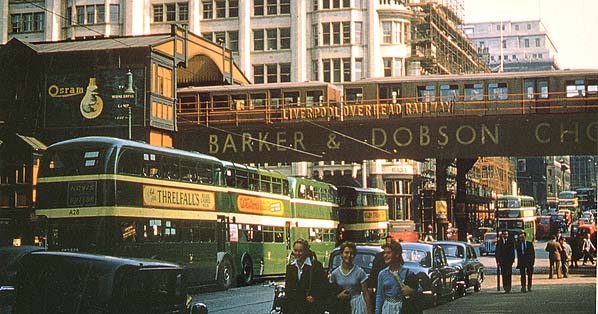
Other times, we’d take the overhead railway (long since dismantled, sadly) along the Mersey estuary to Southport, where there was an impressive sandy beach, and they used to operate pleasure flights in a rickety old biplane, actually from the beach. I remember it cost 10 shillings for a 10 minute flight. On one trip there, I seem to recall baby-sitting a young Sharon while Mum and Dad had a flight round the estuary.
On another occasion, the four of us were walking around the ‘pleasure beach’ (a.k.a funfair) at Southport. There was a stall called the Kentucky Derby where twenty or so people would roll a ball up a ramp towards the target which was a series on concentric circles… most points for the bullseye, fewer points as you went outward. And whatever points you scored would advance your horse on a track at the back of the stall. Well, I had a go, and quickly got the hang of it and started doing well. I could hear my family behind yelling encouragement, and it was very intense, but I won! And these were significant prizes… not just small stuffed bears. I walked away with something called a Revo-Jet, which was essentially a kite in the shape of a plane, but it had rotating wings and made a buzzing noise as it soared high in the sky.
I think I’d recently failed my 11+ exams, and I sometimes felt like I fell short of my Dad’s expectations of me, but on this day, I remember feeling really proud of myself.
He and I went to some air displays at local aerodromes; the old Burnaston Aerodrome near Derby was the first I remember. We also went further afield (by train of course) to RAF air displays at Newton in Nottinghamshire, and Litchfield in Staffordshire. I remember the always impressive V-bombers… the Vulcans, Valiants and Victors. And this was before considerations of crowd safety, so the fighters would come screaming in at low level over the crowd’s heads. Very exciting, but it’s worth remembering that around this time, a De Havilland DH110 crashed into the crowd at the Farnborough Airshow, killing 31 people.
An event the whole family looked forwards to was the Loco Works Annual Flower Show. It was an open day where Dad worked. In the works canteen, people would exhibit flowers, vegetables, fruit, etc. Mum used to make fruit cakes and jam sponges, and I still have a trophy that she won for one of them. We could visit the various workshops, including Dad’s work area; we could see locomotives being lifted and carried from one location to another, and a favourite of mine was the Butt-Welding demonstration where two pieces of steel were welded together by passing large currents through them, creating huge showers of sparks!
Sometimes on a summer evening, we’d play cricket on the lawn, with my Mum and Sharon, until one of us (mostly me, I suspect), would knock the tennis ball into a neighbour’s garden. Mum would bring us glasses of home-made ginger beer, and on rare occasions when the Corona lorry had just been, and there was a few bob of her housekeeping money left, maybe even a glass of Dandelion and Burdock!
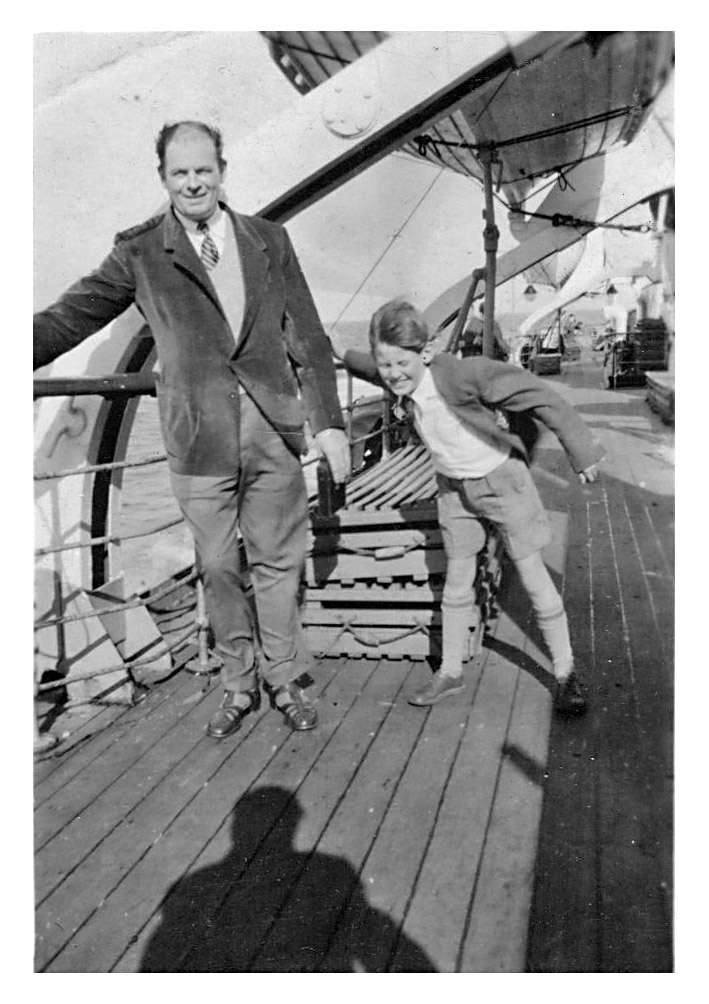
One of the last things I remember Dad and I doing together, was in 1957 during a long weekend staying with his relatives in Liverpool, we took a three-hour boat trip from Liverpool to Bangor in Wales. I enjoyed going downstairs into the bowel of the ship, because it had portholes at sea level, so were sometimes submerged, and I’d imagine I was in a submarine!
This trip was the first time I saw dolphins, and I was enthralled by both this and the birdlife on Puffin Island near Anglesey. When the ferry arrived in Bangor, we walked over the Menai Bridge and I remember seeing the wreck of the training ship HMS Conway, which had run aground and broke its back in the Menai Straits a year or two previously.
Goodbye I
In 1957, some friends of my parents emigrated to Canada, and we bought their house. It was in the same Derby suburb as our old house, but had bay windows, a conservatory, a separate kitchen and a bigger garden. It represented a fairly serious step up the ladder. It also had an air-raid shelter, and since I was interested in chemistry at this point, I was allowed to use it as my own chemical lab. My Mum and Dad briefly seemed happier there, and they allowed themselves a short holiday in Paris.
They also enjoyed socialising with our new next-door neighbours. Unfortunately, Mum fell in love with the guy; my Dad and the guy’s wife sort of found each other, and so in the spring of 1959, my Mum and Dad separated. Mum had custody of Sharon and I, and we found ourselves with a new father, and a new home in Mackworth, a suburb on the opposite side of Derby. I said goodbye to my Father, and it was only a few weeks later that I found that I’d been awarded a scholarship to the Joseph Wright School of Art… it would have been nice to know what Dad thought of that.
So I lost touch with my real father, and gained a largely disinterested step-father, but did get a (half) brother Rob, born in 1960, who I used to enjoy taking around in the pushchair. And later, walks in the Derbyshire Hills. But essentially, I was in another loveless father-son relationship, but this time with someone who I had no common interests with. On the plus side, the stepfather was a substantial incentive for me to leave home, and in 1966 at the age of 20, I found a job in computing, and moved out of Derby to a new life in London.
Reconcilliation
In 1970 I got married to a lady called Lin from Enfield in north London, and we moved to live in the Sussex village of Hassocks. A couple of years later, having lost touch with the Dorés about the same time that I lost touch with my Dad, I decided on a trip back to Derby, to pop in to see them, say hello and introduce them to Lin. Julie answered the door… she was about six the last time I saw her, and now looked to be around twenty. Of course she didn’t recognise me, until I introduced myself; there was a moment of stunned silence, then “Bloody hell… Mum, it’s Rodney!”
We all chatted for an hour or so, and learned that Tony was studying for a PhD in geology at University College in London, and was living in Fulham. We decided to make a surprise visit to Tony on our way back to Sussex. Again, he would have been around ten when I last saw him. Anyway, we found his flat in Fulham and the door was answered by this long-haired, bearded hippy in a tie-dye tee-shirt… it was Tony, and the response was similar to Julie’s “Bloody hell…. Wow, well you’d better come in”. Anyway, we had a pleasant evening there despite our cat crapping under a table, and we’ve been friends ever since.
Anyway, going back to around 1972, Christmas time and briefly back again in Derby; my rediscovered friend Tony, in cahoots with his Mum and Dad went against my express wishes, and engineered a re-union with my Dad. I already knew that they’d stayed in touch with him and his wife, but since I had few good memories of my Dad from my childhood, when they invited me and my wife to a Christmas party, I had no real interest in trying to rekindle things, and I said “Not if he’s going to be there”. “OK, we won’t invite him” they said. Well of course he was there, and after an awkward start, we had a long chat, and got on really well, so I’m grateful to this day to Tony and his Mum and Dad for their deception. It meant that I (and Lin) got to know my father anew. He and his wife visited us often at our home in Sussex.
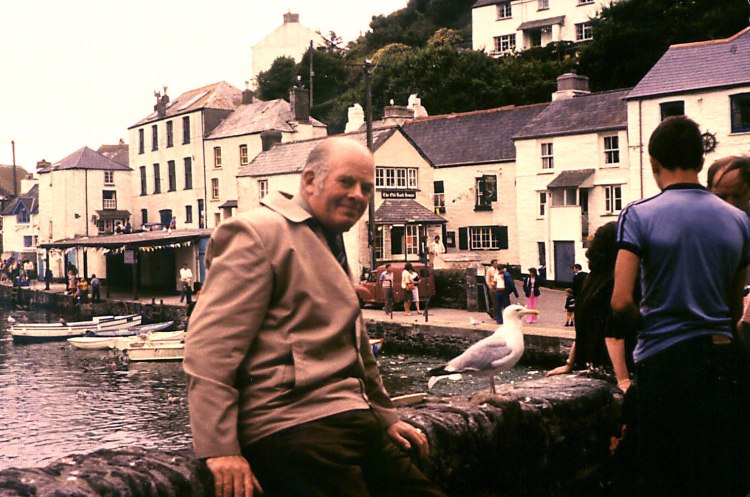
A year or so after the reconcilliation, there was a big party for his 60th birthday at their house in Derby, and looking at his interactions with other guests, I realised then that he was held in great affection by those around him.
It was about this time that Lin and I moved from Sussex to West London, and again they continued to visit us often. It was great to catchup on lost times, and I enjoyed talking to him about shared interests, and realised that I was something of a “chip off the old block”, having interests such as science, astronomy, photography, electronics, music and art in common with him.
Goodbye II
In 1979 I accepted a job in Minneapolis, and on December 5th, we got an early morning phone call from his wife… “Rodney, your father died this morning from a massive heart attack”.
And there’s a sad irony there… given how afraid he was of hospitals, it turns out he’d finally decided get his double hernia operated-on. He died in hospital the next day… his birthday.
He was a very intelligent man, steeped in the sciences, and knowledgeable in many areas. In a different era, or perhaps from a more prosperous background, he would have been a real polymath, and could have been a teacher, a scientist, an engineer, an inventor… who knows? Did I mention that he could also draw and paint to high standard, and was briefly a drummer in a Derby band?
So, like many other men of that generation that I’ve known, he had a frustrated and largely unfulfilled life; a family that came before he was ready for it; a job he hated, and with little or no prospects for advancement. Too little time and/or energy for hobbies and interests, poor health and then premature death. And talking of irony, his was the generation that had to sit and watch during MacMillan’s “You’ve never had it so good” era. Most of our parents were stuck in dead-end jobs, while us baby-boomers were beginning to experience freedoms they’d never dreamed of. And probably had more disposable income too.
I remember seeing him in the mid-sixties after we’d lost touch… I was riding my gleaming red 500cc Triumph, and he cast a very sad figure, as grimy as I remembered, old before his time, and riding his little moped on his way back from his shift.
But I’m so glad we became friends before he died.
Incidentally, he was outlived by my mother by 37 years!
One of the things my Dad said to me when we met at Mick and Kath’s party was “I’m afraid I wasn’t much of a father to you was I?”. And ironically, some years later when my brother Rob got married, I met his father (my step-father) for the first time in twenty-odd years. He took me aside and said “I realise that I wasn’t much of a father to you was I?” Hmmm…
Appendix
By the time he died, my Dad had downsized and got rid of most of his old stuff, but I still have a few bits of his…
⦁ Two books of colourised photos of Venice
⦁ A small chest of drawers containing jewellery, some lenses and prisms, some fishing weights and lures, other bric-a-brac, and a small black box that says “Atomic Kit” on the lid!
⦁ The tank periscope
⦁ The Aldis lamp
⦁ The Edwardian brass microscope, and my Dad’s collection of slides
⦁ Some interesting chemicals, and the jar of cordite (but you didn’t hear it from me…)
⦁ I’m not sure what happened to the incendiary bomb… I’m sure it’ll turn up.


Your memories are so detailed and rich. Nice work putting this together. 🏄♂️
LikeLike
Thanks very much!
LikeLiked by 1 person